Old School. Biblically Independent.
By Kayleigh Donaldson | TV | April 8, 2026
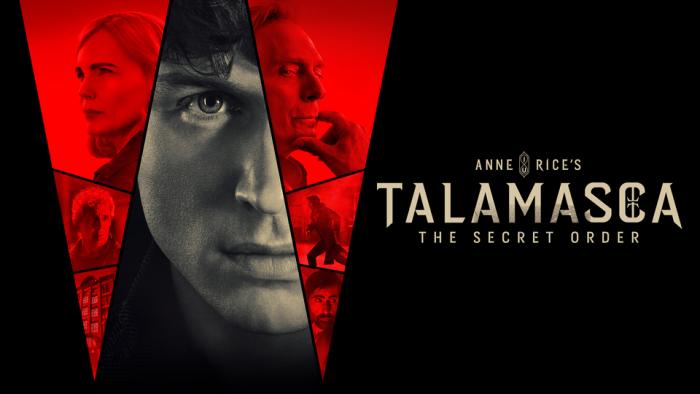
AMC has cancelled Talamasca: The Secret Order after one season. The series was the first attempt from the network to make a show inspired by the works of Anne Rice that wasn’t a direct adaptation of any of her books. I thought it was fun, a paranormal mystery set in the world of Rice’s vampires and witches that tried to dig into the tricky balance between human and not, and with a fun villain performance by William Fichter. Still, I got why it didn’t take off, another example of a show where the potential was there but the execution was somewhat lacking.
The network has been eager to turn the legendary expanded universe of Rice’s novels, books that helped to reshape the vampire mythos for a whole generation, into a sprawling series of shows that dip in and out of one another’s narratives. In that respect, they’ve been very ambitious and also eager to demonstrate their faithfulness to Rice’s material. The Vampire Chronicles and Mayfair Witches novels share a few plot threads (some of which Rice later said no longer counted as canon but that’s a whole other story), and the richness of her imagination was certainly ripe for a lavish adaptation. AMC has given us one excellent series — Interview with the Vampire — one not-so-good one — Mayfair Witches — and one now resigned to the cancellation bin. Is their plan for the Immortal Universe going off the rails?
It’s kind of a miracle that Interview with the Vampire is as good as it is. We already had an excellent film adaptation, directed by Neil Jordan, that nailed the novel’s baroque melodrama and queer yearning, but it famously has a huge miscasting problem in every role. That’s not a knock against the actors, who are all excellent (Tom Cruise, you’ve never been better), but it was definitely a case of Hollywood fame over suitability. The film, one of my top 20 favourites of all time, did such a good job keeping the essence of Rice’s book that it felt, perhaps, a tad redundant to remake it. Showrunner Rolin Jones, however, had other ideas.
The AMC series is very different from the book yet feels utterly organic in its contrasts. Louis is now a Black man from the early 1900s but his empathy and undead struggles are straight from the book. Armand is as scheming and tricksy as his novel counterpart, even if he’s no longer a 17 year old redhead (and he knows how to use modern technology.) Building upon Daniel’s work as a writer to have him be the interrogating opposition to the vampires’ messy biases is genius. And, of course, there’s Lestat, more book accurate than we’ve ever seen, and French to boot. It’s remarkable how much the series changes feel inimitably Rice-ian. That’s probably because the show is committed to its earnest and emotionally charged tone, the thing from the novels it shares the most DNA with.
You can’t half-arse Anne Rice’s tone. You either commit to the feverish drama of these larger-than-life characters, or you just don’t bother. Rice’s books are weird in ways they often don’t get credit for. I’m not even talking about the plots of some of the extended Vampire Chronicles, which include hanging out with Satan, body-swapping, giving birth to creatures that instantly become adults, and f*cking aliens (although I do desperately crave seeing all of this on the show. Let it run for 16 seasons, baby.) I’m talking about Rice’s intensity, her portrayals of figures who eschew mortality while embodying its most universal emotions to the hilt. They challenge our perspectives on what it means to be human, to be tethered to morality as dictated by society or religion or some innate sense of right and wrong, and to reject that in favour of something deeply taboo. A lot of Rice’s books play like high fantasy in this regard, and so few of the scant adaptations we have seem to understand this.
But then we have Mayfair Witches, based on Rice’s trilogy about a family of witches bound together by centuries of trauma and a demon named Lasher. The books contain some of the weirdest stuff Rice ever wrote, and that’s saying something because she set the bar HIGH for herself. The first book is a 1000-page epic history that spans centuries, is largely plotless but dense with mythology, and delves into some of the freakier territory in Rice’s canon. Any adaptation of The Mayfair Witches should be a hell of a lot weirder. It should be overheated and sprawling and gross and never boring. And yet it’s mostly just kind of meh. Dare I say it, but it seems as though it wants to be respectable.
Most of the cast seem oddly soporific (shout out to Harry Hamlin for being an exception) and there’s so little chemistry between any of them. It lacks the fire of the vampire series, as well as its curiosity over issues of morality and desire. All of those things are present in the books, so why not on screen? In fairness, even by Rice’s plotless standards (her books are largely written like biographies of their characters or worlds and less like traditional narrative arcs), the witches trilogy is sprawling and tough to keep a grasp on. Still, it’s missing the sheer oddness of the novels, its swings into horror and psychological mania that make the books equal parts thrilling and maddening.
Adapting Rice does mean having to make the choice to excise some of her more unhinged elements. There’s a reason no IWTV adaptation has tackled the fact that Claudia is turned into a vampire at the age of five, or fully confronted her exploration of sexual desire as she ages while trapped in a child’s body. With The Mayfair Witches, you have generations of incest, a seductress teenager, and the weirdest childbirth scenes this side of Renesmee Cullen. And the show… it just feels timid, something Rice never was, even when it made her readers testy.
As Interview with the Vampire has shown, there’s clearly an audience for a show that is unabashedly queer, melodramatic to the fangs, and unabashed in its lasciviousness. Rice adaptations fail when they try to pretend they’re above it all, and this one never makes that mistake. It may make major changes to Rice’s material but it is staunch in its respect of it. Like I said, you cannot be wimpy in your commitment to Anne Rice, and it feels like the rest of the Immortal Universe is making that error.
I’d love to see AMC invest further in this property. We’re meant to be getting a Night Island series, which is the absolute dream for Armand/Daniel fans. I’d love to see them incorporate non-canon stuff from Rice’s bibliography into the world, like her werewolf and angel books, the latter of which is fascinating and ripe for further development. And it’s not too late to let the witches go haywire. By the end of the second season, they had started to dip their toes into the madness of the source material. Let Rice be Rice, and the viewers will flock to you.


