
Old School. Biblically Independent.
By Dustin Rowles | TV | December 19, 2024
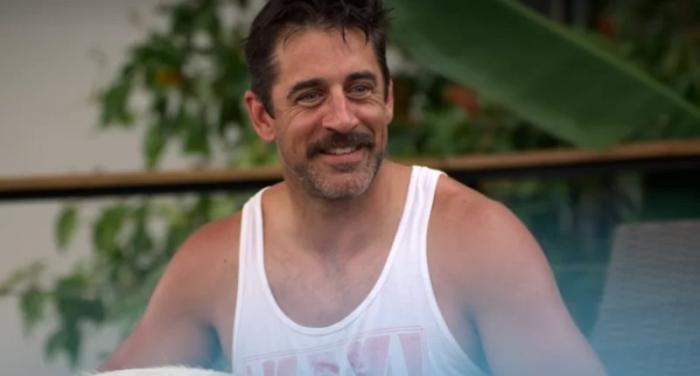
The so-called “enigma” in Netflix’s new series Aaron Rodgers: Enigma lies in how one person can embody two of the most grating personalities imaginable. On one side, he’s the cocky jock who once tried to appear humble by muttering, “One of them,” when called “the best quarterback in the NFL.” On the other, he’s the pseudo-guru sipping Ayahuasca and dropping pretentious lines like, “Hope is the memory of the future,” “I’m just trying to listen to the universe,” and “Success was always binary. It was win-loss matrix.”
This contrast reminded me of a recent Search Engine podcast episode where PJ Vogt interviewed a podcaster who attended an Ayahuasca ceremony, quit her job, and reoriented her life. She described how these ceremonies often lead to profound personality shifts and new priorities. For her, it was transformative—she let go of Twitter’s stranglehold on her thoughts and gained clarity.
Aaron Rodgers seems to have undergone a similar experience, but instead of clarity, he emerged with a scrambled sense of self. He’s always held “alternative beliefs,” but they used to be tempered with humor and self-awareness. There was even something oddly charming about his defiant streak. Now, that charm has given way to a baffling, self-serious narcissism.
Rodgers’ personality shifts feel reactionary. He found early NFL success, winning a Super Bowl in his third year as the Green Bay Packers’ starter. But he couldn’t replicate that success, repeatedly falling short in the playoffs, often deep into the postseason. The criticism appears to have taken a toll. Rodgers — by his own admission in the docuseries — was always trying to prove his critics wrong. But now he can’t.
Add to this an ugly falling out with his family — he’s critical of their religious orthodoxy and his brother’s fame-seeking stint on The Bachelor —the backlash to his anti-vax stance during the pandemic, and his rejection by Jeopardy as a permanent host. What emerges is a Frankenstein of narcissism and unresolved trauma. He’s lost his sense of humor, doubling down on his “research” and leaning into the adoration of his most vocal supporters. The transformation mirrors what we’ve seen in figures like Elon Musk and other thin-skinned, reactionary white men whose egos buckle under public scrutiny. Rather than engaging with criticism, they entrench themselves deeper in their own echo chambers.
Not that this understanding breeds sympathy. Rodgers is now the kind of guy who kicks off debates by literally asking someone what their vaccination status is. He’s become the self-serious, “just asking questions” guy, retreating further into this persona as his football skills deteriorate. His current team, the New York Jets, has been abysmal, and it only seems to drive him deeper into his newfound identity.
All of this is on display in Aaron Rodgers: Enigma, a documentary series by directors Gotham Chopra and Liam Hughes, who wisely try to focus as much as possible on the football—because that’s where Rodgers is at least slightly more palatable. The three-hour series cuts between his recovery from last season’s Achilles injury, sustained during his first game with the Jets, and his career trajectory through high school, college, and the NFL.
Unfortunately, when Rodgers isn’t talking about football — and often when he is — he comes across as humorless, self-aggrandizing, and utterly daft. The series tries to frame his story as complex and compelling, but it only underscores the gap between the myth of Aaron Rodgers and the unflattering reality.


