Old School. Biblically Independent.
By Dustin Rowles | TV | March 4, 2025
This week’s episode of 1923 was another brutal one, as Taylor Sheridan continues his quest to chronicle every calamity and misery that could befall a person in the early 20th century. As a middle-aged dad, however, I find that 1923—especially this season—feels like a direct injection of 1920s history straight into my veins. So, for the hell of it, let’s examine this week’s episode through its historical references.
Skiing in Montana — In the episode’s opening minutes, Timothy Dalton’s despicable rich villain, Donald Whitfield, spots some Norwegian miners skiing down a mountain on his property. Rather than being annoyed by the trespass—like his henchman Banner Creighton (Jerome Flynn)—Whitfield sees an opportunity. As he explains to Creighton, downhill skiing could offer wealthy men a more civilized way to chase an adrenaline rush than bar fights or killing. And indeed, the first ski resort in Montana opened in 1936, a little over a decade after the events of 1923.
Miscegenation Laws in Montana — Harrison Ford’s Jacob Dutton heads into town to talk to a judge about releasing Zane (Brian Geraghty) and his family, who have been imprisoned for violating the state’s miscegenation laws (Zane’s wife is Asian). Dutton essentially blackmails the judge, threatening to report him for violating the Prohibition Act—given that he’s openly spiking his coffee with alcohol and snorting something.
Montana did pass a miscegenation law in 1909, though interestingly, it did not apply to marriages between white people and Native Americans. As Dutton notes, such laws did exist elsewhere. However, Montana didn’t officially pass an anti-miscegenation law until 1953. For what it’s worth, Dutton tries to take Zane and his family back to his ranch but gets caught in a snowstorm. They’re all hunkered down in a cave, trying to ride it out.
Rabies Shots — Michelle Randolph’s Elizabeth is bitten by an angry wolf—just the latest in her ongoing brushes with death since moving to the ranch. By the episode’s end, a doctor is called and asked to stay in the Dutton home to administer rabies shots for 12 consecutive days. Elizabeth resists, and after being forced to take the first shot, she announces she’s leaving the ranch and going home once the snowstorm passes. Alas, during the night, the possibly rabid wolf breaks into the house and mauls the doctor’s assistant.
As for the rabies shots: In 1923, patients had to endure 14 to 21 (and sometimes up to 30) daily injections into the abdomen with a large needle. Yeesh. Sheridan actually downplayed it—today, patients typically need only about four shots. We’ve come so far?
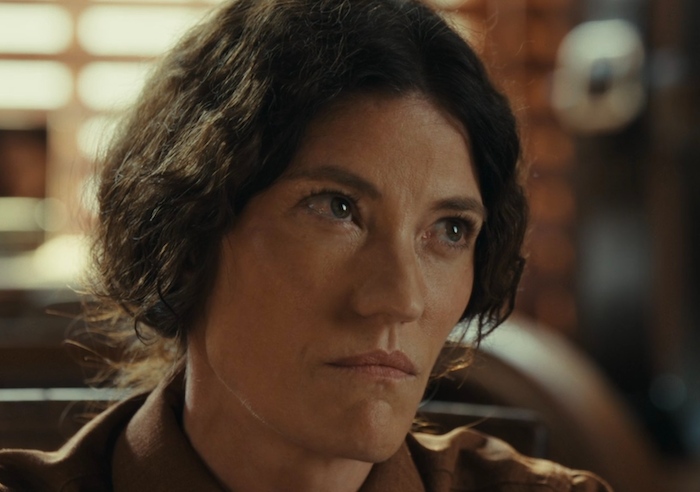
Female Marshals in 1923 — Father Renaud (Sebastian Roché) and Marshal Kent (Jamie McShane) are still searching for Teonna Rainwater. Their search leads them to Anadarko, Oklahoma, where they encounter a female marshal named Mamie Fossett, played by Dexter’s Jennifer Carpenter. Fossett doesn’t care for Kent or Renaud but begrudgingly agrees to cooperate by having wanted posters printed.
And yes, there were female marshals in the 1920s, though they were rare. Carpenter’s character is based on Mary Francis “Mamie” Fossett, who served as a deputy marshal in Guthrie, Oklahoma, in the 1890s. She once camped out for five days to bring in witnesses for a Native American murder case. This likely foreshadows a trial for Teonna.
Andalusia — During another point in the episode—before they’re ambushed by Natives—Renaud tells Marshal Kent about a place in Spain where Black men ruled for 800 years, called Andalusia. That’s not entirely accurate. Various Muslim dynasties ruled Spain from 711 to 1492. Moorish Spain was primarily governed by Berbers from North Africa and Arab leaders from the Middle East, though some sub-Saharan Africans played a role in governance. Andalusia did not still exist in 1923, as Renaud suggests, though its cultural influence—particularly in architecture—remained strong well into the 20th century.
Free State of Galveston — Brandon Sklenar’s Spencer Dutton is still trying to get home. He makes a pit stop in what is graffiti-tagged as “The Free State of Galveston,” where he encounters an Italian crime family. After a scuffle, they essentially force him to smuggle alcohol to Fort Worth, which he reluctantly agrees to do—because, again, he’s just trying to get home.
In the 1920s, Galveston was a major hub for alcohol smuggling, largely because law enforcement either turned a blind eye or actively participated. The city was, in effect, run by an Italian crime family, just as depicted in 1923. I should note, however, that Sal Maceo—the head of this crime family—is not played by Antonio Banderas, despite what some fans believe. Instead, he’s portrayed by Gilles Marini, who does bear a passing resemblance to a younger Banderas. Marini is probably best known for his two-season run on the network drama Brothers and Sisters.


