Old School. Biblically Independent.
By Kayleigh Donaldson | Miscellaneous | October 29, 2026
I Want to Be Famous: When Everybody and Nobody Is a Celebrity by Bobby Finger and Lindsey Weber
Do you know the difference between a Who and a Them? If you do, then you're probably a fan of Who? Weekly, the podcast dedicated to exploring the ever-changing ecosystem of celebrity in the 21st century. Hosts Bobby Finger and Lindsey Weber have spent the past decade exploring the changing hierarchy of fame. You have the Thems, those A-Listers everyone recognizes, and the Whos, the influencers, reality TV stars, has-beens, and pseudo-famous figures of vague familiarity. Where the podcast is chatty, casual, and laden with inside jokes--ScarJo YummyPop--their first book, I Want to Be Famous, offers a more structured version of their thesis that works as an entry point to new Wholigans.
I Want to Be Famous is most fascinated by the increasingly ephemeral nature of celebrity, whether it's the endless nepo baby discourse or the omnipresence of social media in these spaces. Fame ain't what it used to be. Even Thems do sponcon now. Once upon a time, reality TV stars were flashes in the pan, but now, you can use a Bravo show as a launching pad for a career in Them-dom, or a full-time position as a reality contestant. Finger and Weber delve into these shifting concepts, showing how the barriers between Them and Who are more liminal than ever. If shilling for products on Instagram is Who behaviour, does that turn undeniable Thems like Ryan Reynolds who do it into Whos? Why is the Notes App apology so ubiquitous? Why do some celebrity podcasts fail while others become money-printing machines? If you've ever wondered about stuff like this then this is the book for you.
While it's a more formal affair than the podcast, offering a broad exploration of topics like the history of celebrity journalism, Finger and Weber have done a good job in maintaining the balance of snark and sincerity that has made the podcast endure. The references and chronically online gags are there for the devotees, and the final chapter on the unifying theory of Who-ness as represented by Rita Ora feels like a long-awaited conclusion to the show's best running joke. Good form, Bella Thorne.
Blood Price by Tanya Huff
What is everyone reading this week?
— Kayleigh Donaldson (@ceilidhann.bsky.social) October 19, 2026 at 10:08 PM
[image or embed]
Whenever I go to Toronto for TIFF, I like to buy books that I cannot get back in the UK. While browsing a church book sale taking place near the Roy Thompson Hall, I wanted to pick up something retro and Canadian, so how could I say no to this mass market paperback urban fantasy set in Toronto that's been out of print in my neck of the woods for years?
Vicky Nelson is a former Toronto chop who was forced to retire after her vision began to fail her. Now a private investigator, she is called upon to find the culprit behind a series of impossibly gruesome murders. Someone is tearing people to shreds and draining them of their blood. The press thinks it's a vampire. An actual vampire-- Henry FitzRoy, the illegitimate son of King Henry VIII turned undead romance novelist--thinks it's a demon.
As the romantasy trend grows ever-more popular, I find myself more drawn to the classic urban fantasy and paranormal romance of yore: that post-Buffy, pre-Twilight time when every book cover featured a hot lady in low-slung leather trousers and a halter top with a knife and lower-back tattoo. You know the ones: Laurell K. Hamilton, Kim Harrison, Ilona Andrews, L.A. Banks, Patricia Briggs, etc. I wanted P.I. witches and vampires with nightclubs. Sorry, faerie smut fans, but I need some retro cheese. Bless Tanya Huff for providing.
This is a classic noir-inflected paranormal mystery, complete with a sardonic detective and a well-adjusted vampire who writes bodice rippers inspired by his own time in the Tudor court. The banter is fun, there are lots of jokes about the Maple Leafs sucking (I was hurt), and I appreciated the relationship between Vicky and her ex who is also her former colleague, one where they are endlessly fighting but also co-dependent in the way many trauma-ridden cops are. I do wonder if later books will go full love triangle with them and Henry, which I am less excited about (fact: the vast majority of love triangle stories suck.) Despite being written in 1991, Blood Price had an eerily modern subplot featuring an incel creep villain whose entitlement to women's attention has led him to make literal deals with demons. Boy, men like that have just always excited, right?
I got exactly what I wanted from this book and now wish I'd picked up the sequel at the book sale. To eBay I go.
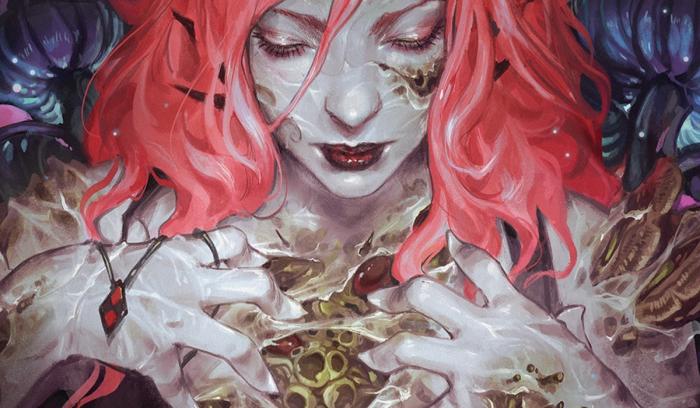
Poison Ivy: The Virtuous Cycle by G. Willow Wilson
Poison Ivy is a tough character to write well. She's a sexy ecofascist whose ethics have only grown more understandable in the era of the climate crisis, but D.C. Comics cannot let her win for obvious reasons. She's usually used for flavour in other characters' stories of the focus is placed on her romance with Harley Quinn. I've no idea how the news of G. Willow Wilson, the creator of Kamala Khan, taking over Ivy's comic in 2023 passed me by. At least it's still relevant to our current nightmarish timeline, eh? Ha ha ha...
After being disempowered to save her life, Dr. Pamela Isley is having an existential crisis. She feels trapped in the wrong body and cannot forget what it was like to have the powers of a god. She decides to go on a suicide mission, poisoning herself with a strain of fungi that she can use to kill off humanity and let Earth heal without its vandals spoiling everything.
As you can imagine, this is an intense plot, but Wilson tackles it with a light touch and the right amount of humour, blended together with some gnarly body horror that evokes memories of The Last of Us. Wilson is intrigued by Pamela's motivations, by her relatable desire to fix the ecological hell of our daily existence and her increasing disregard for the people she lives alongside. Reading this comic, I thought a lot about those people who claim that there's no drama or complexity to Superman, a character of intense optimism who believes in doing the right thing. They're wrong, obviously, but they do hint at how tough it actually is to write in favour of earnestness. Being a fatalist is easy, but growing to cate about others is the real trial, and Pamela must find the nuances in her own philosophy beyond a callous disregard for eight billion people. Wilson pulls it off and then some. Clearly, I've been missing out and need to read more of this take on Ivy.
Exit Party by Emily St. John Mandel
It's 2031. America has fractured into various independent states and lawless realms dominated by warring militias. In the Republic of California, the curfew in Los Angeles has been lifted. Fresh out of prison, Ari accompanies her friend Gloria to a party. People are ready to feel joy once more. But something is off at this party. Some attendees look incredibly familiar but are acting strangely. Then, the next day, the host disappears without warning. Since then, Ari feels adrift. What happened that night, and how does one survive in a world like this?
The release of a new Emily St. John Mandel book is always cause for celebration. She is one of my all-time favourite writers, with Station Eleven being one of my most cherished reads. Her ability to weave together several seemingly disparate plot threads into a richly layered narrative always astounds me. Here, she is blending together two very difficult genres: dystopian drama and the multiverse sci-fi.
There are two Americas here, each crushed by a different kind of fascistic rule. Ari's world is one of divided states and violence. The other is dominated by endless surveillance, where neighbours snitch on one another to the state and democracy has been replaced by hierarchal rule. The new normal that each has created for their residents is a life of resilience blended with wilful ignorance. As one character puts it, "The thing about living in a place like this was how hard you had to work to not see the obvious." Mandel does not belabour the point because she doesn't need to. We can all draw the dots between her speculation and the reality of her readers' lives. Like her fellow Canadian author of dystopian lore, Margaret Atwood, she's simply teasing out what is already here.
Mandel, always ambitious in her ability to tackle multiple point-of-view characters and timelines at once, has given herself a mighty task in this tale of doppelgangers and "what-if" shifts that forever define one's life. Exit Party is a Möbius strip of multiverse doubling but also the latest strand in the Mandel-Verse, which has grown in scope to the point where this book included a chart to reveal all of the connections between stories. Yet Mandel still manages to do a lot with a little, relying on mere hints and minor details to flesh out her worlds rather than endless infodumps.
Despite her penchant for the dystopian, Mandel remains a stubbornly hopeful writer, and Exit Party is no exception. The world may go to sh*t but people endure, and the connections we form in the face of lawlessness or censorship matter. The universe is vast but you are not small because of it. While this book didn't make me bawl hysterically like Sea of Tranquillity did, I still left Exit Party feeling buoyed, which is one reason Mandel's work means the world to me.


