Old School. Biblically Independent.
By Kayleigh Donaldson | Miscellaneous | July 3, 2025
In times of struggle, one is tempted to turn to fiction, either for answers or an escape. Maybe the latter isn’t fruitful when your tastes, like mine, lean towards bleak narratives where not a lot happens and everyone dies horribly (well, that or romance novels featuring vampires - I have range.) Often, I find myself reading something and wondering if real life has gotten too parodic in how much cruelty has prevailed. Was our dystopia ever supposed to be this effing stupid? Write it down verbatim and send it to an editor and the chances are they’d tell you it was unbelievable. But surely the grandeur of our imaginations can create something even more evil than this timeline?
We’ve talked before on this site about our most disturbing films and the things that unnerve us. I mentioned that I’m especially upset by ‘stories about the weary inevitability of human failure, tales where our terrifying endpoint is inescapable and enforced by broken systems that destroy time and time again.’ Blood and guts is one thing, but slasher villains don’t impact me anywhere near as much as the cold hard reality of hopelessness. It’s the plausible that gets to me more than the heightened mania of genre fare. I carry this definition over in my search for the most evil figures in fiction. Cackling villains with dramatic monologues are entertaining but there’s also a cathartic release in seeing such lunacy unfold. We enjoy a competent baddie who’s more charming than the bland hero.
That can make the evil go down more effectively with an unwitting audience. Light Yagami from the manga/anime Death Note is frequently heralded as an anti-hero by his ardent defenders. Never mind that, in the very first episode, after he acquires the eponymous notebook that allows him to kill whoever he wishes by writing down their name, he declares himself the new god on Earth with plans to cleanse it of the unworthy. Such genocidal agendas are easy to justify if you’re taken in by the villain’s propaganda (and they’re hot, let’s be honest.)
Villains who truly believe they’re on the right side of history come with their own kind of disturbing power. Mrs. Coulter in Philip Pullman’s His Dark Materials is a zealot who is unflinchingly committed to a barbaric cause because, in her eyes, it’s a crucial part of human progress. She experiments on children to essentially rip their souls from their bodies, a process that is described as inhumane and a sign of pure moral rot on Coulter’s part. One character describes her as ‘Cruelty and coldness. A vicious probing curiosity. Pure, poisonous, toxic malice.’ He wasn’t wrong. Even her about-turn and self-sacrifice in the final novel feels minute in comparison to the damage she’s caused (and frankly, I always had issue with Pullman making Coulter suddenly sympathetic because of ‘motherly instinct.’ Weak.)
Are we more scared by villains with their own moral code or without one? Cormac McCarthy’s Blood Meridian, widely cited as one of the most disturbing novels ever written, offers us an antagonist who could be argued to embody both qualities. The Judge is the stuff of hell: a pale giant of a man completely lacking in body hair who is eloquent and talented but also utterly monstrous.
He’s a scalp hunter who leads a band of killers who indiscriminately kill whoever they please. He’s also a paedophile who lures away children with sweets. All of this on its own would make the Judge a strong contender for the title of most evil fictional character, but there’s more to him than mere genocide. He is violent even by the standards of the American West and its annihilation of the indigenous population, but he’s still a representation of a grander brutality. Blood Meridian is a fiercely moral novel about the inevitable endgame of Manifest Destiny and the sea of blood upon which a nation was built. The Judge talks of himself in ambiguous terms that hint of him being something beyond human. Whether or not he is actually Satan, he remains the voice of a very real and destructive philosophy. As the famous closing lines say, ‘He never sleeps, the judge. He is dancing, dancing. He says that he will never die.’
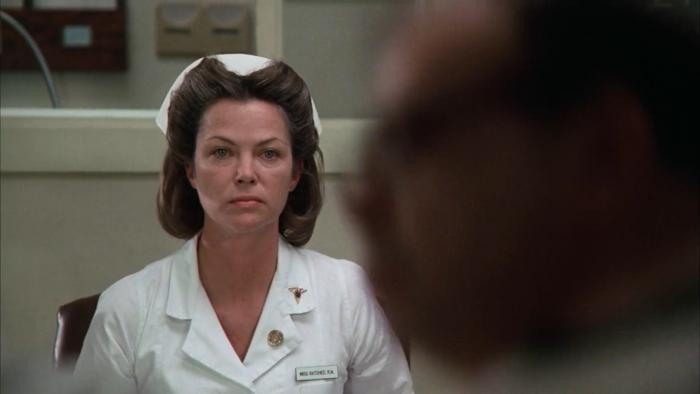
We’re terrified by the inexplicable, those figures who commit astonishing atrocities simply because they can. Nurse Ratched in One Flew Over the Cuckoo’s Nest is judge, jury and executioner to a hospital full of mentally ill and vulnerable people. Her job requires her to never show weakness or personality, but the coldness with which she terrorizes Billy Bibbit suggests an undeniable pleasure in her professionally mandated control over these men’s lives. Of course, we’re also seeing her, on the page and screen, through the perspective of Randle McMurphy, a giddy creep behind bars for statutory rape who sees himself as a rebel. We know where our loyalties are meant to lie, although it’s not hard to root against the impersonal ‘objectivity’ of bureaucracy. Just ask Big Brother and his goons in 1984.
There’s a mundanity to this kind of evil too. It’s so awfully every day, the nightmare of faceless cruelty and our ensuing powerlessness that nobody is immune from participating in. We’re forced to exist in a misogynistic, racist, queerphobic society where such bigotries are more likely to be reinforced than refuted. Patrick Bateman of American Psycho talks of his brutal murders of women with the same disaffected tone that he discusses his morning routine. But is any of it real? Critics have spent decades arguing over whether or not Bateman’s graphic crimes (one of which includes rats and continues to haunt me) are fact within the narrative or fevered fantasies he has lost control of. If it is indeed the latter, that doesn’t absolve Batman of his astonishing hatred of women. It just makes him depressingly familiar. What’s less shocking than a sexist creep in a suit with more money than morals?
Plain, undiluted hate can be terrifying. It cannot be reasoned with or quashed by force. It’s not personal until it is. This is just how one is made, or programmed, as is the case with AM, the hyper-intelligent computer from Harlan Ellison’s most infamous short story ‘I Have No Mouth and I Must Scream.’ Upon gaining sentience, AM immediately annihilates humanity except for a handful of random people who he keeps alive beyond their natural lifespans solely so he can torture them. Why? Because, as it says in one of Sci-Fi’s most notorious monologues, it hates. Cold, clinical, omnipotent hatred that will never tire or conclude. It would be stupid if it weren’t so life-ruining.
With our real-world villains, we can find ourselves tied in knots trying to figure them out. There must be a key to unlock this dense psychological pain and root out the pain in favour of change, right? What makes our politicians and oligarchs the way they are? It must be so layered and complicated. That feels, strangely, more comforting than the more likely answer: that evil is evil and these creeps are dumb. They’re just greedy and bigoted and empowered by generational wealth and broken institutions of authority. As John Waters so succinctly said about Pasolini’s Salò, the pornography of power is ruinous and alluring. Why not escape into the fiction of the understandable?


