
Old School. Biblically Independent.
By Kayleigh Donaldson | Miscellaneous | April 17, 2023
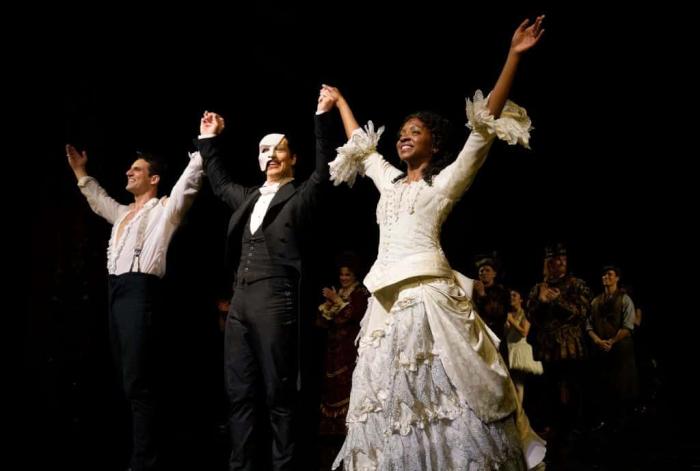
They said it would never happen. The Phantom of the Opera would never close on Broadway. It would outlive us all, like cockroaches and Keith Richards. But, alas, it happened. Andrew Lloyd-Webber’s wildly iconic epic romance musical closed its doors on the Great White Way this month after close to 35 years and 14,000 performances. To call it the end of an era feels like an understatement. This is history, kids, and for Phantom sluts like myself (yes, I have a whole shelf in my house dedicated to this crap), it’s a moment to remember. The murder incel is leaving his basement for the final time.
A little illumination! Our chandelier rises on Broadway for the final time 🌹 pic.twitter.com/GTmKacZYZO
— The Phantom Of The Opera (@PhantomOpera) April 16, 2023
It’s so very easy to mock, but there is a reason that Phantom is the longest-running Broadway musical, regardless of critical scorn or its occasional status as a cultural punchline. The romantic tale of a soprano and the masked composer who obsesses over her has undeniable appeal and is the stuff of fandom catnip. This is a show that was created with pinpoint precision to be A Big Deal and it’s succeeded in doing so for close to four decades. It outlived every Sondheim show, every other Lloyd Webber musical, and its ’80s mega-musical cohorts. It will take Chicago, the second longest-running Broadway show, over 3,600 shows to catch up to the chandelier crash felt around the world. Frankly, ever major musical that followed in its footsteps owes some of its success to Phantom, the show that changed the game and inspired millions of devotees.
Andrew Lloyd-Webber is widely derided by theatre critics because he often seemed to prize commerce over art. He’s the Thatcher dream with a piano (no surprise that he later became a Conservative peer in the House of Lords.) With one eye on the box office, he revamped the modern mould of how musicals are produced, with various productions being recreated across the world under his watchful eye. Yet his choices of adaptation material were seldom safe. It’s a miracle that some of the most profitable musicals of all-time are based on the story of Jesus’ crucifixion, a book of T.S. Eliot poems about cats, some toy trains inspired by Thomas the Tank Engine, and the biography of a South American politician’s wife. Yet from these shows came a brand-new model of theatre: the mega musical blockbuster.
I am gonna die. This was so f**king next level good. I don’t even have words, on top of my history and what this show means to me. Incredible. pic.twitter.com/iveSyBlthb
— Angelina. (@whyangelinawhy) April 16, 2023
These shows were flashy, high-concept, focused more on spectacle than thematic heft, and full of earworms. Lloyd-Webber’s composer talents have always been rooted in his ability to create the inescapable hooks, which is why you can never stop singing ‘The Magical Mister Mistoffelees’ no matter how hard you try (you’re welcome.) You see every penny of the budget on-stage with a Lloyd-Webber show, and you’re easily swept up in the drama and spectacle, even if you don’t speak English (it’s no coincidence that the mega-musical took off in a big way around the same time that budget travel became popular and tourists grew into a key demographic for London and New York theatre.) Ever wondered why Cats ran for as long as it did? It’s a show you can be swept up in without knowing what the hell is going on. And that’s by design!
Phantom endured because, beneath the chintzy costumes and rockin’ electric guitar, its emotional core is rock-solid. Sure, we don’t all kidnap people and force them to perform our fanfiction on the stage of the Paris Opera House (at least not yet anyway), but we’ve all felt heartbreak in some form or another. We’ve all experienced the pain of exclusion, of being judged by the outside world in ways that leave deep-seated scars. Gaston Leroux’s novel is not a romance. Rather, it’s a strange genre mish-mash of mystery, morality tale, horror, and romantic tragedy. Changing that into a story of a misunderstood sex god with a banging underground pad was one of Lord Andy’s smartest career moves, but it also tapped into something eternal about love, rejection, and doing the right thing. You become consumed by the obsessive nature of that relationship between the Phantom and his darling soprano Christine, but what makes it sing (heh) is that he lets her go.
This is ultimately a coming-of-age story for a middle-aged man who was denied compassion at every turn from birth to now. His brilliance was never to be taken seriously in a world where his appearance dominated everything else. When he is shown true empathy, it destroys him and he knows he cannot reject the possibility it offers him. He may not die in the end like he does in the book, but that central moral still packs the punch of Leroux’s story, and overall, it’s an endlessly relevant theme that’s kept audiences gripped for decades. And Christine doesn’t have to choose one man or another. She chooses herself (not Raoul, who sucks in every iteration of this story, sorry not sorry.)
It’s also another reason why the sequel SUCKS and makes no damn sense and seriously, Andrew, what the hell were you thinking?!
It seems likely that Phantom will, one day, return to Broadway, probably in a more stripped-down and cheaper production that can be more easily replicated for national tours. It’s still playing in theatres the world over, including the West End where it’s been a mainstay since its premiere in 1986 (only Les Misérables has run longer in London.) Truly, Phantom will never die, much like love (but Love Never Dies is a whole other problem.) Its legacy is a whole other matter. Without Phantom, there would be no mega-musical, no Lin-Manuel Miranda, no Disney stage dominance, no modern Broadway.
For weirdos like me who love this show, this moment is oddly emotional. There’s something to be said about the curious reliability of Phantom and its omnipresence on Broadway, even if you’re 3000 miles away from New York like I am. Yet the real impact, for me, came from the fandom, from fellow Phans who adored this show but had a knowing sense of humour about it all (nobody loves ragging on Andrew Lloyd Webber more than people who like his work.) Being into Phantom helped me with a lot of adolescent angst and lockdown malaise. I can track the origins of a huge chunk of my current pop culture loves directly to seeing the Joel Schumacher adaptation as a teenager. Yes, that film is hilariously bad, but it led to good things! For better or worse, this show is in my DNA. I think it’s for better.
This story prevails, and I’m glad it does. So, we say goodbye to the chandelier, goodbye to the gondola, and au revoir to a true icon. And seriously, can you get this thing on a UK tour already so I can finally see it on-stage?!
Phamily. #PhantomBroadway pic.twitter.com/DXcBlTckEn
— The Phantom Of The Opera (@PhantomOpera) April 16, 2023


