Old School. Biblically Independent.
By Kayleigh Donaldson | Miscellaneous | June 24, 2026
I think every Scot knows where they were when we qualified for the 2026 World Cup, beating Denmark 4-2 with a succession of goals that instantly became all-time classics for our nation. It was a long time coming, and we knew that it was an opportunity we couldn’t afford to waste. The last time Scotland qualified for the World Cup, I was eight years old. Last week, I turned 36. The country hasn’t stopped partying for weeks now. In my city, traffic cones are adorning many a statue and the saltire flags are flying from windows on nearly every street. We even got a bank holiday for the Monday after the Saturday night game against Haiti because our government was savvy enough to know that it was a safer option than everyone mysteriously calling in sick at the same time.
The World Cup, as we’ve discussed before, is a complicated thing to love thanks to the involvement of FIFA, an organisation so staggeringly corrupt that they make various wings of the mafia seem like pious monks by comparison. The stench of their sleaze is all over this year’s event, which is unfolding across three countries, one of which is in the midst of a fascistic nightmare. They’ve tried to squeeze every penny from fans of home and away, all while insisting it’s totally normal to charge four figures for a ticket to a football match. Every year, FIFA finds new ways to get worse. And yet, in the face of it all, the community experience of the beautiful game has been undeniable, and for this Scot, it’s been especially heartening.
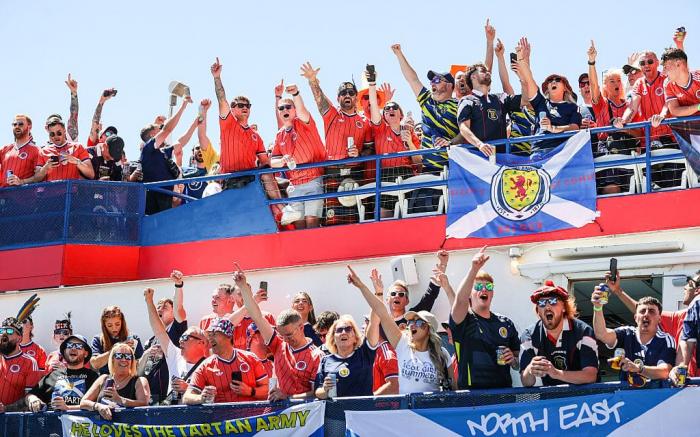
The Tartan Army has made its mark across both Boston and Miami, where Scotland are playing their qualifying round matches, and social media has captured it all. Fans drank the city dry. They partied at Red Sox and Marlins games, even though they had no idea what baseball is (it’s just rounders, guys.) They put traffic cones everywhere. They’ve danced in Little Havana, mingled at the Cheers bar, ate all of the delicacies, raised money for local charities, and taught people how to dance the Slosh. Never before have people been so excited to see dozens of people marching with the bagpipes. In a sea of tartan and kilts and our salmon-coloured team strips, the atmosphere has been one of undiluted joy. My dad and his pals went to Boston for the first game (they brought me back saltwater taffy!), and they said it was even more electric in person.
Football fans are not necessarily a community with a stellar reputation. We’ve all seen instances of hooliganism, bigotry, and violent rivalries that have killed more than a few games over the years. And I do not mean to position Scotland fans as somehow above it all (hello, the Old Firm battle), but when I saw all of those first-hand reports heralding the Tartan Army’s revelry and lack of mess, I wasn’t surprised. We were on the world’s stage for the first time in nearly three decades and we wanted to make a good impression. We wanted to show the best of Scotland in a way that felt authentically ours.
What do I think of when I think of Scots? Well, it’s a blend of dry humour, profanity, and no-nonsense candour. We’re stingy with our own cash but unfailingly generous when required. We’re self-deprecating but fiercely protective when someone else tries to get in on the act. The love of drinking isn’t always a positive - I certainly feel like we over-romanticise that as an aspect of national pride - and yet we still laughed with a touch of pride at the notion of leaving Boston dry. It’s a tight-knit clan but one with a lot of open arms to anyone eager to party alongside us. When our big moment comes, we grab it with both hands, even if we know the journey is short.
All of the Tartan Army shenanigans has felt like the exemplification of the good stuff, of the side seldom seen by those who only think of the country as the backdrop for sh*tty wizard books and golf bros. A lot of tourists treat Scotland as an empty stage for their tourist fantasies, leaving five million people out of frame or replaced by Americans. Like many a small nation, we don’t get a ton of opportunities to define ourselves on a grand scale for the cultural conversation. So, seeing tens of thousands of Scots take over the World Cup and leave everyone dazzled is something of a generational opportunity. We’re always punching above our weight.
The football’s almost come second to the party. Really, isn’t that the true point of an event like the World Cup? We’re meant to gather and unite under a common goal, to be so distracted by the buzz of our fellow man that we barely notice the ball being kicked around. Becoming interested in a sport, any sport really, is a chance to find your people. And sometimes they suck. You wade through a lot of jerks and bigots, weighed down by the corporate nightmare of right-wing team ownerships, player allegations, and predatory gambling ads. Being a fan of sports is to be endlessly reminded that the thing you love seldom loves you back. The World Cup certainly doesn’t love its fans. FIFA views them all as pinatas they can punch until coins fall out. And yet the fans persist. The Norwegians row their Viking boats. The Korean and Mexican fans share their local dishes. The Japanese players don their cowboy hats with joy. Fans swap shirts, dance together, and bond over this wild moment.
FIFA will try to claim all of this as their own success, a sign that their ceaseless cruelty and exploitation was responsible for the good vibes and unity. But it happened in spite of them. they didn’t organize a tartan parade to a Marlins game. They didn’t raise funds for local charities. They didn’t leave local businesses and politicians so overwhelmed by their presence that they wrote open letters in celebration. The bloated ad-fest of the World Cup, with its Trump pandering and craven greed, succeeds in spite of itself, and the fans who were priced out of the party just threw their own instead.
So, when Scotland 100% beats Brazil tonight, I’ll be up late to cheer them on. They’ve already won the real match, so this would just be a traffic cone on top of the statue.


