Old School. Biblically Independent.
By Kayleigh Donaldson | Film | June 4, 2026
The mega-success of Backrooms has left many in the film industry flabbergasted. How is it that a horror movie directed by a 20-year-old that was based on internet folklore has earned more than 13 times its budget in less than a week? Who saw this coming? Kane Parson’s directorial debut, based on his version of the viral lore, was always going to be a hit to those who were paying attention. Still, it speaks to how oft-underestimated narratives like this are, and how much the stagnant world of traditional corporate media has failed to understand the online world. Backrooms isn’t the first story that originated from the internet (known as creepypasta) to get this kind of treatment, but it has succeeded far beyond what came before it. The backrooms got to shine, but poor Slender Man was left in the shadows.
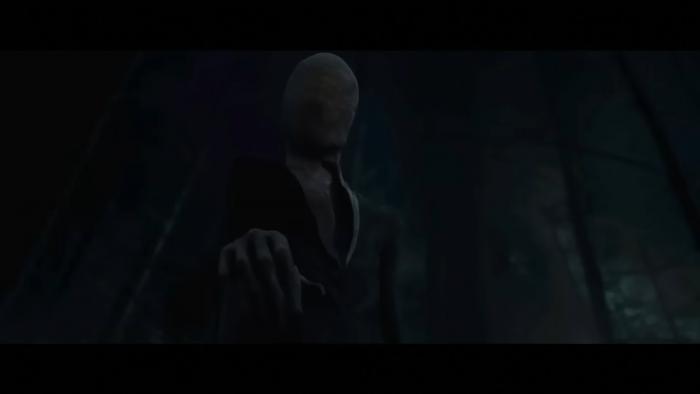
For many, Slender Man is the official face(less) of creepypasta. He’s the most recognizable figure from decades of internet horror, a mascot of sorts who represents the internet’s ability to create, together and separately, a rich mythology that takes on a life of its own. You’ll know him from his unnerving height, blank face, curiously neat suit, and unnaturally long tendrils. Who is he? What does he want? Well, that’s for you to decide.
The Slender Man was created on 10 June 2009, as part of a Photoshop contest on the Something Awful forums. Users were challenged to make “paranormal images” and see who could come up with the most interesting. The user Victor Surge, real name Eric Knudsen, shared two black and white images of groups of kids that featured this tall, thin, ghost-like figure in the background. He added a couple paragraphs of text to make things scarier, and suddenly the lore was born.
Knudsen has said that his influences were Stephen King, H.P. Lovecraft, the Tall Man from Phantasm, and the game Silent Hill. He wanted to create “something whose motivations can barely be comprehended, and [which caused] unease and terror in a general population.” In that sense, he had the same motivations as those creative the backrooms mythology. Internet horror is at its scariest when it delves into that liminal space between mundane and cosmically horrifying.
Everyone else agreed, and soon, Slender Man was everywhere. There was fan-art, video games, stories, and web-series. Marble Hornets, perhaps the most famous expanded project featuring the Slender Man, went viral thanks to its found footage take on the story. People even started reporting real-life sightings. It’s not hard to see why Slender Man sparked such creativity. He is a classic boogeyman of the genre, like something brought to life from a children’s drawing, one of unknown power and motivation. For an internet creation, he feels not unlike something that would have been written about centuries ago, albeit with a different outfit. He’s often described as someone/thing who spirits away children or the disturbed, which puts him in the direct lineage of classic faerie stories.
Of course Hollywood came calling. The 2018 film Slender Man, directed by Sylvain White, is pretty bad. It felt stale, disconnected from the qualities that made the creepypasta work. Crafting a solid narrative out of a deliberately sprawling lore with no central point is always hard, but the film went for the laziest, most Hollywood-ised option possible. Why is it a teen slasher? Is that the best they could do? It spoke to a fundamental misunderstanding, or even disrespect, for the creepypasta’s methods. Frankly, it was the movie we all feared Backrooms would be.
Watching Backrooms, both as a horror lover and someone who was fascinated by the creepypasta, it was easy to spot all of the areas where the film could have gone horribly wrong. I kept expecting a giant exposition dump in the third act, or a frenzied action climax, or lots of running and screaming through the halls punctuated by a tedious succession of jump-scares. It has none of that, which feels like a minor miracle given how bad Slender Man is. The quiet unease of the folklore was diluted into nothing and dismissed in favour of a story we’ve seen a thousand times before. Granted, Backrooms benefitted from being adapted from one creator’s take on the lore, but capturing the disparate elements of mystery and evolution that made Slender Man work could have been done with the right filmmaker. One wonders if the studio simply didn’t care to do much beyond plunder a public-domain idea. A24 was savvy enough to let one of the architects of the backrooms steer the ship. The community remained at the forefront there.
We can’t talk about Slender Man without confronting the tragedies surrounding it. In 2014, two 12-year-old girls stabbed a classmate then claimed that they did so as a way to appease Slender Man. The perpetrators were not well and were tried as adults, receiving sentences of 25 years jail and 40 years in a mental hospital respectively (both were eventually granted supervised release.) The stabbing led to a nationwide moral panic, not unlike the ways that metal music and violent video games were blamed for school shootings. The Slender Man became a new kind of satanic panic, one that obfuscated the very real issue of mental illness. It took the wind out of the fandom’s sails, and the movie, which seemed tasteless in hindsight given its focus on adolescent girls, was seen by many as the final nail in the coffin of Slender Man’s popularity.
The intriguing spread of Slender Man folklore will always have that asterisk next to it, but its status as one of the defining texts of internet storytelling is secure. I wonder if it was too ephemeral a concept for Hollywood, or just made at the wrong time. I would have loved to see a Slender Man story that fully dived into the tangled weeds of is forever-changing and unreliable nature, perhaps like the ways that the legendary anime Paranoia Agent tackled the power of belief in a collective lie. Backrooms succeeds because Kane Parsons took the vibes and made them about something, but there is a difference between rooms and a man in terms of what you can extract without losing its inherent essence. It may also be simpler than that: myth should remain myth. If you try to grab it, it flows through your fingers like smoke.


