
Old School. Biblically Independent.
By Jessie Wallace | Film | August 14, 2025
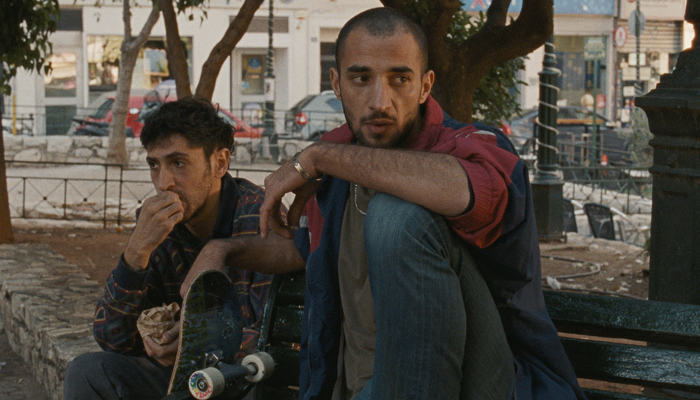
As a filmmaker, how do you grapple with a topic as large and all-consuming as the systematic eradication of an entire people and their culture? It has been difficult enough to simply exist as a human being in the same world as what has been happening in Palestine over the last year and a half. The sheer unrelenting, remorseless horror of it all has led to a state of mental unreality and borderline dissociation in many people paying attention to it. Danish-Palestinian director Mahdi Fleifel (A World Not Ours) attempts to reckon with this unspeakable crime in his new feature, To A Land Unknown, perhaps the only way a filmmaker can: by zooming in on just one element of the story and focusing on the human beings affected by it.
Working from a script he co-wrote with Fyzal Boulifa and Jason McColgan, Fleifel’s film follows two Palestinian friends, Chatila (Mahmood Bakri) and Reda (Aram Sabbah), temporarily living in Athens, who are trying to save enough money to move to Germany with the help of some forged passports they aim to buy from a contact in the local underworld. Chatila, wily and wiry, stalks with shoulders hunched with determination and a burning desire to escape and open a cafe, eventually hoping to find a way to also bring his wife and child over from a refugee camp in Lebanon. Reda, softer, has kind eyes and a similar demeanour. Those less scrupulous might sense an opportunity for exploitation in this. He has an unfortunate history with substance abuse. Chatila knows this and is fiercely protective of him, while at the same time becoming frequently exasperated with him, in the way that we can with those we care about deeply.
To a Land Unknown opens with the pair robbing an old lady’s purse by running a quick street scam. Disappearing down an alleyway with their gains, they empty out the purse onto the street and curse when there’s nothing much of value inside, moving on without much remorse for their victim. It’s a bold opening that trusts the audience and doesn’t feel the need to spoon-feed relatability like so much of modern filmmaking seems to. By the same token, it does not fall into the trap of ‘liberal’ arguments for refugee rights that draw an artificial distinction between those who are worthy of compassion and succor because they behave a certain way, or because they might be ‘useful’, and the rest, who can be reduced to faceless statistics.
Clear-eyed and deeply compassionate without being patronizing or mawkish, Fleifel’s direction and Thodoros Mihopoulos’ photography match the script’s intention and tone, shooting the sides of Athens not often seen in Instagram reels with frankness and urgency while also finding space for beauty and humor. The two central performances are never less than excellent, with Angeliki Papoulia (Dogtooth, The Lobster) appearing in an important supporting role. There are parts of To a Land Unknown that fleetingly veer into slightly heavy-handed exposition, but at some point, it becomes difficult to weigh in on a film’s strengths and weaknesses when it addresses topics such as the ones that this one does. To paraphrase Godard at Cannes in ‘68: how insultingly trivial, to talk of camera angles and editing, when it’s the very future of humanity that’s at stake. Nevertheless, this is a very strong feature from a promising director that should be seen by those who can see it.


