Old School. Biblically Independent.
By Diana Helmuth | Film | October 30, 2026
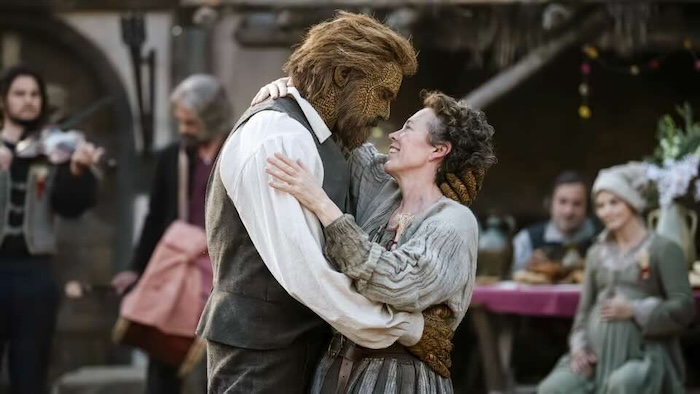
Certain corners of the internet are losing their minds over Alexander Skarsgård’s Wickerman (it is so hard not to type “Wicker Man” here, but that’s not the film we’re trying to invoke, so I’m going to try), and he’s opening the floodgates of conversation.
Why do so many women suddenly want to get railed by a 6’2” laundry basket? Because he’s the polar opposite of the toxic masculine archetype. And, as it happens, the traits that define his anti-toxicity also define his neurodivergence. It says a lot about our society that what makes for a great husband is the inability to act like a normal guy, but, well, that’s the thesis of Wicker itself.
Skarsgård is the perfect actor for this exploration, having played a steady run of autistic-coded characters, a streak now on full display in a time-warpy Ren Faire parody whose best supporting character is The Patriarchy.
To sum up Wickerman as a mere female fantasy — a gender-swapped Born Sexy Yesterday — is to misunderstand him. Even though he is quite literally made to order, he has his own agency and character. The Basketweaver monologues this point while crafting him, and repeats it when chastising Fisherwoman in Act 3. The writers really want us to know that all of Wickerman’s choices, other than being born, are his own.
The symbolism in Wicker is not subtle. In the little village where this self-described fable is set, a bride’s wedding ring is literally a collar, and a woman’s identity is limited to her husband’s job (Tailor’s Wife, Baker’s Wife, etc.). Marital sex comes in three flavors: a chore, a bore, or assault. What the writers think of traditional marriage is pretty clear, including how often the most toxic parts of patriarchy are propped up by other women, as exemplified by Elizabeth Debicki’s perfectly portrayed Tailor’s Wife.
Every married woman in the village lives by this oppressive code in order to be normal, safe, welcomed into the warmth of the group. Except, of course, Fisherwoman. She knows the social rules but prefers to live outside them, understanding that this makes her an outcast. But her real crime is that when she finally does marry, she is somehow still the freest woman in the village: keeping her own name, staying uncollared, and enjoying a happy, unapologetically loud sex life. She’s living the dream because of her perfect husband, who is — who must be — extraordinarily abnormal. “Men are not like that,” the other women observe of Wickerman, staring at the darkness between his laces far longer than their own husbands would approve of.
Fisherwoman is a punk. Wickerman is neurodivergent. She’s choosing to be different. He just is.
Neurodivergences are not all the same, and most exist on a spectrum. But the Wicker husband has all the classic signs of either NVLD or Level 1 ASD: an inability to read social cues, a flat voice with an atypical rhythm, blinding devotion to his safe person, an iron sense of morality, comfort with alone time, and a communication style that could only be described as the complete and total antithesis of “game.”
Most notably, though, he has a presence that doesn’t fit with the other men. From the moment he shows up, they don’t know what to do with him. He, in turn, doesn’t understand the subtleties of the patriarchal culture into which he has been made. The jokes, the entitlement, the times you’re supposed to be angry about your wife and the times you’re supposed to keep quiet — it all goes over his head. Will he be bullied, or simply ignored? I squirmed in my seat every time he walked into the tavern to try to shoot the shit with the other village bros. He seems to be there not for any actual social nourishment, but because someone told him that’s what you do to act normal. He has virtually no male friends to usher him into the patriarchal mysteries that run this town.
But how else could Fisherwoman be happily married in a place like this, unless she were married to someone with no interest in participating in, much less understanding, the status quo?
A quiet trope has been blooming online over the past five years: the argument that neurodivergent men make better husbands, and better lovers in general. There’s a joke in there about nerds being hot, but it goes much deeper. For many neurodivergent men, their defining social awkwardness pulled double duty when they were growing up. It often left them without many close friends or invitations to the cool-kid parties (kids have an uncanny ability to identify autistic peers, and too often proceed to mercilessly bully them). For some young neurodivergent boys, that social exclusion also meant exclusion from the places where toxic traits get trained into men: the worst of the locker-room talk, the social pressure to treat women as sex objects, and onward to the fraternity-house horror stories that, unfortunately, still define so many mainstream boys’ passages into manhood. As in all conversations about gender, I am generalizing. But many neurodivergent men were socially selected out of these “normal,” toxic masculine rites precisely because of their neurodivergence. They didn’t get invited. They were too weird.
Are all neurodivergent men anti-patriarchal? Of course not (see: Elon Musk). But the traits that define Wickerman’s non-toxicity happen to be the very same traits that define his neurodivergence, and I believe that was intentional on the writers’ part.
We watch the Wicker husband struggle to fit into the village just as a young autistic man might: completely sucking at it, but also hardly seeming to care, since he doesn’t really register the benefits of fitting in anyway. He loves the clear communication his wife gives him, and the lack of ambiguity about his role in her life. He is comfortable being solitary, working on his projects and hobbies while she works on hers (“He has his days, I have mine.”). He compliments his wife with hyperbole that would make Gomez Addams proud, in a way only a man who doesn’t care whether other men laugh at him could. The writers even refused to give him the same naming convention as the other men in town, defining him by his strangeness rather than his job. (Arguably, he should be called Repairman, given how often he has to fix the bed.)
Do you have to be… a little different… to be a good husband in a society where a normal guy is a bad husband? No. That’s not the lesson of this fable. Young Bottlewasher sees what’s up and tries to take some notes from Wickerman, hoping his own new wife might become as happy as Wickerman’s. His quest ends poorly, but only because he can’t escape the clutches of the town’s ultimate toxic patriarch: the Doctor (played with perfect, sinister glee by Richard E. Grant).
Fisherwoman’s expectations for her husband, in turn, are a model of atypical, patriarchy-free attraction. She doesn’t expect him to guess what she wants, make decisions for her, or provide for her. She states what she needs from him and largely provides for herself. Wickerman is welcome bonus content in her life, not the foundation of it. That’s a fantasy many women aspire to embody: loving a man completely, without the patriarchal expectations. It’s not always easy for us to figure out. It’s fun to watch Olivia Colman pull it off.
Like many neurodivergent men, however, Wickerman has areas of great sensitivity, and Fisherwoman forgets this to her peril. One major fight can scar him permanently. He also has no visceral sense of when he’s fanning the flames of his wife’s insecurities — like giving long, comforting hugs to the other young women in town when they’re sad. He can’t intuit why this would bother her, and she’s too ashamed to tell him. That, of course, becomes the film’s Act 3 problem: the thing Fisherwoman can’t clearly communicate to her ND husband. Instead, she lashes out and nearly ruins everything.
I write this as a woman currently partnered with a neurodivergent man. At one point while we were watching, my friend turned to me and asked, “Is this what it’s like?” Without hesitation, I said, “Yes.”
My goal here is not to fetishize the spectrum of neurodivergence that so many people live with, and have struggled with. Wicker is a movie that celebrates the abnormal, the socially awkward, the strange: not just those who choose not to fit in, but those who don’t understand how to fit in. It’s a story about how that can be a world-changing advantage in a world where normalcy is defined by oppression and cruelty. And it’s something “normal” people could learn a great deal from.


