Old School. Biblically Independent.
By Jason Adams | Film | October 23, 2026
Some day in the future surely Alexander Skarsgard will be honored for his lifetime’s worth of artistic achievements, and you can bet now that the clip reel showcasing his performances is going to be the goofiest, sexiest little car-crash of footage ever assembled. Tarzan swinging into True Blood, naked volcano fights and Nicole Kidman hitting his erection with a tennis racket, a soap-opera-obsessed killer cyborg sweetly smiling at a gay leather daddy—it’s not just on red carpets that this scion of Swedish acting royalty’s been having a blast. He seems to pick his roles, in a respectable manner, for maximum meme-ability—Alex is just very good at hype, and at being one of our most entertaining movie stars.
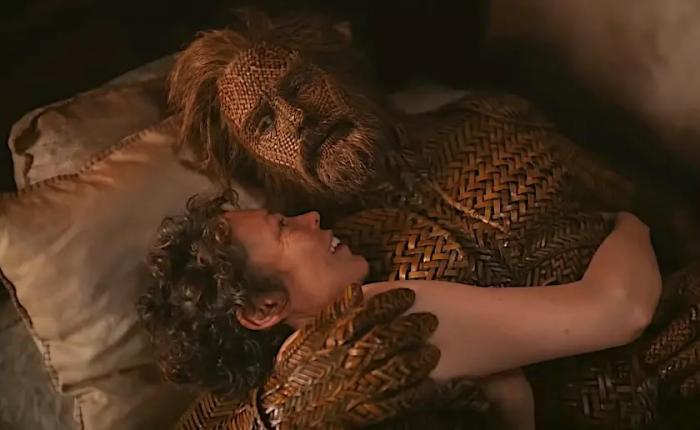
None of this would matter if he wasn’t quite good at the acting part of the equation; thankfully he’s great at that too. (Try not to hate him for seeming so perfect; double dare you.) But one would have be talented to give a turn as low-key lovely as the one he gives from beneath a creaking, crackling pile of 3D-printed wood-fibers and straw hair in Wicker, Eleanor Wilson and Alex Huston Fischer’s wicked sweet fable that’s out in theaters this weekend. (And that’s without even getting around to the nipples.) Adapted from Ursula Willis’ short story, you’ve surely already seen some of these memes—Olivia Colman wishes herself a husband made out of wicker and Peter Dinklage whips her up the studliest one imaginable: voila, all the eyes and all the attentions are yours.
Thankfully Wicker is more than just that gimmick. Like a hornier Princess Bride (“As you wish” becomes “As you wood”), this is a sweet and silly fantasy world worth a good bonk or two—this could be the book that Grandpa Peter Falk reads to Grandson Fred Savage a few years later when his firm “eww kissing” stance has been usurped by hormones. (Did I just accidentally invent the world’s first Peter Falk / Fred Savage slash? For the world’s sake I hope so.)
Olivia Colman plays the Fisherwoman, because everyone in the little village where Wicker is set goes by their job instead of a proper name—save the majority of the women who are just known as Wives and Daughters, like Elizabeth Debicki (having great fun here) being The Tailor’s Wife aka The Wife Formerly Known As The Doctor’s Daughter. But Olivia, as every nasty person in the town is more than happy to holler at her as she wanders the village hawking her wares, is a stinky spinster not worth her weight in minnow heads. Fine by her, leaving her to blissfully pee in a bucket in peace. Ahh heaven.
Or so she says. After one particularly nasty bout of mocking from the townspeople the Fisherwoman heads out to the cabin where the Basket Weaver (Dinklage) lives and, sort of on a lark but not really, asks him to craft her a husband. And he simply tells her to be at the church in one month. And one month later, wham bam, there the Wicker Husband is in all his wicker glory. Literally, since the Basket Weaver apparently pushed the fellow out the door without any clothes on. (And no matter how many silly outfits he models on red carpets, the urge to not clothe Alexander Skargard at all is a more than understandable one.)
Anyway Colman and Skarsgard have always been pros at whipping up palpable chemistry with their co-stars out of thin air, and together they truly whip up magic—from the moment they meet it’s fire between them. Dangerous indeed for a man so flammable! But the Wicker Husband (and please note that he is the only man in the village whose job / name is in service to a woman) is the perfect companion—kind, thoughtful, packing heat that keeps her cottage a’rockin so hard every night that he’s got to hammer it back into place every morning.
Skarsgard, probably given the way everyone reacts to being in his presence, has always been drawn to roles that explore the side-effects of perfection—in Pillion everyone looked at poor Harry Melling cross-eyed wondering what someone that beautiful wanted from him; in Big Little Lies the ugliness beneath the portrait of upper-middle-class cashmere impeccability that him and Nicole Kidman presented as was main engine of the story. Wicker’s no different, although it comes at it from another angle—in this fairy tale the perfect prince exists; it’s just he’s so good and decent and true that he sends everyone else spiraling.
This includes all of those nasty townspeople, Debicki’s nosy queen bee most of all, which leads to third act shenanigans that are fairly obvious and not altogether convincing. (There’s a lot of false drama prodded on by people not explaining things, which is always the weakest kind.) What works best is when the story focuses in on the way the Wicker Husband’s superior standard of being and loving unravels the Fisherwoman herself. All her self-doubts, all the walls she’d built and stories she’d been selling, get magnified by his calm presence, and that feels extremely relatable to anyone who’s found themselves in love while simultaneously convinced they’re unworthy of it. And Colman is, once again, exquisite. When it’s on point this odd little fable about a middle-aged Dorothy humping her Scarecrow more than earns both heart and brain, and sing-song saunters down a golden path all its own. Some proper delight, some life-making magic, will be had.


