
Old School. Biblically Independent.
By Dustin Rowles | Film | August 21, 2026
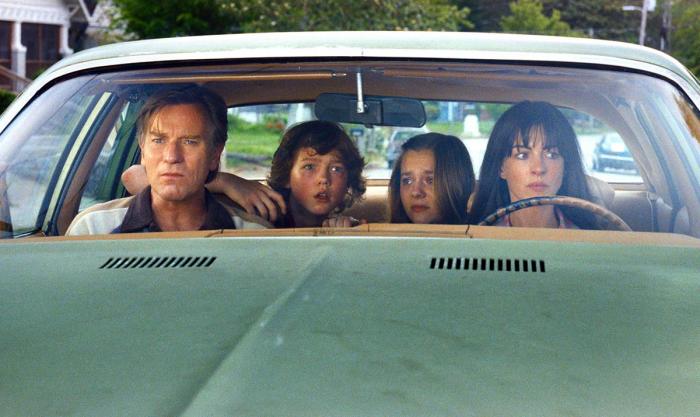
I want to echo what TK wrote about The End of Oak Street — an opinion shared by most critics (86 percent on RT) — which is that David Robert Mitchell’s film is an absolute blast. Yes, the trailers didn’t effectively convey that, and yes, the dinosaur effects are a little undercooked, but it really is “the best kind of summer film.” It is good, stupid fun built upon grounded, believable performances from Anne Hathaway and Ewan McGregor.
A big part of the reason it works is the tone shift: It’s sold as a sort of family-fun, Amblin-esque action adventure, and it is, but — as TK notes — the pivot into survival horror lands so well precisely because of the film’s lighter opening. Like, what if E.T., except Drew Barrymore and Henry Thomas got their arms ripped off by the alien?
The film does, however, require a lot of suspension of disbelief. You have to accept the premise that an entire neighborhood gets sucked into a wormhole and transported back 200 million years. You also have to accept that the Platt family spoilers can save themselves by jumping into randomly occurring wormhole bubbles that take them back to the present. And don’t ask where the wormholes come from (shhhh. There’s still a couple of weeks of summer left. Don’t turn your brains back on yet!).
So I braced myself for the ending to fall apart. Time-travel movies almost always do, and this one teeters on the verge of collapse. But here’s the thing: The logic actually holds. It’s not Timecrimes-tier — nothing is — but it’s a lot more coherent than it has any right to be for a dumb summer movie.
Here’s how it works: The neighborhood is swallowed into a wormhole. Everyone goes back 200 million years. They fight for their lives against a bunch of dinosaurs. The Platt family takes in Jeanette, whose parents were killed, and in the film’s HOLY S*** moment, Ewan McGregor — while saving his wife, Anne Hathaway’s Denise, from a dinosaur — gets his leg bitten off and is then chomp chomp chomped to death.
Eventually, the three remaining Platts and Jeanette find a wormhole bubble, and in the film’s climactic sequence, they fight off a swarm of prehistoric creatures, leap in, and land back in their 1982 present — only it’s about 20 minutes before the moment their neighborhood was originally transported into the past.
Here’s where a lesser movie gets wonky, because for those 20 minutes, two versions of the three surviving Platts and Jeanette exist at the same time. But The End of Oak Street commits to a branching model rather than a single-timeline one, and that’s why it works. The returning Platts don’t overwrite their past selves — they arrive alongside them and split the timeline in two. Nothing has to be un-happened. Two branches run in parallel.
From there, every move is just Denise spending her foreknowledge wisely. She’s safely up on a hill, outside the neighborhood, so she gets on a payphone and orders a pizza to their location. Greg works as a pizza delivery guy, so that version of him gets pulled away from the neighborhood and spared when the wormhole hits (and congrats on getting a pizza baked and delivered in 20 minutes!). She calls a number of other neighbors, too, and tells them to leave immediately, and they’re gone before the neighborhood goes back in time.
That leaves the branch nobody wants to look at: the other three Platts, the versions who still go back to the past, this time without Greg to save them. The movie never says what happens to them, but the branching model works anyway — they’re a separate timeline, and we just don’t think about it. Presumably, without Greg, they perish. So the Platts survive and save Greg in one branch, and die in another. There
And the two-Jeanettes thing — the wrinkle the movie actually does address — shows that Mitchell knows exactly what model he’s using. If Denise’s phone call saved Jeanette’s parents, they’d obviously have brought their Jeanette along. So there are two of her in the epilogue: the one who survived the trip to the past and returned, and the one who never made the trip at all. Blink and you’ll miss it, but it’s not a mistake. It’s Mitchell telling us he knows what’s up.
Which brings me to the one thing I thought didn’t resolve: The Greg who delivered the pizza and survived is not the same Greg who went back in time and saved his wife. The original Greg spent the whole ordeal working through serious marital problems with Denise, and those got resolved right up until the moment a dinosaur ripped his leg off and ate him. The surviving Greg went through none of that. He never had the near-death reckoning that saved the marriage. So Denise ends the film reconciled with a man who never had the reconciliation — which, at first, feels like the one thing that doesn’t add up.
Except it does. Because Denise lived it. The kids lived it. They came back from the past having watched this man die to save them, and they carry that knowledge into the new branch. The marriage doesn’t heal because this Greg earned it — it heals because his family already knows exactly what he’s capable of, and because surviving something like that together is precisely the kind of thing that mends a fractured family. He doesn’t need to remember the ordeal. The people who love him remember it for him. Got it? Makes perfect sense!


