
Old School. Biblically Independent.
By Dustin Rowles | Film | January 23, 2026
You know Mercy is bad. I knew Mercy was bad before I even stepped foot into the movie theater. There’s no point in reviewing it. But my god, it was so much worse than you could imagine. Let us count the ways.
Spoilers
First off: Yes, it’s a rip-off of Minority Report, except that Minority Report had the decency to be an indictment of predictive technology and police surveillance. That is not what Mercy does. I swear to God, the take-home message is not “AI is bad; it will convict innocent people.” It is, and this is something Chris Pratt’s character actually says, “Humans make mistakes. Computers make mistakes.” The message here is that if humans and computers work together, then they can actually solve crimes. Computers have predictive technology. Humans have gut feelings. They make the perfect pair. And the victims here? White guys like Chris Pratt’s character, wrongly accused of murder, and Chris Sullivan’s character, whose brother was wrongly accused of murder. And the real villain? The biracial and Indigenous woman played by Kali Reis.
I AM NOT KIDDING YOU.
I have so many problems with just the setup of this movie, not least of which is the Mercy system itself. Chris Pratt plays Chris Raven, a cop who wakes up in an empty room strapped to a chair. He is placed in front of the Mercy system, an AI Judge Maddox (Rebecca Ferguson), who is there to try his case. He has 90 minutes to use all the surveillance materials and evidence at her disposal to prove that there is less than a 92 percent probability, or reasonable doubt, that he killed his wife, or else he will be executed on the spot.
Issue number one: This trial takes place on the day of his wife’s murder. Hours later. Chris has just woken up from a bender with no memory of the day’s events. He doesn’t even know his wife is dead. Judge Maddox shows him evidence from Ring cameras and his wife’s and daughter’s phones establishing that he has a drinking problem, a bad temper, violently resisted arrest at a bar, and was captured on a Ring camera entering the home his wife tried to lock him out of minutes before she was stabbed to death.
It looks like a slam-dunk case. But also, the police have not even finished processing the scene. They’ve had only a few hours, tops, to investigate and collect evidence. The only reason Chris has a prayer of proving reasonable doubt is that he’s a police officer and that he has friends on the police force who can help him. He doesn’t have a lawyer, but he does have a hell of a hangover.
And despite the hour-and-a-half time limit before he is executed, he also has to contend with various technology problems like buffering issues, power loss, and the fact that Judge Maddox glitches whenever she feels a sentient wave coming on.
And yes: Despite the computer’s insistence on relying on facts only, the Judge herself starts to believe in Chris’s hunches, begins to question herself, and even betrays the occasional bit of compassion, as illustrated through her facial expressions.
This AI judge is developing feelings during a murder trial.
I’ll spare you the full account. The short version is this: Chris was blackout drunk, he was in a loveless marriage, he does have a violent temper, his daughter was afraid of him, and he did beat the hell out of several cops who tried to arrest him. But forget all that. A bad temper runs in the family. ABSOLVED.
The bad guy, or victim here, is Rob Nelson (Chris Sullivan), a co-worker of Chris’s wife, Nicole (Annabelle Wallis), and also Chris’s AA sponsor. Unbeknownst to Chris or Judge Maddox, Rob’s brother was the first person tried and executed by Judge Maddox, and Rob had a bone to pick. So he had been amassing a chemical, urea, at work in order to build a bomb and blow up the Mercy system with Chris inside.
It takes a while for Chris to deduce that Rob is behind it, mostly because he’s played by the really nice man from This Is Us. Eventually, he figures it out, and despite having the kind of technology required to build flying motorcycle-choppers, the police cannot figure out how to stop an 18-wheeler headed straight downtown.
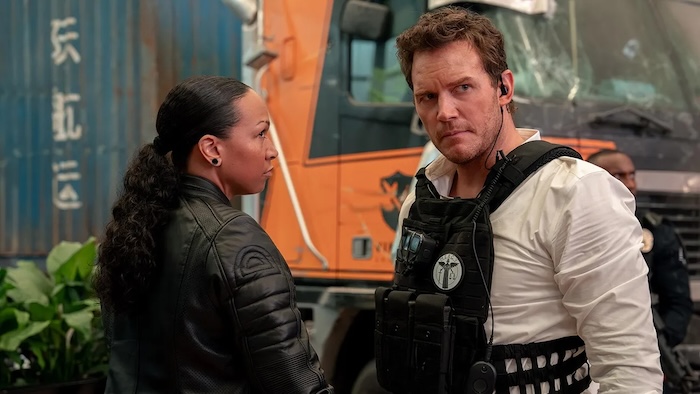
Rob eventually makes it to the Mercy headquarters, using Chris’s daughter as a human shield. Judge Maddox releases Chris, and Chris does his Chris Pratt thing and takes down Rob in a poorly choreographed fight sequence before the bomb can go off. At that point, Rob rails about how his brother was innocent, and Judge Maddox decides to allow him to present evidence on the spot, never mind the tons of explosives inside the 18-wheeler or the fact that he just tried to kill thousands of people. Trial now! A little sleuthing, which could have been done two years earlier, reveals that Chris’s partner, JAQ (Kali Reis), buried evidence that would have exonerated Rob’s brother because it was important that the first case involving this AI be a slam-dunk. You know what might have saved the man? A LAWYER.
Anyway, it wasn’t a slam dunk. An innocent white man was killed. That innocent white man’s brother killed an innocent white woman, and another innocent white man was framed for it, all because the character played by Kali Reis was a dirty cop. Got it?
This movie is something else. I’m at a complete loss for words. I mean, even putting the terrible script (written by Marco van Belle) and bad direction (Timur Bekmambetov) aside, fully two-thirds of the movie are just close-ups of Chris Pratt and Rebecca Ferguson’s stoic faces. That is no way to spend an hour and a half.


