Old School. Biblically Independent.
By Dustin Rowles | Film | August 21, 2026
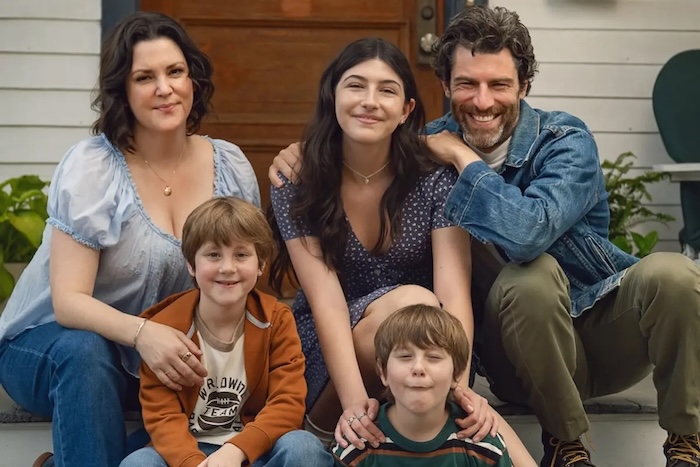
Adam Sandler, his Happy Madison production company, and a heavy dose of nepotism are working overtime these days to fuel the acting careers of Sandler’s daughters, Sunny and Sadie Sandler. The results, thus far, however, haven’t been bad: 2023’s You Are So Not Invited to My Bat Mitzvah (starring both daughters) is a legitimately good streaming movie, and Roommates, starring Sadie Sandler, is a surprisingly solid streaming comedy.
But since Sadie got her own movie, Adam must have thought it only fair that Sunny land her own lead role. Alas, the well-intentioned weeper wannabe Don’t Say Good Luck is easily the shakiest of the Sandler-daughter ventures. It’s a messy dead-mom movie weakened by a lead performance and a script that pulls back when it could have easily gone full throttle and left its audience a blubbering mess. Instead, Don’t Say Good Luck builds toward a tearjerker of an ending only to inexplicably fizzle out.
The shape of Don’t Say Good Luck, from writer/director Julia Hart (Laura Hankin and Jordan Horowitz co-write the screenplay), is fairly obvious from the first ten minutes: Melanie Lynskey’s Elizabeth Birenbaum gets bad news from a doctor (her cancer has returned) around the same time that her daughter, Sophie (Sandler), lands the lead in the high-school production of Waitress. Res ipsa loquitur, the thing speaks for itself: Sophie is going to deliver a rousing performance in the school play right around the same time that her mother passes away.
This is clearly what the entire movie is building toward, and the anticipation of it ends up being sadder than the movie itself. Part of the problem is that moments along the way read as if they could have been bigger emotional beats, or as if Hart could have employed a bigger musical number from Waitress (songs from the musical are sprinkled throughout the film) — but the movie seems to want to hold back so as not to overwhelm its big emotional payoff. The film also clearly has a particular final image in mind, and it’s not the one you’d expect, but the expected one would’ve actually been a much more satisfyingly devastating end point.
Thematically, the movie hits upon a fairly novel idea: Sophie’s mother is dying, but she wants her daughter — despite that — to have a normal high-school experience, which means continuing with the play. She also doesn’t tell Sophie she’s dying, so the parents (and grandparents, played by Steve Buscemi and Bebe Neuwirth) have to carry the weight of that secret. There is also a best friend, Chandra (Ishita Bansal), who is trying to be supportive but is also nursing a time-consuming crush.
There were a number of moments where Hart could’ve inserted the emotional beats that Don’t Say Good Luck seems to be missing: Max Greenfield plays the Dad, and he gives great Dad and is terrific with what little he has to work with, but the movie never gives him a big father-daughter connection scene. Likewise, Steve Buscemi is great as the grandfather, once you get past the fact that Steve Buscemi is old enough to be a grandfather, but the movie doesn’t do enough to lean into his tenderness.
Most critical, however, is how the film totally botches the layup at the end. Spoilers here, but it’s not just the choices, it’s the sequencing. After a disastrous final rehearsal, Sophie goes home, where Elizabeth finally confesses that she’s not going to make it. The next day, while they’re preparing for opening night, Sophie slips out during the pre-show because she’s decided she needs to be with her mother. When she gets home, though, she and Elizabeth have the big talk, and Elizabeth convinces her to return to the play.
But the whole thing is muted because Elizabeth doesn’t go see the performance — she’s too sick. So the big rousing finale isn’t witnessed by the person we most want to see it: Sophie’s mom. The climactic musical number is good. And as genuinely bad as I feel saying this — because I don’t like slighting young actors, even ones with famous parents — a better actress who isn’t Adam Sandler’s daughter could’ve delivered a better performance. The coda, meanwhile, feels like something of a letdown: Sophie performs the same song for her mother at home, on a stage her friends have built to look like the family’s vacation home — the one they couldn’t visit this year, as they do every year, because Elizabeth is too sick.
It’s fine, but what we all expected was to see Elizabeth in the audience, crying joyfully during her daughter’s opening-night performance, and the movie kind of robs us of that just to close the loop on this running tag about the vacation home. It just kind of falls flat.
And it’s not the only time Hart makes the unexpected choice, and I get it: subversion is nice! But you have to have the skill to pull it off, and the context in which it makes sense, and a Happy Madison film on Netflix is not exactly the right context. I hate to say it, but this is where you go for the cheap, sentimental move. Muted restraint is not the right move for a Cancer Mom movie. You go for the f***ing jugular, and then you swallow the criticism from sobbing reviewers complaining about emotional manipulation.


