Old School. Biblically Independent.
By Lindsay Traves | Film | February 27, 2026
Horror sequels are different for the Scream movies. Maybe it’s because modern audiences aren’t as willing to enjoy the horror extended franchise installments of the 80s, or maybe because the face of horror has changed and demands a more fleshed out commentary than a kill compilation. Whatever the reason, there’s a high bar for these sequels (whether we agree on which ones are worthy or not), something Scream 7 struggles to clear.
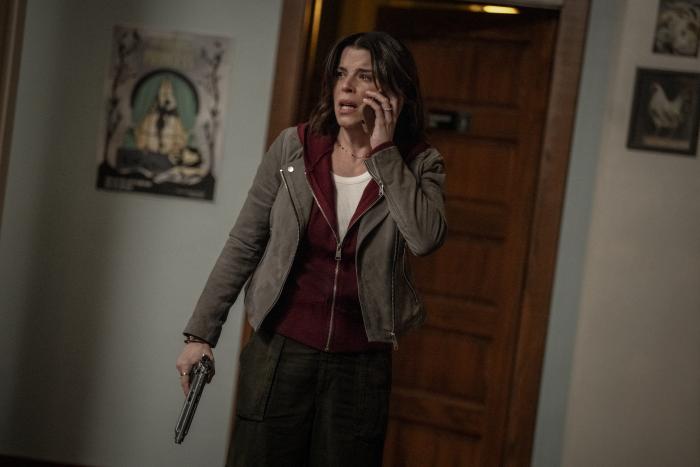
Ghostface is back … maybe. Sidney Evans (Neve Campbell in a return to her iconic role, now with a married name) has retired to her comfortable life as a coffee shop owner married to the Chief of Police, Mark (Joel McHale, a different cop named Mark who certainly isn’t Kincaid). She has three kids, one lovingly named for Tatum (Isabel May), who is nearly the age Sid was when she was first terrorized by a couple of psychos in a peanut-eyed-ghost mask. Even though Sid’s life is the subject of books, documentaries, movies, and TV specials, Tatum feels like she doesn’t know anything about her mother’s past and the two clash over whether Sid is protecting her or keeping her in the dark. And while Sid’s quiet barista life is perpetually mired by true crime fans, she seems comfortable knowing that Ghostface is gone, that is until a threatening call from Stu Macher (Matthew Lillard) makes her question what she thinks she knows.
It’s 2026 now, and no one ever really dies as long as we’ve the eternal logs of their waking life and access to an abundance of tech tools. So haunting video calls from beyond the grave raise skepticism before they raise shock, leaving Sid to struggle with what her and her family are really up against. But whether it’s a missing man from her past or a new crop of cult killers, Sid is in trouble and must reclaim her position as a Final Girl to catch and stop the latest string of Ghostface killings.
Sid’s return to form comes with some baggage. Neve Campbell excluded herself from recent sequels due to a salary disagreement, and this is supposed to be her triumphant return. Naturally, Campbell is flawless and the Sidney suit fits her just fine. She is the emotional core of the franchise and the subject core of this movie, which builds everything around pulling her back in after she tried to get out. Unfortunately, the film never lives up to her.
It’s hard to believe the same person who wrote Scream wrote this latest sequel. Kevin Williamson launched his career on that script, following it up with other meta-horror commentary in The Faculty and I Know What You Did Last Summer. He didn’t work on all of the Scream sequels, but returned here not just to co-write, but to direct for the first time since his debut in 1999. With or without Williamson, the Scream movies have always had themes of obsession and fandom, but this movie has nothing to say. The fantastically delivered killer monologue is entertaining, no doubt, but feels a hollow attempt to rip a theme from a real-world headline about movies that don’t exist in this world.
Sid was on the sidelines for goings-on in New York, and the movie wants to latch on to the idea of her needing to come “back,” but it all becomes a flimsy theme when the meta-commentary moves past in-world and global fandom into Scream fandom. Sure, it makes for a laugh the first time someone mentions how things weren’t the same without Sidney, but after the nth such reference, it feels like a host of tacky sleights at the prior sequels, something those filmmakers don’t deserve, and that feels extra uncomfortable with the inclusion of Chad and Mindy (Mason Gooding and Jasmin Savoy Brown) from those installments. It’s like building an entire feature around the Nightmare on Elm Street “but the rest sucked,” bit from Casey Becker.
Blurring the lines between horror fandom and Scream fandom has been the challenge of later sequels as they thrive on meta-commentary and use Stab as a gateway to conversations about horror fans latching onto Sid’s story. Here, the line is never more crossed, with specific lines and quips referenced that would have died with Ghostface’s earliest victims. There are the ever-familiar nods to horror legacy features like Halloween, and TCM, but it all seems secondary to references to the Scream movies themselves, trying desperately to play the hits in a way that insists it’s still knowing.
The cat-and-mouse sequences are still here, this time with a new tint from Williamson’s directional point-of-view. They’re mostly pretty tension-less, which seems to stem from a miscalculated rhythm and too many disposable characters we aren’t invested in enough to fear for. The greatest sequence, and perhaps one of the better ones in the franchise as a whole, is one where Sid has to direct Tatum over the phone using security camera footage. It’s tense and exciting, and effectively utilizes how technology has changed since 1996 to give us an updated Ghostface game of death. Williamson’s kills are more brutal, boasting a surprising amount of gross-out gore, even for a series that started off with a teenager being gutted.
Scream has never been like other girls. To create its third installment, it referenced trilogies, for the fourth installment, it referenced reboots, to craft its later movies, it referenced legacy sequels, all while being tied to the original story of two highs-schoolers terrorizing Sidney Prescott and turning her into an icon. With a TV series or two tied to the franchise, it’s interesting to consider where this latest sequel lands in the great canon of feature films. Scream 7 comes off feeling like an installment of Fear Street, perfect for an at-home streaming movie event, but not for a come-back sequel event for an iconic franchise.
Scream 7 hits theaters February 27, 2026


