
Old School. Biblically Independent.
By Seth Freilich | Film | August 24, 2026
There’s a version of this piece that spends paragraphs talking about Anthony Bourdain and my feelings about the man, the impact a celebrity I never met had on me, how I revisited his shows for the first time since his passing after a recent trip to Japan, and the pain and joy that brought me, etc. That version of me justifies all that by saying it’s laying the groundwork for the deeply personal and subjective review that follows. But we’re not going to do that. In small part, that’s in tribute to Bourdain, who would say that’s all a bunch of unnecessary, watery bullsh**. But more importantly, it highlights my basic problem with Tony.
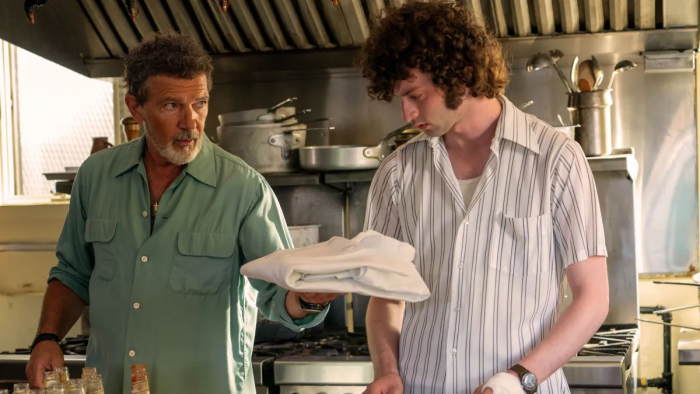
Primarily set in the summer of 1975, the film finds young Tony (Dominic Sessa) following his crush Nancy (Emilia Jones) to Provincetown under the pretense of a writing fellowship. Tony is so full of himself that he can’t see how rudderless he is. Strapped for both cash and a place to live, he winds up working dishes at The Flagship, a local bar and kitchen run by a reclusive chef (Antonio Banderas) who takes Tony under his wing. Over the course of the summer, Tony finds his love for both the kitchen and its addiction-fueled underbelly, setting him on course to become the man who wrote Kitchen Confidential, made twenty-three seasons of travel television (No Reservations, etc.), and introduced countless people to new cuisines and cultures.
The problem with the film is that investment in the entire narrative arc hinges on the viewer knowing who Tony is going to become and presumably having an appreciation, if not adoration, for that man. Tony practically begs the viewer to remember all the reasons many of us would come to love Bourdain. And it has to beg for it because virtually none of it is on the screen.
The movie’s opening prelude involves Bourdain lying to his family about a Vassar writing fellowship he lost out on and then running away from home to chase a girl he barely knows to Provincetown. This Tony is deeply unlikeable and, sure, Bourdain himself wrote and talked about what a disaster he was in those days. The film opens with his money quote: “I was - to be frank - a spoiled, miserable, narcissistic, self-destructive and thoughtless young lout, and badly in need of a good ass-kicking.” And Tony is almost exhaustingly relentless in portraying Tony as a piece of sh** at almost every turn.
And I don’t mind that in and of itself, nor the character’s intentional rudderlessness - it’s all very well acted out, and the “lost direction” part is probably the strongest aspect of the coming-of-age narrative. But even if the real Tony Bourdain in this Provincetown era was as otherwise utterly irredeemable as this character is shown to be, in a movie that has already taken considerable liberties with the true narrative arc, you have to give us at least a base reason to root for and like this protagonist.
Taking this outside the context of Anthony Bourdain, I kept waiting for the movie to give any reason to root for this character. In the kitchen, he’s terrible. To Nancy, who remains inexplicably attracted to this garbage human being even after he confesses to being a total piece of sh**, well, yeah, he’s terrible. To the chef who takes him under his wing … he’s terrible. He turns one or two small corners toward the very end, but by then, you are actively rooting against this man as a movie character and are only more fancifully rooting for him because of what comes from outside the film, knowing who he’ll become.
On the flip side, the scenes in the kitchen of The Flagship are great. If the film were a lot less coming-of-age and a lot more low-stakes The Bear, it might’ve worked for me.* Even more so because the film’s obvious strength is Banderas. Putting aside the fact that his chef’s character’s name is “Chef,” Banderas’ Chef is as watchable as it gets. He has aged into this ability to show so much while doing so seemingly little, and whatever scene you might argue is the film’s best, Banderas is the reason why.
*Heavy emphasis on “for me,” as I feel in a critical minority on my overall lack of enthusiasm for this flick.
To the film’s additional credit, the rest of the performances, while not at Banderas’ level, work. Sessa doesn’t try to do some caricature of Bourdain. It’s not the most nuanced performance, but it does have that same watchability Sessa showed in The Holdovers. But at least he was given something decent to work with. Poor Jones is far better than what the script gives her, which is someone who’s in no way a believable human being in some of her decisions and apparent motivations. I understand the reasons for wanting to bake in some version of the relationship that would become Tony’s first marriage. But I cannot say enough how terrible the entire “romantic” storyline between Jones’ Nancy and Tony is. It’s maybe the worst thing I’ve seen on screen this year, and I sat through every minute of Mercy. Excise that and give us more of the kitchen, and maybe I would not have left with such negative feelings about this film. Especially because the kitchen also includes strong performances from Stavros Halkias and Leo Woodall.
That also may have helped address my other problem with the film - it doesn’t show us what it thinks it does. It thinks it’s showing us hints of the charm, charisma, and inquisitive hunger that would later come to define Bourdain, but it’s less hints and more like half a glimmer. As frustratingly, Tony also fails to really show us how Tony falls in love with the kitchen, ostensibly the entire purpose of focusing on this point in his life. We see him miserably working in the kitchen, and then we suddenly see him just slightly appreciating and maybe even starting to enjoy it. But we don’t really see enough progress getting there; it feels more like jumping between two comic book panels while leaving just a bit too much in the white space between. I dunno man, ultimately, it’s not that this movie fails to do Bourdain justice or anything like that, it just feels like it fails to do the work.


