Old School. Biblically Independent.
By Dustin Rowles | Film | April 16, 2026
I do not typically appreciate Netflix’s algorithmic programming strategy, but there is something to be said for a streamer that occasionally remembers there’s an otherwise sorely ignored and underappreciated demographic buried somewhere in its 325 million worldwide subscribers: people who don’t want prestige television or Christmas Day NFL or another season of Stranger Things. People who just want a bad movie done well.
Tommy Wirkola’s (Dead Snow) Thrash is not quite that — but it is a bad movie, and it’s done modestly well, which in this particular niche counts as a win. There’s no high art here, but there’s also no pretension, and in the economy of garbage cinema, the absence of pretension is basically a virtue. Netflix took one of its stars, Phoebe Dynevor (Bridgerton), and a likely soon-to-be star, Whitney Peak (Gossip Girl, The Hunger Games: Sunrise on the Reaping), and built a quick-and-dirty Sharknado around them. “Dirty” is doing a lot of work there. The special effects are horrendous. The sharks look like they were rendered by a sleep-deprived Grok on a Tuesday afternoon. The screenplay — also by Wirkola — is about as dumb as a box of purple-dyed hair.
Thrash is bad. Not so-bad-it’s-good, exactly, but so bad that somewhere around the midpoint you stop fighting it. You put down your objections, you stop cataloging its sins, and you just… go along for the ride. Life is too short to ax-grind about something this proudly, cheerfully trashy.
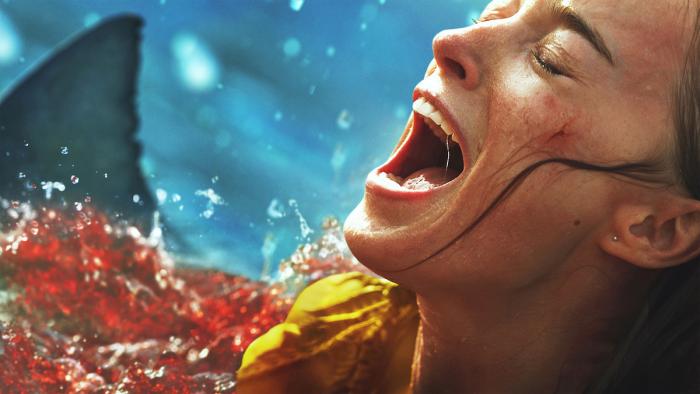
The setup requires approximately one sentence: coastal town, category 5 hurricane, levees break, bull sharks (apparently nastier and more aggressive than Great Whites, which feels like important and also completely insane information) flood a submerged neighborhood. Dynevor’s Lisa is pregnant and trying to drive out of town when the water takes her. Peak’s Dakota is home alone when her house essentially becomes an aquarium. There are also three kids with genuinely terrible foster parents, which makes those foster parents’ deaths feel like the movie doing you a small kindness, trying to survive inside a submerged house while bull sharks patrol the hallways. Djimon Hounsou is also there, providing exposition and the occasional deadpan line reading that suggests he knows exactly what movie he’s in and has made his peace with it.
That’s the whole thing. Lisa eventually gives birth in open water, leaves a blood trail that sends the sharks into a frenzy, and then a Deus Ex Great White materializes to save the day. There are countless better ways to spend 90 minutes. But here’s the thing about Thrash: it knows it’s bad, and it has decided not to make that your problem. It’s not winking at you. It’s not doing the insufferable post-ironic thing where the movie is in on the joke and expects you to applaud it for the self-awareness. It’s just out here, proud of what it is, completely unbothered.
That sincerity — if you can call it that — is the only redeeming quality Thrash has. But it’s a real one. In a streaming landscape increasingly cluttered with content that wants desperately to be taken seriously, there’s something almost refreshing about a movie that has absolutely no such ambitions. It’s trash. It knows it’s trash. It showed up anyway.


