Old School. Biblically Independent.
By Dustin Rowles | Film | November 13, 2026
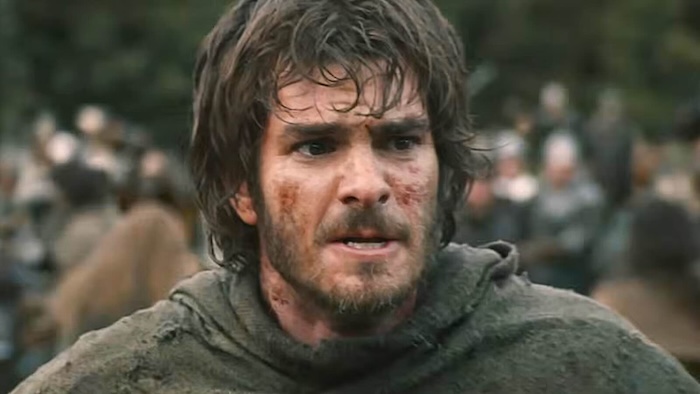
Andrew Garfield isn’t just a phenomenally good actor; he’s really good at choosing roles. I went back through his filmography, starting with what was essentially his breakout, the Red Riding trilogy, and the man almost never makes a bad movie. Sure, there are a few I’m not itching to see in theaters, but when I inevitably catch up with them, I’m always pleasantly surprised. At this point, I shouldn’t be.
As best I can tell, since The Amazing Spider-Man 2, Garfield has made exactly one clunker: Mainstream, a small Gia Coppola indie with Maya Hawke. Some people didn’t care for After the Hunt, but they’re wrong. It was simply a challenging film, and nobody likes challenging films.
Which brings me to The Uprising, a Garfield movie that didn’t fail because of Garfield, or Paul Greengrass, or the story. It failed because of the marketing. I knew going in that I’d like it. It’s a quintessential Dad movie. But I didn’t like it enough to drag myself to a theater, and apparently neither did anyone else. The film earned a measly $10 million worldwide.
Don’t let the box office scare you off, though, especially if you have a soft spot for historical epics. The Uprising is about the Peasants’ Revolt, which is pure catnip for history nerds. After the Black Death wiped out nearly half of England’s population in 1349, the surviving workers suddenly had real leverage. The Crown and Parliament responded by capping wages at pre-plague levels and chaining laborers to their land. Then the king slapped them with a punishing poll tax to bankroll the Hundred Years’ War.
It was a miserable time to be a farmer. Half your family was probably dead, you couldn’t leave, your wages were frozen, and you were footing the bill for a war that never ended. So in 1381, England erupted. An army of thousands of laborers marched on London, stormed the Tower, and executed King Richard II’s advisors.
Richard II, meanwhile, had to deal with all of this, and he was 14 years old. It was a sh**show, but the monarchy did what monarchies do and eventually crushed the rebellion. Still, it marked the beginning of the end of serfdom and planted early seeds of socialism.
It’s a terrific story, and Greengrass, who wrote and directed, tells it well, shaky-cam and all. The film features several real historical figures, including John Ball (Jamie Bell) and Wat Tyler (Cosmo Jarvis), while Garfield plays a composite stand-in for the rebels, a farmer known only as Ploughman.
So what went wrong? Someone in the marketing department decided that The Uprising shouldn’t be sold as a movie about the Peasants’ Revolt. Instead, they pitched Ploughman and the Revolt as the inspiration for Robin Hood. DAMNIT.
That’s not true, and the movie never claims it is (although there is a cute visual at the end that winks at the idea). The Robin Hood ballads actually predate the Peasants’ Revolt, and may even have fueled it by handing the rebels a shared language of resistance. But somebody seized on that one winky visual and built the entire campaign around it. That wasn’t just misleading; it was fatal. Nobody cares about Robin Hood anymore. The last Robin Hood movie that truly connected with audiences was 1991’s terrible but wildly entertaining Robin Hood: Prince of Thieves. Everyone since, Russell Crowe included, has whiffed.
So don’t let one bad marketing campaign keep you from an excellent historical epic, or from yet another great Andrew Garfield performance. The Uprising is streaming on Peacock now, and while it may not have been worth the $85 it costs to take the family to the multiplex, it’s absolutely worth two hours on the couch.


