
Old School. Biblically Independent.
By Jessie Wallace | Film | June 13, 2025
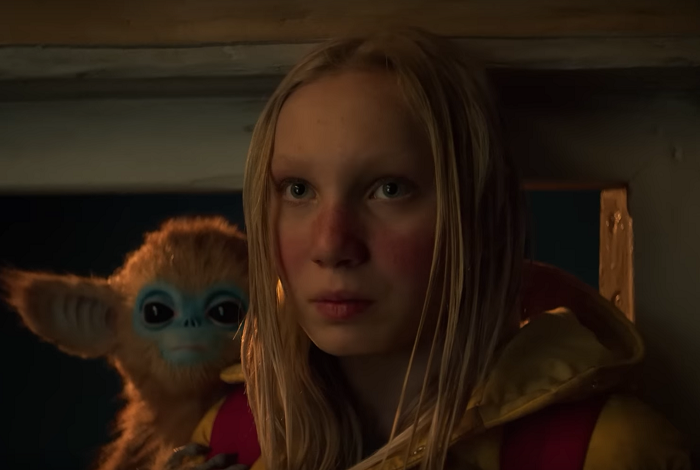
I have to give this to The Legend of Ochi: It certainly looks good. It’s a sad state of affairs that these days it seems like the minority of films being released are interested in (or capable of) having a distinct visual language, competent direction, or even just acknowledging that color and contrast exist. Writer-director Isaiah Saxon is one of the founders of animation studio Encyclopedia Pictura, which has been responsible for some of the more visually striking music videos of the twenty-first century, including Björk’s ‘Wanderlust’ and Grizzly Bear’s ‘Knife’. That aesthetic sensibility, reminiscent at times of the likes of Jan Švankmajer and his peers, which his studio brought to music videos is translated onto the big screen here in The Legend of Ochi. Saxon’s feature debut is a relatively simple fairy-tale about a child and a creature and a journey that they must embark on, which wants us to consider well-worn yet never more timely themes like humanity’s destruction of nature, the poisonous rot that is toxic masculinity, and, well, it being nice when films look nice!
Helena Zengel stars as Yuri, a misfit child in the fictional Eastern European-coded island of village of Carpathia. Isolated and remote, Carpathia’s geography and ecology resemble its real-world namesake, the picturesque mountain range that runs through the Czech Republic, Slovakia, Serbia, Ukraine, Hungary, Romania, and Poland. Saxon and his director of photography, Evan Prosofsky, indulge us with the landscape, ladling out generous helpings of saturated and sun-dappled fields, mystical morning mist, and deep and foreboding jungle. If Ochi’s Carpathia was a real place, parts of this film would be one hell of a tourist brochure! Rustic log cabins? We’ve got ‘em! Snow-covered peaks? You bet! And adorable, Baby Yoda-style puppet creatures and practical effects? Come on, who are you kidding? You know we have them.
This dedication to making things visually appealing is the film’s strongest suit, and it should be commended for that. Similarly, I applaud it for the offbeat tone that it takes in the telling of its fairy-tale. In another instance of the filmmakers hearkening back to a previous era, it doesn’t sugarcoat or soften things too much. Call me old-fashioned but we used to tell children’s stories that lightly traumatized and left a mark while teaching its morals. This always seemed a reasonable way of doing things. The world—as you may have noticed—isn’t all sunshine and rainbows. For most of human history, fairy tales have reflected that, yet in recent decades it seems as if much of children’s entertainment has veered off into coddling our young ones a bit too much. Granted, I’m no expert, childless as I am, but that’s certainly the impression I get. The Legend Of Ochi isn’t exactly an ‘as it was written’ Grimm adaptation come to life, but it doesn’t assume children are made of glass either.
Across Ochi’s striking landscape stomps a demented and insecure father figure named Maxim (Willem Dafoe). Clad in ramshackle armor like an Eastern European Don Quixote, Maxim is one of the very few adults we see in the story. Raging against ‘the enemy’, ape-like creatures called the Ochi, that live ‘out there’ in the woods, he commands a platoon of indoctrinated Carpathian children (including Finn Wolfhard), molding them into bloodthirsty, anti-Ochi killing machines. Zengel’s Yuri, the only girl under his command, can’t quite find it within herself to toe the line when it comes to Maxim’s agenda. This dissonance comes to a head when Yuri encounters a vulnerable and orphaned baby Ochi, at which point a largely predictable and safe telling of a story template unfolds for ninety or so minutes. There are a few instances of atonal humor that surprise and elevate the material, but for the most part, this is a film in which the primary draw really is the visuals. For a debut, however, that’s not bad, and if you vibe with it, The Legend of Ochi is a pleasant enough way to spend some time.
The Legend of Ochi is currently avaiable for digital rental or purchase.


