Old School. Biblically Independent.
By Jason Adams | Film | September 10, 2025
They say that history is written by the victors, but whispers of other stories usually manage to slip past. Many of us, queerer ones not among the victorious majority, have been forced to be the keepers of our own side-histories. Written in symbols and signs, glances and insinuations, we decode when we can or we invent when we’re forced to. What must have been. We become documentarians of the invisible. The sissies on the sidelines in old movies, always good for a laugh. The “old maids” and “confirmed bachelors” that litter other people’s ever-afters.
Being queer is akin to listening for frequencies that the mainstream misses. The secret dissonance laid over an even more secret resonance. Which brings us to The History of Sound. Set in the 1910s and 20s, adapted by Ben Shattuck from two of his own short stories and directed by Living director Oliver Hermanus, The History of Sound is a gorgeously contemplative attempt to capture that sensation. The intangible languages given voice, beauty, a semblance of permanence and place. Train your ear and you’ll hear eternities speaking back.
The film begins with Lionel Worthing (Paul Mescal as a young man, Chris Cooper when not so young) telling us in voiceover that he’s been able to see sound since he was a child. His description of it seems akin to the opening sequence in Disney’s film Fantasia where Bach’s “Toccata and Fugue in D Minor” is animated into color and abstraction—shape and form birthed out of emptiness. The imagination, a portal through space and time—trapping the impossible in a bottle.
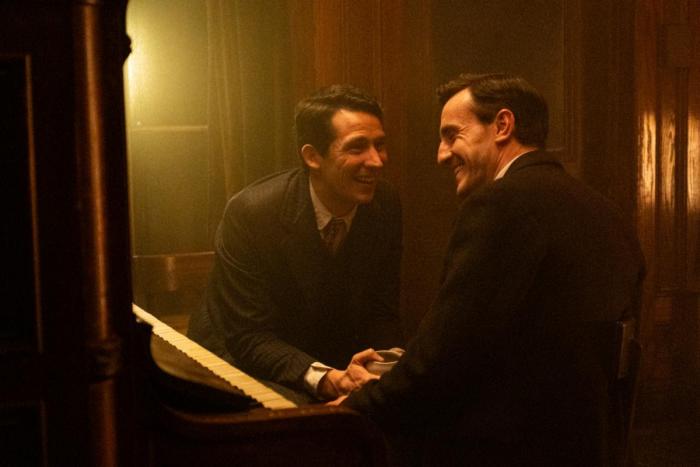
A story explicitly about capturing stories that would’ve otherwise been lost unto time, Lionel meets up one fateful evening with David White (Josh O’Connor), another student at his university, as David sits tinkling away a familiar song on the pub’s piano. The tune was one that Lionel’s father would sing back home on their farm in Tennessee—David’s playing it transported Lionel through space and time to his childhood, as if he were there on that porch once again. David is a composer, Lionel a voice—like so many men must have then, before, since, the two fall into each other’s arms a perfect fit. But those stories certainly weren’t told then, and they’ve barely been cracked now.
David says he heard Lionel’s familiar tune when he and his uncle went on folk music expeditions during his own childhood—they’d traverse the country on foot going into isolated rural communities where they’d ask people to sing their old songs into a recorder. Capture them for posterity. So many obscure songs disappeared over centuries, millennia. Now with modernity, technology, a chance to actually capture history in a physical form. Pin butterflies on paper.
In one moving passage of the film, once Lionel and David have set out on their own expedition to record folk songs, Lionel explains to some children how sound can be a physical thing—hold your hand to your throat and hum. You feel it. It might be invisible, but it leaves a mark—it goes into the recording machine and those same vibrations cut ridges and mountains into a wax cylinder. Forever things—something snatched out of obscurity, out of the past, to be carried forward. A memory made flesh. Just wait til they come back for you. Knocks the wind away.
David and Lionel’s time together is beautiful but short-lived, as it so often went in those days. Wars, years, miles, expectations. So many impossible factors would have to fall into place to make such moments even catch ablaze for a second, and keeping a hold of them was usually insurmountable. There weren’t even words for it. A trick Lionel’s father showed him once—you light a rolled up piece of paper on fire on each side and it will burn bright, brief, defying gravity and flung into space. We watch it happen several times—we will remember it even if it only lasted so long. It left its mark on us. We carry it forward. Somewhere. On our person. Etched, tattooed upon us.
Their lives pull them in separate directions—Lionel’s pure and lovely voice makes a world-class singer of him for a passage of time. He travels Europe, leaving behind a sick and lonely mother (Molly Price leaving her own mark on several brief interludes of memory) to see the world. A fling with a beautiful boy in Rome; a doomed engagement with a rich girl (Emma Canning) in London. All the time he sends letters to David who teaches at a music conservatory outside of Boston, hearing nothing in return. So many letters, so many handsome words—an enormity that will look so small, almost meaningless, when bundled together and tossed carelessly onto a kitchen table. A puff of smoke.
“Have you thought about what your life will be?” David asked Lionel that question once while on their trip. And as Lionel lays on the floor of that doomed fiance’s magnificent living-room one night just half-dressed, curled like an infant against the leg of the piano, their conversation comes back to him. How he confused life and music; how David was looking for an answer that hadn’t even occurred to him then. A decade dissolves in an instant. Decades. Regrets, we have a few.
The unfathomable erasure of so many stories like this, of ours. Disappeared into air. The History of Sound is about what it means to grapple with centuries of similar ghosts—knowing you too will slip into the ether; a story that nobody wanted told.
Hermanus does something brilliant across The History of Sound, purposefully nodding toward other recent cinematic excavations of our lost history—Lionel’s brief love story in Rome calls to mind Call Me By Your Name. There are a pair of scenes that are explicitly Brokeback-coded. And a bedtime retelling of the contradictions of “Orpheus and Eurydice” is straight out of Portrait of a Lady on Fire. Queer artists are right now digging into the past, feeling for the places where our erased predecessors left the smallest of marks. Zoom in and they’re mountains.
Many people will say, have said, the film is too reserved; too restrained. An oft accusation hurled at queer stories set in the past, as if we had to see Michelle Pfeiffer and Daniel Day-Lewis raw-dogging it in The Age of Innocence to understand the oceans their impossible affair spanned. The History of Sound wants to immerse us in just such teleportations from the past—it is asking us to see sound, hear color. To close our eyes and recall frequencies that were never captured in their time. The tenderness of granting memory to the forgotten. Zoom in, we are mountains.


