
Old School. Biblically Independent.
By Jason Adams | Film | June 11, 2026
There’s a shot toward the end of 1977’s Close Encounters of the Third Kind, iconic now for sure, where the stars begin to scatter like fireflies in the night sky. And, as Steven Spielberg’s characters have often been wont to do, Roy Neary (Richard Dreyfuss) & Co. are all struck dumb by this, only able to stare upwards in still, rapt awe. It’s a moment of spectacle, real magic, and yet rewatching that film this past week when I looked at that feat of cinematic astonishment all I could think was of space-junk and satellites. Watching lights blip across the skies now it’s really just lights; the every-day pollution of Earth 2026. Do you find yourself sometimes wondering if we can even see actual outer space anymore? The cosmic trash from billionaires blankets us, burning us up under its cover—we’re all suffocating inside Elon Musk’s Dutch Oven. Our government literally told us that hey aliens are probably real, and we were all like, “Excuse me sir, this is a Wendy’s” in return.
There’s a pretty obvious and heavy metaphor in there about humanity’s flailing ability to dream circa now, circa here—unlike Spielberg’s signature shot we all now stare downward, at our phones and computers, screens inside of screens inside of screens ad infinitum, in order to space out. And once you’ve been convinced all of everything sits in your hand, next comes the unraveling of reality itself—CGI and AI have dissolved flesh into micro-pixels, and matter into a chatbot’s meaningless hallucinations. We’re simulacrum creatures knee-deep in red versus blue pill conspiracies, watching for blips and glitches to give us some kind of meaning. A door the hell out of here. At least the uncanny Backrooms promise us feeling something!
Watching Disclosure Day (which has already been dubbed the third part of Spielberg’s space trilogy alongside his decades-enshrined masterpieces Close Encounters and E.T.) one gets the feeling that humanity’s current crisis state of cynicism and apathy bums Steven Spielberg out to Jupiter and back. And so he has gone and he has crafted this strange, often thrilling, and always deeply fascinating blockbuster auteur vehicle, one which is so in conversation with his own culture-defining oeuvre that it only could’ve sprung up from him and him alone. If a lot of America is reckoning with itself and its past right now, then Disclosure Day is a part of that—car chases and space races and not-so-little green men included.
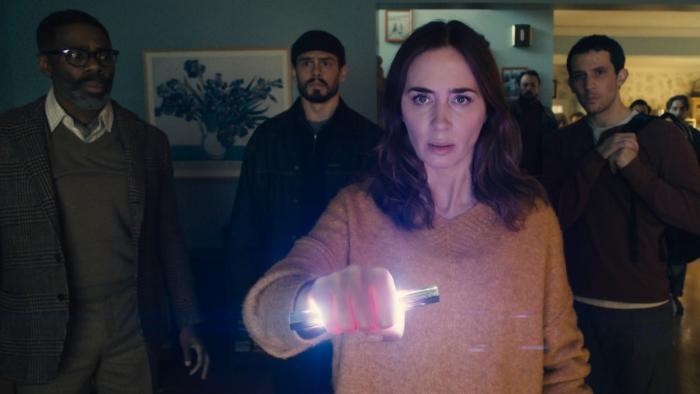
The film drops us in medias res as a numbers-geek named Daniel Kellner (Josh O’Connor, as always terrific) has found himself on the run, having just stolen a glowing MacGuffin Stick from Wardex, the tech company he works (or rather worked) for. Wardex is run by the more-government-than-the-government boss Noah Scanlon (Colin Firth, going real big), who’s sent a literal army of black-suited nogoodniks to sniff out Daniel’s tail, but thankfully Daniel’s not working alone. He’s just one part of an inside group of former Wardex employees that’s splintered off due to their growing discontent with Scanlon’s unhinged methods and secrecy. This faction is led by one Hugo Wakefield (Colman Domingo), who spends 90% of the film pacing about some sort of make-shift warehouse while talking to Daniel on the phone and, we can see in the background, building … something. Something… sinisterly suburban. Hey it is Spielberg after all.
But we’ll get to that eventually. Indeed a lot of Disclosure Day feels summed up by that sentence—“oh we’ll get to that eventually.” Spielberg and his co-screenwriter David Koepp do drop their breadcrumbs, some of them as big as a house, along the way, but Disclosure Day can be frustrating by how defiantly glued it is onto its sense of mysteriousness. When the movie slows down a bit in between its several baller action set-pieces, its hesitation to fan out its cards does seem, here and there, somewhat infuriating. Is there anything there, Steven? Are you playing the man behind the curtain again?
All of that is until you realize that it’s the “mysteriousness” itself that Disclosure Day is actually about about. It’s got to hit you sooner rather than later since the film’s actual plot is laughably thin—in the way that Mad Max: Fury Road is really just a car chase in one direction and then in the other, Disclosure Day is really just a bunch of scattered characters who have to find their way to the same spot so we can get to the titular disclosin’. In order for this to happen Daniel needs to get his MacGuffin Stick to Hugo, with the added wrinkle that he’s also got to rescue his girlfriend Jane (Eve Hewsen), who’s been kidnapped (and kinda pseudo-brain-washed) by big bad Noah.
And meanwhile a weather reporter and shiny-set-of-chompers named Margaret (Emily Blunt, absolute aces) has started having some sort of sudden empathy seizures—ones that grant her a sixth sense of where to go and what to say in order to get her there as fast as possible. Which is important, as you’ll find out, clearly inevitably and semi-exaustingly not until the third act.
And it’s basically all car chases and space races from there. Not that I’d want to be held in any other director’s immaculate grip for such spectacle—there are at least three moments off the top of my head in Disclosure Day where you’re reminded why Spielberg is Spielberg; moments where you’re reminded that his camera-work remains unrivaled; and that oh yeah, oh right, heck and hell yeah, this is what a blockbuster is supposed to be, feel, look like and do. But I’d be lying if the action doesn’t begin to feel a bit samey-samey too—one wonders if Spielberg had a bet with his legendary DP Janusz Kaminski on how many times they could swoop their camera around a speeding vehicle while also focusing with laser-like precision on what the characters inside said-speeding-vehicle are up to in there. It’s a great trick, one of their best, but by like the tenth time you kinda get it, ya know?
Thankfully those car chases and yes space races are merely the vehicle for Spielberg’s ideas—that’s often true in his best work but it’s fairly bald, stripped to basics, here. These ideas which are forefronted in ways that make Disclosure Day feel closer to the contemplative emotional core of A.I. than it does almost anything else in his filmography. Because the kicking of its own mystery ball down and down and yes further down the road, in a movie about spilling the beans—it’s right there in the title!—eventually becomes the film’s defining tension; hell it’s all anybody can talk about. Daniel thinks humanity has the right to know the truth about what his company’s been covering up, while Jane, a one-time novitiate (cue a wonderful cameo from the always wonderful Elizabeth Marvel as Jane’s former mother superior), has ethical and moral fears about how the truth might unravel the whole of society. Meanwhile Noah and his underlings simply want to keep their clutches on the boundless power of black rooms that secrecy affords them, because of course they do. We see these people on the news every day. Or worse, we don’t.
It almost doesn’t even matter, the Aliens of all of this—as the aforementioned so-called final part of Spielberg’s thematically-linked Close Encounters / E.T. trilogy one would hope that you’d realized by now that yes, big black-bug-eyed aliens are indeed the secrets, the governmental beans that Daniel & Co. are out there, bouncing off the sides of locomotives in order to be spilling. (I guess we just don’t really count War of the Worlds among this “trilogy” since, for all that film’s mastery, it’s the intelligence and benevolence of extraterrestrial visitors that’s been the riff that Spielberg, as Spielberg, was always meant to play. And those big meanies in their tripods couldn’t even figure out “air” ffs.)
So what matters in Disclosure Day is never really the aliens themselves, but the metaphorical wonder of them. The awe we feel when the stars themselves scatter and reveal themselves to not be stars at all, but boundless possibility. Disclosure Day is Spielberg grappling with mystery itself—how now that we can see all of everything right in our palms, how do we find, and appreciate, magic anymore? Can we find our way back to wonder? And what would that take? One can’t help but wonder—if he hadn’t been forced to play hide-and-seek with that malfunctioning animatronic shark all those many decades ago, learning there that it’s in not seeing where believing comes from, would this have become Spielberg’s life-long preoccupation?
Who can ever say. But the shark is still working, trailing magic somehow. Disclosure Day, thrilling and really just conceptually bizarre when you come down to it, is an odd space duck of magnificent proportions. It’s a film as wrapped up in its maker’s one-man obsessions as anything by Malick on existence and wheat, or anything by Tarantino on kung-fu and feet. This is a mature auteur project from the tips of its toes to the twinkling galaxies ricocheting above the heads of its confounded, desperate, and unyieldingly hopeful characters. In a world on the brink it decides to turn on all of the cameras and all of the lights and say, simply, lights, action, go. Now hope for the best.


