
Old School. Biblically Independent.
By Jason Adams | Film | October 6, 2026
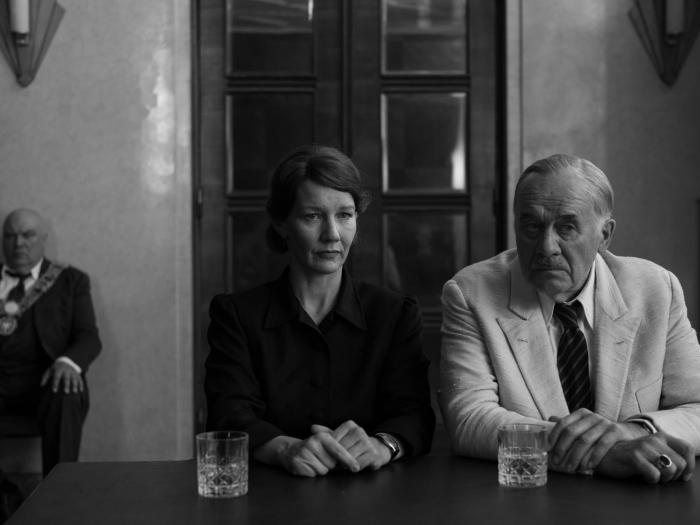
Bless the stars and all they shine for, we can already happily put Sandra Hüller’s atypically bad performance in Digger behind us thanks to Paweł Pawlikowski’s fortuitously-timed and stunning new drama Fatherland washing up on our shores. This is the second film starring the extraordinary actor that’s screening at this year’s New York Film Festival (alongside the already reviewed Rose) and it’s yet more proof she’s truly a generational talent. But Pawlikowski’s no slouch either, as here he follows up his gorgeous Oscar-nominated 2019 film Cold War with what might be an even better picture—one that just so happens to also be about the human and artistic wreckage that political extremism will leave in its wake.
In Fatherland we find ourselves in Germany in 1949, just four short years after Hitler blessedly blew his brains out and caused a mass amnesia event wherein every Nazi conveniently forgot they’d ever been a Nazi. Hüller plays Erika Mann, the daughter of legendary author and infamous expatriate Thomas Mann (Hanns Zischler, also giving a tremendous performance). Erika was herself a fascinating figure—a writer and an actress who embodied the sexual permissiveness of the Weimar-era, and who briefly married the poet W.H. Auden solely to get Swiss citizenship and escape the Nazi regime when that fateful time arrived. But fame of the sort her father held is a black hole—no matter how skilled or interesting Erika and her brother Klaus (August Diehl) might be, the shadow their father casts is one impossible to escape.
There are a couple of routes one can take to mitigate one’s nepo-baby status in such situations—one can implode, as Klaus seems to be doing from his place on the distant end of phone calls that keep leaving Erika shaken. Or one can make one’s peace with it, which is the main arc of Hüller’s performance. The Erika Mann of this moment and this story has found herself tasked with the role of the dutiful daughter, transporting her father back to Germany for the first time since the war to see him feted by the newly installed powers-that-be there. Desperate to exploit Mann’s international clout as a vociferous anti-fascist and to begin and scrub their country’s tarnished image just a whisper cleaner, Papa Mann’s ego and deep longing for home find themselves quietly but pervasively at war with his clear-eyed knowledge of just exactly what’s happening here. He sees what’s up; Erika sees what’s up. Everybody knows what’s up. The romance of home and our commingling hearts tangles up even the wisest among us.
Fatherland isn’t precisely a road trip movie, but it’s not not one, as Erika and her father slowly drive through the barely-done-smoldering wreckage of post-war Europe—which, thanks to the ravishing black-and-white cinematography of Lukasz Zal (who worked the same magic for Cold War) is worth the price of admission alone. Glamorous parties and ruined churches each gleam with a monochromatic majesty. The film’s just more focused on the stops the Mann family make along their way, all of which grow more insidious and strange as they go—the country’s carved into quadrants run by the Americans, French, British, and Soviets, and so it’s a whirlwind of papers and name-dropping that only gets them by. And even then just.
Little parades of propaganda keep encircling them too—songs and the forced smiles of people who should probably have swastikas carved into their foreheads a la Christoph Waltz’s Hans Landa. Both Erika and her father are smart enough to see straight through this bombastic patriotism and hollowed-out nostalgia—making Germany great again feels like spit in the eye at this stage of mourning. But if you love a good slap (and who doesn’t) Fatherland contains one of cinema’s newest greatest slapping scenes as at some random party Erika finds herself confronted with her ex-husband, an actor who stayed in Germany so he could become a movie star. There is some satisfaction to be had, but it takes brutality.
For the most part Erika maintains a buttoned-up exterior, but the life that bubbles from under Hüller’s surface is as ever something furious and righteous to behold—at her lowest she screams with frenzy at the fascists she hears singing in the night-time streets, those times when the ugly and unrepentant face of 1949 Germany sneaks back out to play. But it’s an impotent rage that she’s watching in real time be fed into the machine of forgetting. The Manns know the belly of this beast too well, one which they escaped only too randomly and unlike so many less fortunate, and you can see on their faces the doubts at every slip back into its strangling intestines. Branded as degenerates a decade before from the pulpits of this place, can it really be home again? When they know what horrors still lie just beneath?
An unfortunately timely question to be asking one’s self today, a dozen countries over. Nobody ever said homecomings are easy, but when the face of home has been torn off to reveal a mass of insects and devils squirming underneath it’s something else altogether. And Pawlikowski’s brilliance in Fatherland is in documenting the ways this happens to both the human residents of a place as well as their art itself—these are artists, great writers and thinkers after all, ones who are wrestling with where the borders between self and home and art begins and ends. Beyond their reach; beyond their best machinations, protestations. It’s all got a horrible terrible life of its own, and we might can only find comfort through stumbling acquiescence. The Manns are driving through a wasteland of their dreams and former selves, the rebar of crumbled concrete walls jutting out like crooked teeth, but oh they make the mournful sound of a pipe organ hit just so.
Fatherland is currently screening at the New York Film Festival. It will be released in U.S. theaters on October 23rd.


