Old School. Biblically Independent.
By Jason Adams | Film | September 26, 2026
Do you ever find yourself randomly, just all of a sudden in the middle of your day, giggling about that time Sanrda Hüller belted out Whitney Houston’s “Greatest Love of All” in Toni Erdmann? Or what about when she did the same thing with Harry Styles’ “Sign of the Times” in Project Hail Mary? (We stan a karaoke queen.) Then, to the opposite end, there’s her eviscerating her dead husband with the argument to end all arguments, the Oscar Clip to end all Oscar Clips, in Anatomy of a Fall—“Your generosity conceals something dirtier and meaner.” Phew! And all of those moments delivered with an ego-less honesty that only someone with a talent as rare as hers can channel.
Although she’d been delivering exceptional work for years before Erdmann made her a “name” it’s really just been over the course of the decade since that Hüller’s begun swatting her international peers outta the damn way to become a main attraction, carving out her own delicious niche inside any cinephile’s core memories. Can you not immediately picture the way she gracelessly modelled the clumpy fur coat of a dead woman in The Zone of Interest? Her body language alone reinvigorating actual heft back to the fallen insult “lipstick on a pig.” That’s skill.
All of this is to say that it’s as exciting walking into any new Hüller movie right now as it’s long been when there’s a new Juliette Binoche or Isabelle Huppert or Nina Hoss picture coming out. And we’re eating well this fall with a proper double-feature showcasing her talents. (She’s also in Alejandro G. Iñárritu’s Digger with Tom Cruise in some capacity, but honestly—that pairing terrifies us.)
Eventually will come Fatherland, the new one from Cold War director Paweł Pawlikowski (also screening at the New York Film Festival). But first comes Rose, Austrian director Markus Schleinzer’s gorgeous, sad, and slyly funny fable of gender fluidity in 17th century Germany. Granted “funny” might not be the first word that springs to mind when I tell you that its most obvious touchstones for Rose are Michael Haneke’s The White Ribbon and Carl Theodor Dreyer’s The Passion of Joan of Arc—movies about close-minded communities demanding blood aren’t typically considered laugh riots.
And yet Schleinzer masterfully (with a big dose of help from Hüller) achieves such a delicate balance here. “Rose” is, in modern terminology, the dead-name of Huller’s character, who’s been living life as a man for as far back as she can remember. (And please excuse the slippery pronoun situation but the film and the characters therein switch them up constantly, given this is actively not a tale of modern terminology. If “transgender” had been a concept in 17th century Germany it’s unclear whether Rose would identify as such—as she puts it, “There is more freedom in trousers and they’re just a piece of cloth, so I put them on.”)
This is even further complicated by the fact that the film never gives us the name Rose uses to pass herself off as male with; indeed the entire film is narrated by a moralistic scold coming from the townspeople’s point of view. As Rose ingratiates herself into this small Protestant village via a stolen man’s identity and a big bag of money, even marrying one of their daughters in the process (played by Caro Braun, who gives the film some of its choicest laughs as she turns out to be far more fiery than she at first lets on), the narration basically exists to remind us that this liar, “she” had it coming.
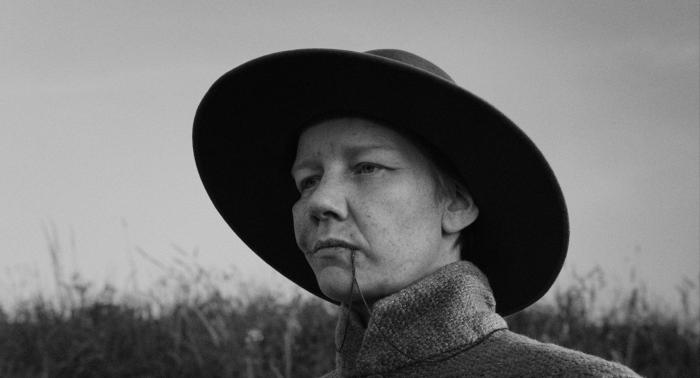
In lesser hands this telling of an unconventionally queer life dropped deep into hostile territory could have been nothing but dreary miserablism—more persecuted gays for history’s kindling. Not so Rose though, which borrows against Haneke’s visual iciness (featuring exceptionally steely black-and-white cinematography from D.P. Gerald Kerkletz) only to have everybody acting just a little bit goofy and off-kilter therein.
It’s as if the absurdity of life is just so abundantly clear to everybody as they act out their roles in this society that even they can’t really even take it seriously—that doesn’t stop them from being total shits, mind you. But when the torch-wielding mob comes for the “perverts,” as it ever must, they’re a ragged and sad little bunch knocking on window-panes, waving around their genitals like apes. It’s pathetic, as well it too should be. Just because they get to write the book of history doesn’t mean they get to come off good.
In contrast Rose (for lack of a better term), sucking showily on the smashed bullet that ripped through her face back during the Thirty Years War that she’s a veteran of, comes off grand. It’s such a precise and lovely turn from Hüller—deeply reserved and awkward, but bursting with life in those big watery eyes. Save the pretense of what’s in her pants Rose continually proves herself to be brave and honest and kind, teaching the townspeople how to read and write just so they can inevitably use their new words to persecute her. The relationship that brews up between Rose and her wife Suzanna is especially unexpected and tender. And their pratfall into parenthood is the stuff of longstanding sex comedy.
Not that Rose is a movie that loudly broadcasts its humor—all the beats of the depressing histories that have forever trailed queer people are here in their ceaseless horror. It’s not dishonest enough to lie to us (like some people). But Schleinzer never lets the film wallow and in turn neither does Huller—all the worst bits are kept off-screen and so what lives on, in its way, is Rose’s small but extraordinary life. Not based on any specific historical story (we queers were all but erased, after all) Rose manages then to live on as all of us. They’re a great ghost to be given.
Rose is currently screening at the New York Film Festival. it will be released by Mubi on December 11th.


