Old School. Biblically Independent.
By Jason Adams | Film | October 31, 2023
“You’ll be so lonely, baby… you’ll be so lonely you could die…”
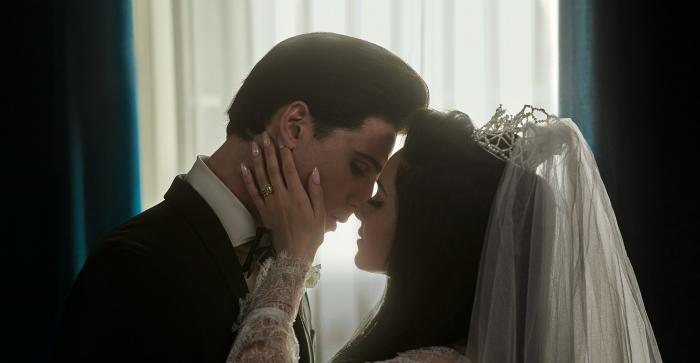
Even if those “Heartbreak Hotel” lyrics are never heard in Sofia Coppola’s emotionally lush American biopic Priscilla (seeing as how the filmmaker wasn’t granted the rights to Elvis Presley’s catalogue) they hover like a specter, a whisper of cigarette smoke, just off frame for its entire runtime. Summoned up during the very first meeting between 14-year-old Priscilla Beaulieu (Cailee Spaeny) and the decade-her-senior Elvis (Jacob Elordi) when he asks her what her favorite song of his is, Priscilla foretells her own innocence’s destruction with that throwaway line—even as she stares a mile heaven-ward into that icon’s soulful eyes, she can already sense the storm of being cast down from those clouds from its start.
But still—has any break-up song ever been hornier than that one? Elvis sings of his loneliness, so profound that it’s killing him, as if the feeling is a turn-on. And there might not be a filmmaker working today better suited to straddling that sumptuous fissure than Sofia Coppola, who’s made a career—think the teen girls of The Virgin Suicides, Marie Antoinette’s claustrophobic Versailles, Scarlett Johannson’s hotel room perched above Tokyo in Lost in Translation—of luxuriating in a loneliness so exquisite and tangible you can practically orgasm off the crush of velvets as they’re walling up your own tomb.
Priscilla is another vividly textured masterstroke from the filmmaker. The story of Priscilla’s thirteen-ish years with Elvis—just think, by the time they’d divorced, she’d spent as much time with Elvis as she had her parents and she wasn’t even thirty, and she’d then spend the rest of her life strapped to this man’s legacy—is perfectly suited to Coppola’s seeming long-term project of feminine reclamation. Last year Baz Luhrmann got to tell his bulge-first questions-later tale of Elvis swinging them loose trousers back and forth, leaving Priscilla nothing more than a footnote littered among the legend’s pinky rings. Well, here’s the flipside story, the one of the little girl ghost left on her own to haunt the pink carpets and heavy drapes of Graceland, weighted down by beehives and blue satin until she was fit to burst.
Based on Priscilla’s 1985 memoir Elvis and Me—written seven years after Elvis’ death and twelve years after their divorce—Coppola keeps us contained for the most part to Priscilla’s time at Graceland, which ended like most old-fashioned fairy-tales, in disaster. The carriage will always transform back into a pumpkin at midnight, and every celebrity and superstar is really just a f**ked-up pack of mess like the rest of us. Priscilla is one steady stripping down of the myth—the stars in baby Priscilla’s eyes blotted out one by one until she’s finally able to shake some form of self out from the fool’s gold and rubble. The story of Priscilla and Elvis might not have a happy ending, but her bittersweet one was better than its alternative.
After a brief mood-setting sequence of eyelashes and tippy toes, Coppola shoots us back in time to the courtship of Lisa-Marie’s mother—it’s 1959 and 14-ish Priscilla is a bobbysoxer sitting at the soda counter sipping a milkshake in the small German town where her father, an officer in the Army, has been freshly stationed. It also happens to be the exact same small German town where one Elvis Presley has been shipped off to serve god and country, much to the dismay of his legion of fans. And whaddya know, coincidence of coincidences, a friend of Elvis approaches Priscilla with an offer—maybe you’d wanna come to a party at Elvis’ house, he ever so slyly suggests? And Coppola smartly feels no need to underline what’s going on here—the machinations that got everybody to this point remain unspoken, but we can easily fill in the blanks. Coppola’s succinct editing of the inevitability of these movements, the black hole inescapability of their endpoint, says enough.
Indeed the film as a whole thankfully, wisely, never feels the need to hold our hands too firmly and lead our opinions forcefully with regard to the whole moral morass on display. Splendor’s all well and good but in my experience, love’s a many complicated thing—the good sh** and the bad sh** sitting tightly shoulder to shoulder. We can make up our own minds—the information is here, and it’s presented as it would seem Priscilla experienced it. Coppola extends a whole lot of grace to her story, and the knotted-up tumult of exploitation at its heart is met with what feels like honesty, not judgment.
As such, Elordi’s Elvis is a far cry from the Wikipedia page highlight reel that Austin Butler embodied to much awards attention last year—save a few brief flashes of performance from behind or half-glanced on a TV screen, this is an Elvis who’s sleeping off the pills and rejecting Priscilla’s sexual advances with a honey-voiced side-hug more often than it’s one you’d see from an impersonator patrolling the Vegas strip. This is the Elvis in-between, exhausted and looking for something to manipulate the way the world’s manipulating him. It’s not a competition; obviously, the two performances exist in wholly different worlds, but Elordi still reigns triumphant over Butler’s to my eye just by reining it way in. This is a person, as pathetic as he is beautiful, and you feel the pull of both.
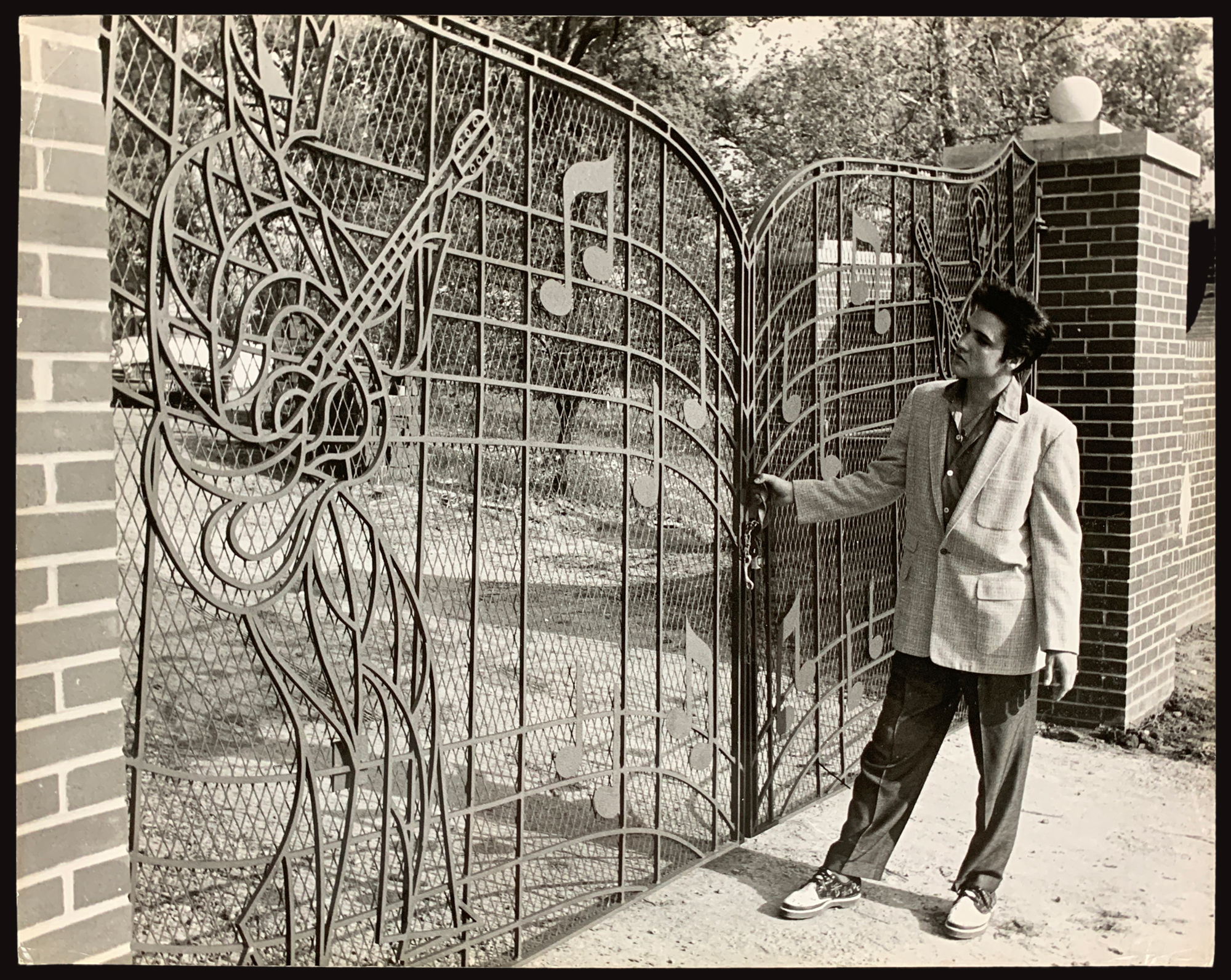
His casting reveals another spot of brilliance the second you see him and Cailee Spaeny standing beside one another—the six-foot-five actor has an entire Oompa Loompa on her, gifting us an immediate visual shorthand for the age and experience differential between the two. Spaeny’s itty-bitty Priscilla could be a toddler that’s wandered onto the Graceland grounds, and with legendary musical-note front gates resembling nothing less than those baby-gates that parents use to keep their kiddos from tumbling down the stairs. Priscilla’s trapped in her own satin-lined playpen, with a puppy and a pat on the head in between tours. (I could write another five thousand words on the sexlessness of their relationship, as presented here.)
The barrage of infantilization onto Priscilla speaks plenty, and Coppola thankfully doesn’t feel any need to push it further, into hamhanded harangue. Spaeny’s performance, understated, extremely lovely, never for a moment false, is its own slow-motion car-crash of self-realization. Relying heavily on fades-to-black that sometimes signal the passing of years, Spaeny lands us with elegant precision on Priscilla’s journey every step of the way—it’s extraordinary work that never once feels strained. It’s just a gentle series of nudges toward an understanding of her series of missteps—ones she never had a whole lot of choice in making. And what the hell does she do with that now?
The film refuses to talk down to her—everybody making it knew we’d know what we knew going in, and so it fixes its transfixing cat-eyes right on the matters within arm’s length. The process of putting on one’s face mid-labor. A cascade of tabloid magazines with your husband kissing other women sitting beside your morning orange juice. His lips; his wet back as he crawls out of a swimming pool. The sound of an empty house, white as snow. Watching LSD soak into a sugar cube, the texture on one’s tongue. Not many directors can make such small details accumulate the way Sofia Coppola can, and Priscilla is her in purest, finest form.