
Old School. Biblically Independent.
By Dustin Rowles | Film | April 14, 2026
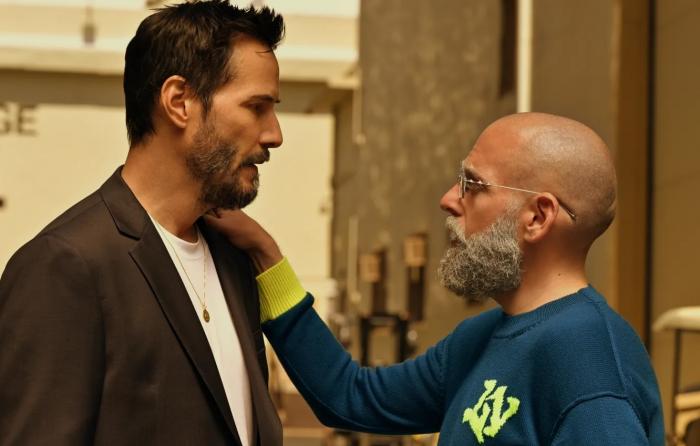
I don’t want to be cruel in writing about Outcome, directed and written by Jonah Hill (with co-writer Ezra Woods), but it is obnoxiously facile. What’s worse is that Hill probably thinks he’s being profound. He is not. Outcome is occasionally funny — Hill’s bizarro PR crisis manager is the film’s genuine bright spot — but the whole thing feels like a celebrity apology written by a publicist: empty and meaningless masquerading as meaningful.
Worse: He dragged Keanu Reeves into this.
Look: Jonah Hill hasn’t done much over the last five years outside of directing, starring in, and co-writing the mostly forgotten Eddie Murphy Netflix comedy You People (which was unpleasant), so it’s hard not to believe there’s something autobiographical lurking in Outcome. The film is about Reef Hawk (Keanu Reeves), a wildly popular and beloved actor who has spent the last five years essentially checked out of the industry. What the public doesn’t know is that he’s been working on his sobriety. What the public also doesn’t know is that Reef Hawk is a narcissistic, fame-chasing asshole.
Given the writer-director at play here, it’s hard not to map the real-life Jonah Hill — possibly a real-life narcissistic asshole? — onto a character built around the public’s warm perception of Keanu Reeves, generally regarded as one of the most genuinely beloved figures in Hollywood. The plot kicks off when someone blackmails Reef Hawk with an embarrassing video (the details withheld until the end), forcing him onto an apology tour to make amends to everyone he suspects of possibly leaking it. The suspect list is long, because Reef Hawk is such an unrelenting dick that it could be virtually anyone.
To the film’s modest credit, Reeves doesn’t play a particularly believable jerk — bless — which creates a strange, ambient dissonance throughout. Hawk is constantly flanked by his two-person posse: Kyle (Cameron Diaz) and Xander (Matt Bomer), his best friends since high school, neither of whom he treats especially well. His crisis manager, Ira Slitz (Hill), is easily the best part of the film, mostly because Hill plays him as a possible coke-fueled sleazebag with both feet submerged in the industry cesspool. He is the kind of guy who summons his client into the bathroom mid-conversation and demands full eye contact while on the toilet. It’s the most alive the movie gets.
Reef’s apology tour takes him to his first manager (played by Martin Scorsese), his mother (Susan Lucci), and an ex-girlfriend, Savannah (Welker White). He’s not good at apologizing — that’s the premise — and the idea is that he can fake it until he makes it. Somewhere along the way, I kept waiting for the moment when Reef would have some genuine epiphany that would crack the character open. He does, technically, but he never feels particularly cracked. His “sincere” apologies land with roughly the same emotional weight as his fake ones, which may be a Reeves limitation, or may be a scripting one. Probably both.
What Outcome seems to want to be is a pointed statement about how fame hollows celebrities out, turning them into human algorithms — Ryan Reynolds-esque content-delivery systems no longer capable of authentic human connection. That’s not a bad idea for a film. But if this is Hill’s best evidence for that thesis, it raises an uncomfortable question about whether Hill himself is capable of connecting with humanity through his filmmaking. Is this his idea of a personality evolution? A dick acts like a dick for 85 minutes, has a realization, issues a slightly more heartfelt apology to his fairly superficial hangers-on, and a musical montage declares him a changed man. Roll credits.
It left me with a bad feeling. There are some sharp jokes about Mel Gibson and Diddy, and the black-comedy elements are legitimately funny when they land. But whatever Hill is actually trying to say in Outcome feels badly muddled and poorly thought through — the work of someone who has important things he wants to express but hasn’t yet developed the craft to express them. Hill is a considerably better actor than he is a writer-director. I just don’t think he knows that yet.


