Old School. Biblically Independent.
By Jason Adams | Film | July 20, 2026
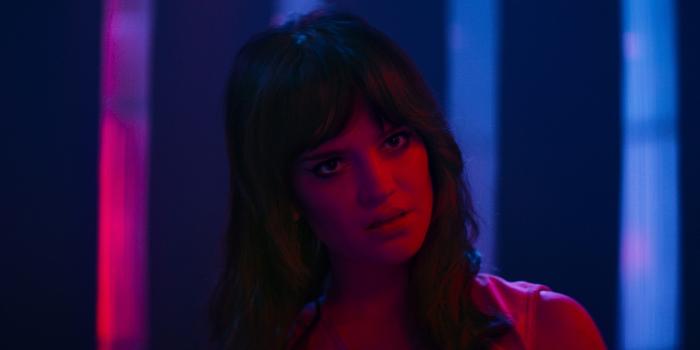
A glittering disco death-dream, Her Private Hell marks a triumphant return to the big screen after a decade away for Nicolas Winding Refn, the visionary writer-director behind Drive and The Neon Demon. And this new joint, like most of his work post-Drive, is likely to turn as many people on as it will off--I'm just delighted to be a firmly ensconced camper of the former, always and forever susceptible to his pervert-brained inclinations. A fairy tale flipped over so we can watch the worms caked in stardust writhe down below, in slow-slower-slowest motion, Her Private Hell is sweet excess for cinematic somnambulists--to sleep is to dream is to Slow Cinema masterpiece, baby.
Sophie Thatcher (Yellowjackets, Companion) here plays an actress named Elle--and perhaps one might note Refn's last film The Neon Demon starred an actress named Elle (Fanning that is)--who's just rolled into town to shoot her new movie. This is a nameless city of Querelle-esque neon towers stretching to the stars and sculptures whose gargantuan heads peak above the clouds as if we've stumbled back into the Gotham of Joel Schumacher's vision. (Shot in Tokyo and Copenhagen this city never for a single instant looks like any actual place on Earth.) Except those aren't clouds--a soup-like fog has descended over everything alongside Elle, blanketing the Fritz Lang's Metropolis in the stillness, the emptiness, of a dreamland.
Immediately in the lobby of her hotel Elle crosses paths with, well, the only other person there--a nubile young thing named Hunter (Kristine Froseth) who's another actress working on Elle's film, and who's found herself trapped in town thanks to the strange weather. As excitable as Elle is cool and jaded, Hunter's the picture of peach-cheeked youth, and Elle eyes her up and down with a detached weariness--the subtext that no matter how young and pretty you are (and Sophie Thatcher is, one might note, still very young and quite ridiculously pretty) there's always another younger one waiting in the lobby to take your place is here tossed off, unspoken, via Elle's momentary expression on the elevator ride up.
Refn leaves things, most of the things, unspoken--he's a director who always seems to know what we're thinking, what he's making us think, and has never seen or felt any need to repeat it. Ryan Gosling's driver-of-few-words ad infinitum. That's why the billion half-glanced references to former movies and their makers that Refn has spent his career blending and re-blending together has never bothered me--they all slide past in a miasma of mood, an all-consuming vibe that has become entirely his own through sheer force of will. Much like Mads Mikkelsen's video-store clerk breathlessly does in a scene in Refn's 1999 movie Bleeder I might be able to rattle off all of the reference points--Bava's Planet of the Vampires, Tetsuro Takeuchi's Wild Zero, Argento and his giallos and everything Brian De Palma (and by extension Alfred Hitchcock) ever made--but I'd never mistake a Refn Movie for any of the others. He's a one man Cinematic Universe.
And what is a "universe" but a word created to contain endlessness? To give the boundless borders. Refn's worlds are claustrophobic ones that stretch out to infinity, where time and space collapses into sensation, sound and sweat. Where a small circle of characters spin around one another so fast and centrifugally terrifying that they we can't even see the motion but they nevertheless pop into flames. Their obsessions are the all-consuming ones of superheroes and psychopaths--right off the bat Hunter confuses Hans Christian Anderson with "European music" and ain't that just the jam?
That the next person we meet, the third side of this cinematic triangle (Refn adores triangles), is a step-mother named Dominique (played by the supernaturally gorgeous Havana Rose Liu from Bottoms and Lurker) ought to indicate that we're ensconced in the make-believe land of Soap Opera here. Because where else do step-mothers named Dominique live? That Liu, all of three years Thatcher's senior, is playing the role only makes the revelation more delicious; that Dominique and Elle were best friends before Elle's father, a semi-wizened bon vivant named Johnny Thunders (Dougray Scott), went and married the former, well that only makes it even deliciouser.
Johnny Thunders only wants to be surrounded by beautiful things. And it's hard not to hear Refn speaking that line through him, as every actor who appears on-screen is more beautiful than the one before--we haven't even gotten to the hardcore fetishism that Refn projects onto actor Charles Melton--and very shot a singular, spectacular act of creation. Often characters just pose in place like mannequins modeling clothes that as sparkly and transfixing as they are, but Refn understands the violence inherent in this ache for perfection--here it's a prick of the needle that sets off our tale.
After all it's hard not to see the mannequins of William Lustig's grisly film Maniac, the ones topped off by human scalps, as being as influential to Refn as the perfume ads he slyly apes. Johnny Thunders, father to Elle, husband to Dominique, and egged on by Hunter, will now regale us with a legend, his face lit in lamp-light like Dean Stockwell in Blue Velvet. It's the legend of The Leatherman, an ancient evil force who's dressed like the Gimp in Pulp Fiction (or half of the characters in Cruising) but with indestructible diamonds sewn onto his gloves that he uses to tear people's chest cavities asunder like he's splitting open a ripe peach.
Once a father whose daughter was stolen from him, The Leatherman was forged in the fires of his fruitless search, his rage turning him into a monster who now only wanders the night attacking women who simply remind him of his lost girl. A Freudian ouroboros of daddy issues who can only be destroyed once he's separated from his fists, he rides in on a fog a la John Carpenter's pirates or Stephen King's inter-dimensional critters--one just like this fog here actually. Coincidentally. Except not. Because sure enough (and the second Johnny Thunders exists left from the story, wink wink) the Leatherman is out here stalking our girls, Can Elle and Dominique learn to love again? Or will the big bad clad-in-black wolf tear them forever apart (like, literally)?
Meanwhile all of this glorious silliness (there is no supposedly straight director working today who breathes camp better than NWR breathes camp) is refracted through the pink prism of a side-quest--we're whisked off to what seems to be the 1960s, where an American soldier named Private K (Melton) is wandering the same city streets, under a blanket of the same fog, looking for his own stolen daughter.
Battling equally with the local yakuza--there's a killer fight scene in a little girl's dress shop that ends with all those little girl's dresses so subtly sprayed with gore--and the local do-nothing police (Drive My Car star Hidetoshi Nishijima), somehow everybody's end-game seems to be... tearing Charles Melton's shirt off? None more so than Refn himself, who leers pornographically at this golden god of his camera's making--K is a hero, one out to extinguish the Leatherman's foul legacy, but one who'll have to slip on the fetishistic leather himself to find his man. And he's shot like an Übermenschen in turn. Yet the line between Good Father and the bad one is thinner than a plane of glass or mirror; punch it as hard as you want but it only seems to crack once you're smashing the face of innocence through it.
At this point you probably know whether Refn is your man or not--at this point in his career and at this point in this review. If everything I just described sounds like pretentious torture to you it probably will be, as Refn seemingly has no desire but to follow his demented muse further and further down the molassesy rabbit hole of his own hardening obsessions. Even though he's basically been making fairy tales for the majority of his career, this one is the most... most. It's sensory overload--every shot blue and pink and black and gold, every line uttered at half speed, all as the operatic score from Italian legend Pino Dinoggio (who came out of retirement to deliver a brand new masterpiece) swirls and coos its madness beside it. When the girls start literally barking at one another, well, what did you expect?
It's true that Refn certainly won't be beating off the people who claim he's all style without substance with this one, although I maintain he's an alchemist who turns style into high substance, like some glorious stardust unlike any mined before--black sand glittering through gloved fingers. His story might be as simple as Hans Christian Anderson (or is that European Music) but haven't those lasted for centuries? Refn thrums Her Private Hell along the base notes buried beneath the fairy tales, a knowingly absurdist profundity that tickles at our bellies and then low, lower, lowest. You should feel it in your baby-maker basically, growing pregnant with the... pause... wait for it.
Her Private Hell opened the Fantasia Film Festival this past week. It opens in U.S. theaters this Friday, July 24th.


