Old School. Biblically Independent.
By Dustin Rowles | Film | February 20, 2026
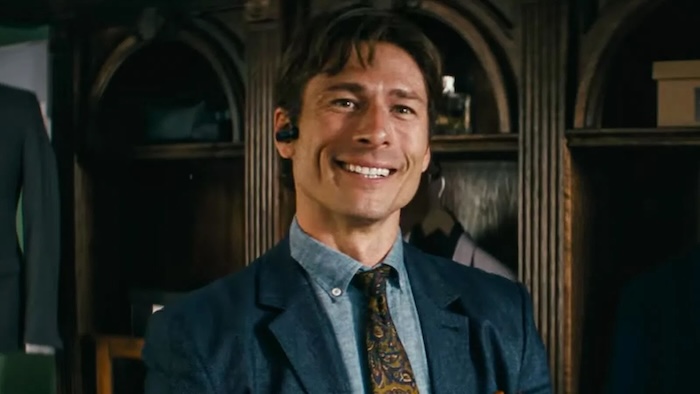
I found it curious that A24’s promotional push for How to Make a Killing has been so muted, particularly for a movie featuring someone as recognizable as Glen Powell and Margaret Qualley coming off The Substance. The trailer, at least, suggested that it’s a movie that could easily exploit the Luigi Mangione/anti-billionaire sentiment in America right now and position its star as a kind of Gordon Gekko vigilante.
But then I saw the movie, and now I get it. How to Make a Killing could have been a great movie. It’s weird to say this, but it’s middling in spite of an otherwise brilliant plot about a man who is literally imprisoned by his own greed. The movie may as well have been called Careful What You Wish For, and Glen Powell’s character could have been positioned as a memorable anti-hero.
Alas, this is a film where director John Patton Ford (Emily the Criminal) does a huge disservice to writer John Patton Ford. The script is good. The approach is terrible. How to Make a Killing is decidedly not the dark comedy I had anticipated. The whole thing takes itself way too seriously, refuses to take advantage of Glen Powell’s charm or comedic sensibility, and completely drops the ball on its tone. The only person who seems to understand what kind of movie How to Make a Killing should be is Margaret Qualley, but she’s also a relatively minor, albeit pivotal, character who at least understands the Coen Brothers-like energy the film should have had: a little weird, a little zany, a little madcap.
But the rest of the film? Honestly, it’s mostly a drag. And about 20-30 minutes too long, to boot.
Powell plays Becket Redfellow. When his mother met a cellist at a young age and got pregnant, her father, Whitelaw Redfellow (Ed Harris), cut her out of the family fortune after she decided to have the baby. The cellist died minutes after Becket was born, his mother died when he was young, and Becket spent much of his early life in the foster care system.
However, the Redfellow family also had an irrevocable trust that left the family’s fortune to the youngest survivor. As an adult, all Becket had to do to inherit the fortune was kill off the seven Redfellows ahead of him in the line of succession. And this is where it should be more fun, watching our narrator (the entire story is told through flashbacks while he’s confessing to a priest hours before his execution), but John Patton Ford doesn’t take advantage of the concept or the douchebag comedic chemistry of some of the victims (Zach Woods, Topher Grace).
Instead, Becket falls in love with Ruth (Jessica Henwick) and loses interest in continuing the plan, but ends up getting swept up in circumstances beyond his control (thanks mostly to Margaret Qualley’s character). The whole thing ends up falling flat despite a fairly intricate plot, whose impact is largely dulled by the movie’s self-serious tone and Powell’s refusal to tap into either his charm or his full douchebag potential.
It’s a shame, too, because the Coen Brothers, or even someone like Joe Carnahan or Guy Ritchie, could have had a blast with this script. But the whole thing just kind of dies on the vine, suffocated by its own pretension and the weight of a limp Glen Powell performance.


