Old School. Biblically Independent.
By Jason Adams | Film | July 22, 2026
With all the talk of the horror genre being the most reliable one around these days it feels important to point out that a good part of that is we’re living inside a golden age for the subgenre that is Folk Horror specifically. You could say the twin towers of Robert Eggers’ The Witch and Ari Aster’s Hereditary lit the match, but much like Slasher movies in their heyday circa 1981 it feels like a dozen new Folk Horrors land on us every month. Perhaps it’s that, as technology devours us from the fingertips, our lizard brains long to dig back down into the mud—we dream of the wriggling things we left behind and of howling at the moon. A wildness that withers inside our glass-walled coffins. Or, to quote the GOAT (no not Black Phillip) Freddie Mercury, we just wanna break free.
Well if that sounds like you then here in director Kasper Kalle’s No Rest For the Wicked is a nice old-fashioned herbal remedy—one refreshed by modern hands, reshaping the clay golem of an oft-told tale into something strange and sexy, bewitching and eerily unfamiliar. Oh and gay. Super duper gay! Freddie’d like that.
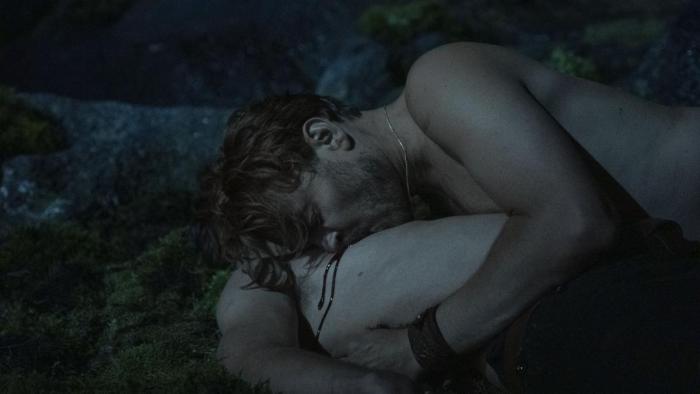
Adapted from an 1884 short story by German author Karl Heinrich Ulrichs, No Rest For the Wicked finds us in a small fishing village on the Faroe Islands, situated off the coast of Denmark in the general Icelandic direction, in the year 1864. Even now Tórshavn, the capital city of this place, gets the least annual sunlight of any city in the world, and you immediately feel that in the twilight-ish cinematography—it’s not black-and-white a la Egger’s The Lighthouse but it’s got that vibe thrumming in its veins; it’s like a Peder Balke painting come to life, where the silverish skies glimmer ever and always just beyond the cliffs. No trees grow here—there’s just stone, dismal shrubs, and the endless tumult of the sea tearing everything from the shore piece by piece.
This place and time is where and when a sensitive and gorgeously sweatered young man named Baldur (Egor Venned) lives, fishes, and cares for his mother Alsa (Sofia Nolsøe Mikkelsen), having lost his father to said same sea some time ago. (And yes, in the way of many a Scandinavian Tale before it, this movie is high sweater porn.) Baldur seems content enough when we meet him—his mother is kind and they clearly care for one another, and the small scale of his life doesn’t even seem to’ve registered. This is his lot; it is what it is. What else could he even know or dream of?
That peace is vigorously poked at the moment a strapping stranger rolls into town—literally, rolling in within a sudden bank of fog that also smashes Baldur’s fishing boat open on the rocks. The handsome stranger’s name is Helge (Pilou Asbæk from Game of Thrones) and he’s a Danish whaler who’s found himself stuck in Baldur’s village awaiting a fresh vessel to carry him off to new adventures on the great wide open. The two men don’t speak quite the same language but it’s close enough that they can get by, and anyway they’re almost immediately doing a lot of silent communication through their eyes and smiles, wink wink nudge vigorous nudge.
It’s not like they’d even have words for what they’re feeling, but to us here in 2026 it’s pretty clear that Baldur and Helge are piping red hot for one another from almost the jump. Unfortunately Baldur’s mom is also over there in the corner batting her own lovely eyelashes in Helge’s direction, which leads to some fast awkwardness—the man from the sea is invited to stay in their home, but he takes little to no notice when Alsa comes wandering past his bed in the middle of the night with her night-dress drooped seductively down one shoulder. Yet within the span of a few days she’s hearing a rustling and a moaning coming from inside Baldur’s room…
So far so hot, but where’s the Folk Horror, you’re surely asking? Kalle’s No Rest For the Wicked thankfully takes its sweet time establishing this little queer love affair and its strange triangle not-to-be before pulling out its rug—anyway inevitably a ship arrives and Helge prepares to be on it, dashing Baldur’s suddenly opened-up heart and loins on the rocks much like his rowboat before them.
But… what if Baldur came with him? What if he left behind his mother and the two men scraped a life together out there on the open seas, one of the few refuges to turn a blind eye to a little extracurricular buggering? Is there such a thing as a happy ending for this ye olde story?
If you guessed “Hell no” you’d only be half-right—Kalle’s film puts the men’s romance through the wringer and then some, as if having multiple wooden crosses hammered down through your chest-cavity twere so simple as a “Missed connection” ad in Craigslist. As Gary Oldman’s Dracula put it, “I’ve crossed oceans of time to find you,” and it’s just swell to be found in a town with this little sunlight (as anybody who’s read or seen 30 Days of Night surely knows).
But even as the bodies pile up and the coffins get to rocking, No Rest For the Wicked still makes space for beauty and peace inside the hollowed husk of despair that gay people have been rolling over in their hands for centuries, smoothing down to the bone. Tragedy befalls our boys as it must, but much like the teenagers in Leviticus earlier this summer—queer love will find purchase on even the stoniest shores. Or to quote our dearly departed Sam Neill, “Life found a way.”
The triumph in Kalle’s unsettling yet emotionally stirring No Rest For the Wicked is that it’s queerness, it’s our love story that will never let go—it’s queerness that’s allowed to smash past the boundaries of life and death, seeping up through the mud a primordial force to be acquiesced for once at last. The prayers and the superstitions that come at Baldur and Helge are as old as the churning waters outside their front door, but finally we’re able to see and be shown that there will be no denying us. We’ll spring up eternal—nice-like as flowers, or alternately as terrifying as a lustful possession slithering between your toes. But you’ll never be rid of us, and you’re the damned ones if you try.
No Rest For the Wicked just world-premiered at the Fantasia Film Fest in Montreal.


