Old School. Biblically Independent.
By Jason Adams | Film | June 8, 2026
Boys like me, ones raised among the floor-rolling and tongue-lolling Pentecostals, got all the choice chapters of The Book of Leviticus burned into (and branded upon, everlasting) our heads during our Bible School years. Specifically the ones about how the greatest thing in all the land—aka a man “laying with” another man—was some rando dude’s idea of an “abomination” back in the day. Those passages, sharpened into deadly weapons by centuries of oh let’s call it enthusiastic mistranslation, left their marks; scratches deep through our psyche poisoning the very thing that makes life worth living. Love is ash; desire soot upon grasping, clawing fingers.
Wherever you’re coming from though that’s some solid back-knowledge to have in your front pocket when you go and see (and you should go and see) Australian director Adrian Chiarella’s emotionally raw and deeply creepy new horror story Leviticus, since the movie never bothers to call out those quotes specifically (save its title, of course).
Chiarella rightly assumes it’s general enough knowledge that the Old Testament and the people who love the cut of its soul-deadening jib in 2026 aren’t the same ones populating the churches currently hanging up rainbow pride banners for the month of June. No, the Leviticus lovers and their damnation-prone deity swap out love and acceptance for pain and rejection, perverting the concept of a “Christ-like life” past recognition; they, with their stank moral certitude, have always been the villains, even before Piper Laurie started swinging her “good book” around like a cudgel.
But here, finally, is a movie that squarely lands its mark.
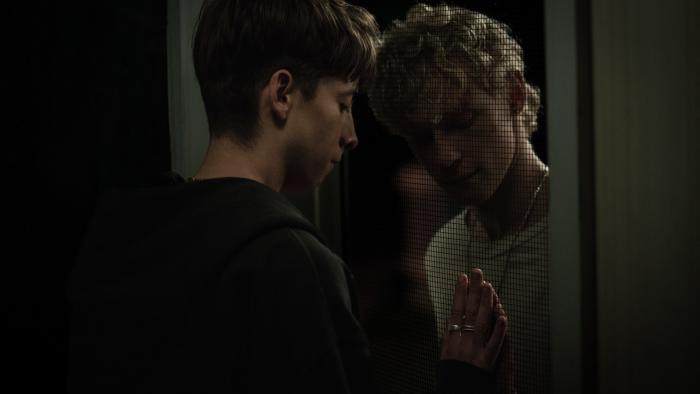
Telling the love story of new-boy-in-town Naim (Joe Bird) and hot-boy-in-town Ryan (Stacy Clausen), whose briefly-cheerful romance is violently interrupted by a “faith healer” invited into their small town church’s fold when two boys are caught being, you know, “abominations,” Leviticus isn’t a ghost story. But it’s not not a ghost story either. Steeped in the inherent sadness of that spectral subgenre, these characters find themselves for all intents and purposes haunted by one another—a curse laid upon them by the very people who profess to love and care for them; a curse of whisper and flame that turns everything beautiful into violence, and all hope into fear.
Leviticus obviously isn’t the first film to tread out into these unholy waters. Far ahead of its time there was the pepto-bright But I’m a Cheerleader in 1999, which tackled the subject of Christian “conversion therapy” via irreverent comedy (not to mention Eddie Cibrian in very short jean-shorts humping a weed-whacker). And in more recent history it’s mainly been straight (so to speak) dramas—films like The Miseducation of Cameron Post with Chloë Grace Moretz and Boy Erased with Lucas Hedges.
Those latter films of course brought their share of horrors along with them, given the inherently horrific subject matter. But their flat sincerity and well-meaning somber air ended up feeling decidedly un-queer—they felt like movies made by or for straight people, for straight people to pity us. Our lived experience is a far knottier thing than those stories made of it—queer people have metaphor built into our bones thanks to centuries of hidden living, and getting to the heart of what it feels like for a queer stifling inside a straight world, well that was always going to take a more roundabout path.
The horror genre, which queers like Mary Shelley and Bram Stoker had already built from the ground up, was probably always gonna be the proper place to go—especially with the genre spending this past decade plus excavating “trauma” and “grief” so thoroughly and so explicitly. But that was no guarantee, either—look no further than the disastrous conversion-camp slasher They/Them in 2022. (But please don’t actually look there; you deserve better than that. We all deserve better than that.)
So how does Chiarella, with this his first-time feature, get it so right?
Well it helps that his central metaphor (one that carries a whisper of It Follows about it) is so simple, so perceptive, and so profoundly felt, that everything else in his story falls into perfect place from there. Naim’s mother (played by the great Mia Wasikowska in another small stunner of a performance) is one of the many who holds so tightly onto their terror at life that they mistake those cold clutches for safety—the writings of Leviticus and its sister books offer bumpers to people tumbling through meaningless space; rules to people who’ll happily wind them around their own throats to keep themselves from screaming.
Naim and Ryan’s affection for one another is never overly idealized by the film—as sweet as they can be these are complicated kids who hurt each other. (Stoning for fun! Who knew!) Just never nearly as much as the world hurts them back. But in that violence the boys will find a camaraderie that any queer person will recognize—there’s such truth ringing through the frames of this film it more than once made me shake in my seat.
And while it’s tempting to say it’s far sadder than it is scary, Leviticus is also legitimately scary too—not just that one helluva jump-scare wedged in its middle, but in the way it weaponizes every soft edge into steel-wool. The way it digs its invisible fingers into throats, and shreds away at every dwindling source of pleasure. (Oh, the ear of it.) Abandon all hope ye who enter here, queer—except Leviticus lives, for all its fantasticism, in a world where we’ve managed to go and turn the terrors unleashed upon us manaegable, in their way. Scarred, battered, with what’s beautiful abused—yes. Surely. But love finds its way. And I have been waiting for a Leviticus like this my entire life.
Leviticus was screened as part of the NewFest festival in NYC; it releases into theaters on June 19th.


