
Old School. Biblically Independent.
By Lindsay Traves | Film | March 27, 2025
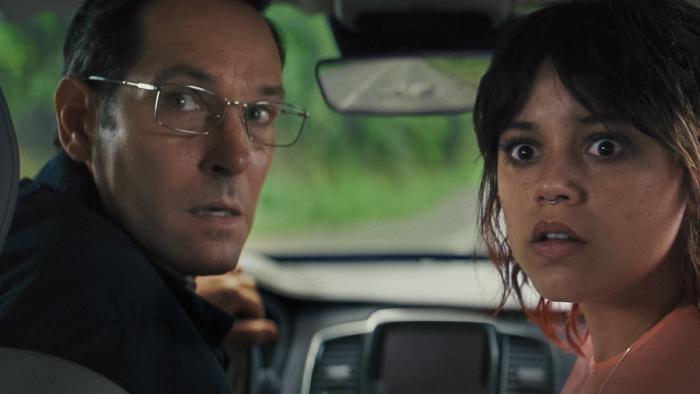
What if “The Colour Out of Space” landed on some pharma capitalists? Perhaps they’d try to monetize it, even as it ripped them apart from the inside. That’s the presumed elevator pitch for Death of a Unicorn, a sparkly pinky-purple metaphor about the hazards of resource hoarding and exploiting the planet.
Paul Rudd and Jenna Ortega take the wheel as father/ daughter duo Ridley and Elliot (Rudd naturally as the doofus dad and Ortega as the bitchy-spooky youngster). The pair are a bit out of sorts since the untimely death of Ridley’s mother, but in an ever-clunky attempt at doing right by his daughter, Elliot has dragged her out to a business meeting. This meeting is with a reclusive yet brash wealthy family, The Leopolds, who’s considering bringing on Rudd as their proxy, something that’d pay Elliot well, giving him the means to afford Ridley the life he thinks he owes her. But the eccentric batch of pharma billionaires wants to know that Elliot has a good family life, so his ability to play Daddy-Daughter is necessary to push the deal over the line. The pair might have already struggled to impress the Leopold family with their fractured relationship, but things are off to a more damning start when on their way to the remote manor, Ridley and Elliot hit a unicorn with their rental car. While they initially try to keep the blunder under wraps lest they spook the jumpy clan, they eventually must confess to the incident and unveil to the big-bad pharma capitalists that the unicorn corpse they’ve stashed in the trunk actually harbors magical healing abilities.
It’s all, of course, a metaphor for capitalism, big pharma, and the hoarding of resources by the ultra wealthy. The Leopolds are a stand-in for the Gates family, the Bezos clan, or far more damning, the Sacklers. They’re rich, out of touch, greedy, and see this impossible medical breakthrough as a business opportunity, hoarding what is scarce when it becomes apparent they cannot synthesize it. It’s interesting timing for such a tale, one about capitalists literally bleeding majestic nature dry, but feels a day late to the anti-Sackler party and a day early to go after pharmacological breakthroughs since 2020. It’s perhaps a warning about the cost of insulin that might have been effective had we not had to watch a unicorn autopsy for half of a movie. While I concur that humanity stripping nature for a profit is ghoulish, Death of a Unicorn seems to have shot its arrow a bit too far off the target (with a compound bow, no less). There are moments where it seems to acknowledge what it’s missing, for instance, in how it doesn’t have a way to reconcile indigenous ideologies of using what is in nature, so it adds a throwaway line about how “this used to be Blackfoot land.”
Larry Fong’s (The Predator, Watchmen etc.) cinematography makes for a nice-to-watch adventure through a lux estate but the large creature events are cloaked in darkness (perhaps not surprising for a regular Zack Snyder collaborator). Maybe it’s the limits of the film’s resources, but the CGI dances close to realism but then has uncanny movement in cartoony shots which is simply not effective.
The attempted zany approach to the ever-relevant metaphor is not worked enough to be successful. At times, there are shades of Spontaneous where a horrid problem (in that case, school shootings) is being ignored and treated bizarrely in a film that ends up feeling like a whacky supernatural plot out of Ick or Cooties. But Death of a Unicorn is somehow not subtle enough in a sub-genre that doesn’t really ask for subtlety, so feels like an idea that stretches into the thinnest possible gag until it becomes a Jurassic Park monster revenge tale in the back half. It’s attempted comedy falls flat which must be a timing and writing issue if you can’t get a laugh with Paul Rudd and Anthony Carrigan. Will Poulter feels massively miscast and his version of Saxon Ratliffe is not believable or funny. Téa Leoni is the standout as the ruthless matriarch whose comedic timing holds it together until (and through) her gory end.
Death of a Unicorn crafts a new era fairy tale about a maiden up against the world who is able to tame a majestic beast that humanity, as it is, is otherwise unable to understand. It’s at its best when it’s a creature feature, and at its worst when it’s a scrubbed Wendigo story built upon a flimsy but glittery allegory held together by runtime stall tactics. It’s about as subtle as Avatar but with less magical effects and fewer memorable performances.
Death of a Unicorn hits theaters March 28, 2025


