Old School. Biblically Independent.
By Jason Adams | Film | October 12, 2026
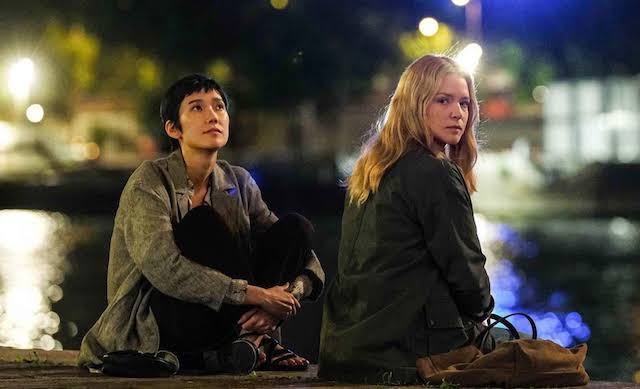
Whatever the opposite of the Bechdel Test is, writer-director Ryûsuke Hamaguchi’s gorgeous new miracle of a movie All of a Sudden seems to have invented it. Here is a three-plus-hour movie which is at least 75% made up of two women talking about everything from the end of life to how they like their noodles, and as soon as it’s over you feel as if a silver thread of magic has slipped through your fingers—you immediately want to watch it again, or for it to have never left you in the first place. However you measure it, it’s another masterpiece from the filmmaker behind Drive My Car and Evil Does Not Exist—gently gifted to us from one of cinema’s most extraordinary humanists working today (or probably ever), All of a Sudden is like its title over too soon.
The film stars French actress Virginie Efira (Benedetta) as Marie-Lou, one of the head administrators and care-givers at a home for the elderly in Paris. Marie-Lou’s whole thing is she cares too much—she’s working herself to a breakdown trying to implement a new system of care-giving called Humanitude, which attempts to simply treat every person within their care as a full and complete human being. Seems like the bare minimum on the surface, but anyone who’s been to one of these facilities knows it’s a big ask—they’re understaffed, under-trained, and under-funded, and the temptation to make everything run like clockwork, turning people into cogs in a machine, is understandably present.
Marie-Lou lives in the facility herself because the work is so important to her; she takes on any extra duties that need seeing to, and it’s visibly straining her—the head nurse named Sophie ((Marie Bunel) thinks Humanitude is a bunch of bunk and the tensions between the two of them are clearly rising. Meanwhile talented people good at their jobs are jumping ship, while the people doling out the money don’t get it—especially controversial is Marie-Lou’s insistence that the residents not be restrained to wheelchairs; if someone was to fall and hurt themselves it could close them down, but Marie-Lou insists that freedom of movement is necessary to quality of life.
Then one day, on one of her infrequent sojourns off the facility’s grounds to try and get some insisted-upon rest, Marie-Lou spots an exuberantly joyful young man running beside her bus. Concerned since he’s 1) clearly developmentally disabled and 2) all alone, she gets off the bus and hangs out with him until someone who knows him shows up. (He’s wearing a tracker so she knows somebody’s coming.) When his people do show Marie-Lou learns his name is Tomoki (Kodai Kurasaki), and here’s his grandfather Goro (Kyozo Nagatsuka) and their friend Mari (Tao Okamoto). In this moment we also learn that Marie-Lou, apparently a superhuman of a human being, also speaks fluent Japanese, having lived in that country for several years.
That’s just one of the little coincidences that feel like kismet as Marie-Lou and Mari get to know one another across the span of All of a Sudden though—turns out Mari is a playwright who has an experimental piece of theater that’s just arrived in Paris, one that’s actually about the healthcare system’s dehumanization of mental patients. We don’t find all of this out immediately—we learn it as Mari invites Marie-Lou to her show and after we follow the two women around as they have one of the single greatest conversations that’s ever been captured on film that goes through the entire night. A whiteboard is brought out! Capitalism is deconstructed! And it’s lovely and riveting and necessary, funny and beautiful and sad but never despairing, with Efira and Okamoto proving in real time why they jointly walked away with the Best Actress prize at Cannes this year.
The film is basically structured into thirds—we separately witness the two women’s work in the first part (Marie-Lou’s caregiving and Mari’s piece of theater), and then we’re privy to the two of them reflecting on the other’s. After the show Mari even follows Marie-Lou on her rounds through the hospital. And so the two discuss at length the ways their work is butting up against the system, and the ways they themselves could each do better. And none of this ever feels forced—we’re as hypnotized by them as they are by one another.
The final third becomes the spin-out from there, as we watch the way one woman’s influence changes the other and vice versa, and when I tell you that there are portions in the final third of this film that will be the most moving things you’ve ever seen, I hope you take my promise to heart. Hamaguchi is basically unrivaled at this moment in time at transporting us up out of our seats via a spell he casts via simple conversation—a shout-out also to his 2021 film Wheel of Fortune and Fantasy, which is basically a triptych of such chats and also an absolute marvel. The fact that time itself is one of Hamaguchi’s main subjects here in All of a Sudden—how there’s never enough of it but it’s vital that we mold what we do have to make the best of it—only seems to click into place the utter majesty of what this film in particular is getting at.
You could easily call All of a Sudden a love story between Marie-Lou and Mari, but it really goes so much further and so much deeper than that box would contain it to. This is a profound film about profound changes within ourselves, and it’s one of those rare films that you will walk out of feeling changed yourself. More than anything it’s a film to be thankful for—for the talks, the emotions, for the cups of noodles and the kindnesses that will last long, long, long after the screen goes black.


