
Old School. Biblically Independent.
By Alberto Cox Délano | Film | March 6, 2023
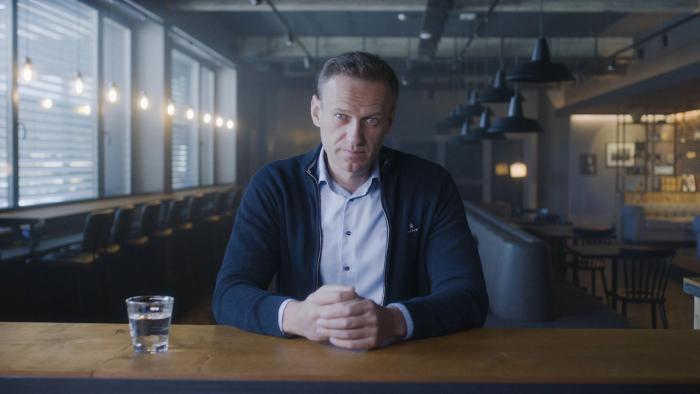
There’s almost no scenario in which Navalny could lose and Oscar this Sunday. A documentary centered on Putin’s biggest domestic rival, his poisoning, and his investigation into proving that he was, indeed, poisoned by Russian agents, is too much bait for the Academy on a normal year. But with the ceremony being held on March 12th, a year and two weeks since Putin’s invaded Ukraine, Academy voters will feel compelled to Send A Message by awarding Navalny the Oscar as a nod to Navalny the person.
But is it any good? Yeah, sure, it’s very compelling.
But is it politically responsible?
Oh boy.
Navalny falls into the “all-access-at-the-right-moment” format of journalistic documentaries. It follows Navalny during his recovery in Germany, after being poisoned in August 2020. The core of the film centers on how Navalny and his team, aided by investigative journalist Christo Grozev, managed to track down the team behind his positioning and get the lead scientist of the operation to confess all the details during a phone call. The documentary ends with Navalny’s return to Russia in 2021, his arrest, and the protests it triggered.
The documentary is careful not to blatantly put him on a pedestal, but the filmmakers make sure he is portrayed … well, as a Russian Jon Stewart: Funny, sardonic, self-aware, a family guy, and brave. In his career as an activist by way of political reporting, Navalny has clearly aped the blueprint set by The Daily Show and its alumni. This is, after all, a documentary made by and for English-speaking audiences, so it makes sense that the filmmakers and Navalny’s team would want to appeal to them as a point of reference.
Except for this one little thing, a little thing that the documentary touches upon but then quickly casts aside: Navalny’s actual ideology.
Let me clarify where I stand ideologically before this article gets misinterpreted by the wrong people: As a Democratic Socialist who leans Hawkish, I hate Putin with a magnicidal passion. I hate him more than the former guy because he propped-up the former guy and other fascists around the world, with whom he shares much more than the common interest of destroying democracies. I believe that the only solution to Russia’s authoritarian woes is for the Russian Empire and Muscovite control to collapse and lead to some sort of National Divorce (if I were more idealistic, I would say anarchism is a better solution). I also believe that Ukraine is a different country and culture altogether, that they should receive more weaponry from the West, and that they should be integrated into the EU once they kick back the Ruskies. But also, the Azov Batallion should be demobilized, de-armed, and denazified, at the very least. With all these nuances out of the way, what I am trying to say is that Navalny is not the solution to Russia’s authoritarianism; he’s probably a more charismatic and telegenic version of the same ultranationalist, reactionary sh**. And also antisemitic. The fact that so many Anglo Liberals are blind to this is … predictable.
Sure, Navalny has denounced Putin’s special military invasion. But when it comes to his past, there is his participation in ultranationalist rallies featuring Russian fascists, or his xenophobic comments on Russian Muslims in the North Caucasus, Central Asians (to Russia what Central Americans are to the US), supported the “special military operation” in South Ossetia in 2008, accusations of wantonly using slurs … so basically an average GOPer, but I guess that counts as “liberal” in Putin’s Russia. Yes, I’m aware that all of this has been amplified and weaponized by the Kremlin’s media machine (that is, all the media in Russia), in one of those classic acts of authoritarian hypocrisy. I mean, Navalny has been racist against the Chechens; Putin has actually killed hundreds of thousands of Chechen civilians.
Over the last few years, as he has gained visibility and support in “The West”, he has backtracked his previous stances and embraced basic tenets of Democratic Liberalism. When it comes to his association with ultranationalism, he has explained it as an attempt to create a broad, anti-Putin front, and as a way to “educate” and reach across the aisle. As if that has ever worked. Far-right movements will always gravitate towards supporting a government that is also authoritarian and reactionary, such as Putin’s, even if they oppose its corruption. Navalny’s direct link to ultranationalism cannot be explained, as some supporters do in the linked New Yorker article, as just a “civic nationalist” who wants to transform Russia in a “Democratic Nation-State”. The fact is, we would be right to suspect Navalny, because even in the unlikely scenario that the becomes President of the Russian Federation (or whatever is left of it in the future), there are too many red flags. Red flags which Ukrainians have called out for years.
Because the biggest mistake we could make, from the point of view of our Liberal and Semi-Liberal Democracies, is to think that a single man can effect positive transformative changes over a country. This should be obvious by now. But in Navalny’s case, as he deftly positioned himself as the sole opposition figure to Putin, he got almost the entirety of the Anglo Liberal Media to fall prey to the Great Man of History fallacy.
This is a simplistic take, but Russia’s history as an Empire proves what a disaster Great Men are. I guess in Russia’s case, more correctly, they should be called “Big Men” or “Larger-Than-Life Men”. Regardless of the title, Russia and its sphere of influence has been brutalized and held back by a succession of men who were too powerful and too unenlightened, even for the standards of their time. And that’s not counting what a certain pair Big Historical Figures did to Russia. Putin is just a successor to that legacy, and there are too many indications that Navalny would follow in a similar path. For actual insight, check analyst Kamil Galeev Twitter threads on Navalny, explaining how he is just another Moscow power player, representing Moscow’s centralized interests and control over the regions.
Navalny, the documentary, is yet another artifact of the naivety of English-speaking Liberals, always trying to frame other countries’ historical processes within their own, very limited experience, and their obsession with Biblical Happy Endings. They are addicted to narratives that prevent them from fully understanding the dynamics of the World outside the Anglosphere. And, as it has been proven time and time again, their own countries’ histories. They’re more refined, much more informed than their Conservative counterparts, but their capacity for analysis isn’t that far ahead. It shouldn’t surprise you that this documentary was produced by CNN Films. The documentary should’ve paid more attention to this framework instead of focusing on proving Navalny was poisoned by Putin. We didn’t need to “learn” about that, we know, the asshole has been doing that for decades now, in foreign soil, the bloody UK’s soil.
Alberto Cox would recommend CNN to do a documentary on an actual Democratic figure who was also poisoned by a dictator. Google one Eduardo Frei Montalva.


