Old School. Biblically Independent.
By Dustin Rowles | Film | June 22, 2026
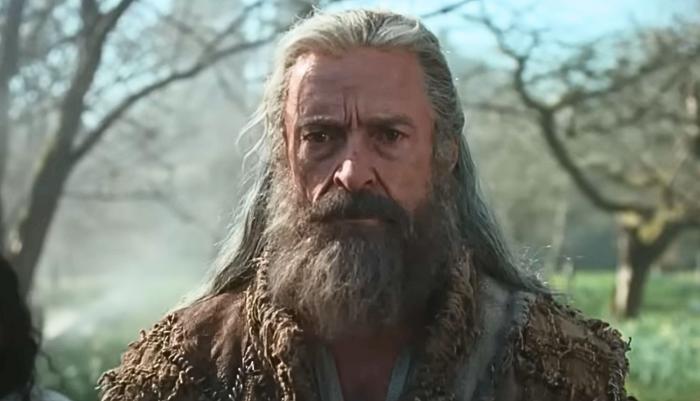
I will say upfront that I liked the idea behind Michael Sarnoski’s (A Quiet Place: Day One, Pig) The Death of Robin Hood. It’s a genuinely interesting concept — decidedly not Logan II, as I’d braced myself for — and I even found something poetic in how Robin Hood dies. Unfortunately, the Hugh Jackman movie is also bleak, grim, and interminable. It is not a summer blockbuster. It’s not even the “thriller” it’s advertised as. It moves like molasses dribbling uphill, and while the character’s ugly brutality is a novel swing, it never quite earns its place on the guy.
Jackman plays Robin the Outlaw, an older, nomad-like version of the character who mostly communicates in grunts and monosyllables. The twist with this Robin Hood is that his legend is almost entirely self-manufactured. He killed a lot of people early on, spun those killings into myths to recruit other outlaws into his band of not-so-merry men, and then they all went on to kill some more.
The trouble with killing people, though, is that it creates blood debts. Kill one guy, and his family comes for you; kill that family, and whoever’s left keeps coming. By the time he’s old, basically everyone Robin meets wants him dead — generations of debts are owed — and he keeps killing largely just to stay alive.
Early on, he reunites with his old, loyal friend Little John (a completely unrecognizable Bill Skarsgård), whose wife and daughter have been taken hostage by a family looking for revenge against the both of them. Robin wades back in to help, and the result is a bloodbath: Little John’s wife is killed, along with several members of the avenging family, and Robin himself is nearly gutted for good.
Little John drags Robin and his daughter to a monastery, where a healer, Sister Brigid (Jodie Comer), nurses him — now going by Randalph — back from the brink. Little John later dies, leaving his daughter, Little Margaret (Faith Delaney), in the care of Robin and Sister Brigid. While he heals, Robin also strikes up a friendship with a leper, Guy of Gisborne (Murray Bartlett, also unrecognizable), who more or less oversees the place.
A young man tied to the family Robin slaughtered in Little John’s name also turns up at the monastery, fully intending to kill him — but he’s played by Noah Jupe, so you already know nothing’s coming of it. Robin chases him off and settles into a quiet, decent life with Little Margaret, growing steadily closer to Sister Brigid, who’s come to see him as the monastery’s protector.
But on his deathbed, Guy confesses he’s known Robin’s true identity the whole time — and that Robin once killed someone he loved — though he forgives him anyway. His dying wish is that Robin never tell Sister Brigid the truth: that Robin is the one who killed her husband, the reason she became a nun in the first place.
Robin tells her anyway. He’s carried the guilt too long, and frankly, he’s killed so many people he doesn’t even remember her husband specifically. Sister Brigid, who also runs the orphanage, isn’t exactly eager to execute the man who protects her makeshift family — but he did slaughter her actual one, so she feels she owes it to them. Lucky for her, Robin’s been waiting for exactly this kind of death; the weight of all that killing has worn him down to nothing, and he lets her drain the blood from his arm over several days until he finally bleeds out — but not before handing Margaret one last myth to carry: that he and Little John stole silver from the rich and gave it to the poor.
It’s an exceedingly melancholy film, quiet and meditative — the grimdark Robin Hood you’d get if A24 made one. Sarnoski clearly executed the vision he set out to make, and Jackman, Comer, et al. all deliver exactly the performances he wanted from them. It’s just not particularly compelling. And while I have no quarrel with hideously unlikable characters on principle, I’m not sure this is the moment to retire the myth of a man who robbed the rich to feed the poor — not when billionaires have never had a tighter grip on everything. Mostly, though, it’s just a long, boring chore of a movie, delivering a payoff nowhere near as profound as Sarnoski clearly hoped.


