Old School. Biblically Independent.
By Kayleigh Donaldson | Film | October 14, 2026
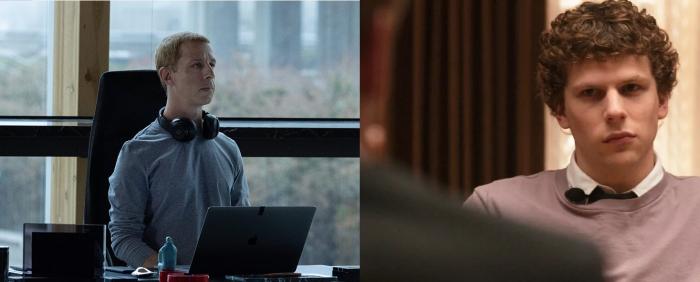
In The Social Reckoning, Mark Zuckerberg spends most of his screentime on a set. His advisors have recreated the conditions of the Senate hearing he's about to speak at, and they're training him to respond appropriately to questions regarding the purported liabilities of Facebook. People flutter around the side-lines, with some acting as his obedient goons while the one played by Bill Burr offers a contrarian perspective. Throughout it all, Zuckerberg sits at his table, stiff necked and reeking of entitlement. Jeremy Strong nails Zuckerberg's voice and blunt cadence, the voice of a man who never hears the word "No." Writer-director Aaron Sorkin has no qualms about depicting the Meta CEO as a callous brat who cares only for profit. But beneath that obvious surface, there's little to be mined in this film. You leave The Social Reckoning wondering how it got things so wrong where The Social Network got them right.
It's been almost 16 years since The Social Network premiered. Directed by David Fincher and written by Sorkin, the biographical drama on the creation of Facebook and fallout between its two founders was a massive success. Since then, the company now known as Meta has changed quite a bit, and all for the worse. The diseased conglomerate that owns Facebook, Instagram and Oculus has been embroiled in an endless series of scandals: the "pivot to video lie", Cambridge Analytica, culpability in a genocide in Myanmar, and pervert glasses, to name but a few. It's not hard to see why Sorkin felt the need to write a sequel.
The focus of his follow-up, he decided, would be the documents leak that led to the Wall Street Journal's "Facebook Files" reports. Led by former employee turned whistleblower Frances Haugen, the leak revealed Facebook's deliberate tweaking of its algorithm to keep users hooked, and their willing ignorance on how this led to increased hate speech, radicalization, and bullying across their platforms. There's logic behind this narrative choice. It's a rare moment where Facebook faced some tangible repercussions for their corrosive actions. But we all know how it ended. That's one of the many problems with The Social Reckoning, a film that felt out of date the moment Sorkin wrote it, and one that is hindered by its writer's old habits.
Sorkin is an oft-parodied writer whose style divides audiences. He's self-consciously unreal, aligned more with the screwball comedies of the '30s and '40s than the grounded grit of so-called "prestige" cinema. In his worlds, people talk the way we all wish we could: forever witty and well-timed in our quips, endlessly erudite and knowledgeable on whatever's being discussed, and able to put down our nemeses with a devastating one-liner. He's a man of fantasy, always has been. Like the golden age screenwriters of the old studio system, Sorkin's focus is on creating a sense of magic instead of realism. When it works, it sings. When it doesn't, you feel suffocated by smugness.
The latter is usually exacerbated by Sorkin's eagerness to send a Message to the audience. He has important things to say and he puts them into the mouths of important people: TV executives, politicians and aides, news anchors, lawyers, activists, and, of course, writers. He wants to show the solutions to all of our problems, albeit in a world where a great speech is the cure for whatever ails us. Being the smart one makes you the hero, and it works every single time. That fantasy worked amazingly for The West Wing, an idealized response to the GWB era when a lot of people yearned for a competent administration. It was less effective with Studio 60 on the Sunset Strip, where sketch comedy writers on the least funny show imaginable were battling for primetime attention.
The Social Network isn't a film about Facebook, not really. It's the story of two guys whose friendship crumbles after a betrayal. Zuckerberg and Eduardo Saverin (played by Jesse Eisenberg and Andrew Garfield) have a real bond when we first meet them, a dynamic that feels lived-in and familiar. It stings when Mark sells out Eduardo, when his previously dickish petulance slides all the way into active cruelty. He made the call, he chose to screw over someone he once cared about, and it stings.
Sorkin has expressed some discomfort with how many people reacted to The Social Network, admitting that some bros loved his fast-talking, smarter-than-you, "I'm CEO, bitch" take on Zuckerberg. Certainly, he faced some criticisms at the time that he made the notoriously gormless charisma vacuum into someone with a flinty charisma, and given what Zuckerberg evolved into, perhaps it wasn't a good idea to massage his public image in such a manner. It was hardly "Trump on SNL" levels of egregious but I get Sorkin's concern. Still, I think that overlooks the power of The Social Network's ending. Mark has all the money in the world, everyone knows him, and Facebook is a certified game changer, but he still can't get his ex-girlfriend to friend him back.
This Zuckerberg evolves from a jerk to a jerk with power. By the end of the film, he has found a way to become obscenely successful through the sheer force of his ruthlessness. The off-putting personality that led him to be dumped in the opening scene and read to filth by Rooney Mara has paid off. He never again has to acquiesce to someone else's rules. And still, his "victory" in that closing scene is to hit refresh over and over again, knowing that not even owning the damn site will make someone want to be his friend on it. It captured the tech bro conundrum that, alas, defines society in 2026: the richest men on the planet will try to destroy it because nobody thinks they're cool.
With The Social Reckoning, Zuckerberg doesn't have an arc. Sorkin isn't interested in his internality, which I don't blame him for. The man himself is probably an emotionally immature jerk who doesn't think twice about societal ruin so long as it makes him an extra couple of bucks. But on-screen, in a medium that demands stakes, it plays out as one scene after another of Zuckerberg being stony-faced and defensive. He still gets a few decent quips in because Sorkin cannot help himself, but none of it satisfies. Why does he call himself a free speech absolutist? Is that his real opinion or one driven by money? And what about his paranoia over assassination attempts, which is only hinted at. There are glimmers to be mined, but Sorkin sweeps past them in favour of one-liners. All Jeremy Strong can do to fill the time is try to evoke his cold heart through unmoving physicality that makes him seem constipated.
There are certain tropes Sorkin seems reluctant to relieve himself of. He loves a strawman for the hero to eviscerate, and if she's a woman then all the more so. Poor Frances Haugen is turned into a fidgety toddler for a man to talk down to, usually while she's in a skimpy dress (and the film has to go out of its way to engineer a flimsy reason for her to wear it.) Often, he has no stronger defence of weak plotting or narrative arcs than "because I said so." It's particularly evident when his characterisations are at their weakest. A meaty monologue isn't necessarily an agreeable substitute for a personality. See how Being the Ricardos turned the process of Lucille Ball's comedy into speeches and self-importance (typically given by Desi Arnaz.) A great director can rein it in or well-chosen actors can find the chemistry necessary to paper over the cracks. Fincher and Sorkin had it with The Social Network. Sorkin solo does not have it in The Social Reckoning.
Aside from poor casting and a distinct lack of directorial flair, The Social Reckoning is hobbled by a Sorkinese conflict. He wants to show the bad guys getting their just desserts for cinematic satisfaction, but the truth contradicts that. Sorkin wants to stick it to the man without changing his own self-satisfied skills as a writer, but if any story called for a stripped down and methodical approach, it's this one. This needed to be a story of the banality of evil, which is a concept at odds with screwball dialogue and an air punch of victory. Perhaps a story of the current Zuckerberg, the one who hangs out with Trump and Joe Rogan, needed a more wry or clinical perspective. Imagine Yorgos Lanthimos directing this. Or remove Zuckerberg entirely and have him be the invisible spectre that haunts a wider ensemble piece showing the radicalisation that Facebook willingly fostered among its users.
The Social Reckoning expects its audience's hatred of Meta and Zuckerberg to do all the heavy lifting in lieu of making its characters more than mouthpieces for an ongoing discourse. Its predecessor had to build real people into characters worth investing in, and so the story of Facebook became an intriguing parallel to its human inventors. By the end of the sequel, you get the sense that it was made because Sorkin felt obliged. It may be that men like Mark Zuckerberg are too beyond the reaches of empathy to be of cinematic interest, or that viewers do not wish to see inside his melted brain. Certainly, the heady rush of a classic tale of treachery that was The Social Network was a better fit for Sorkin than a state of the nation treatise with a pantomime villain's decline. When Zuckerberg does fall--and I believe he will, one day--the cinematic autopsy of his life will need more than quips to make sense.


