
Old School. Biblically Independent.
By Kayleigh Donaldson | Film | January 23, 2026
Warning: This piece contains mild spoilers for 28 Years Later: The Bone Temple.
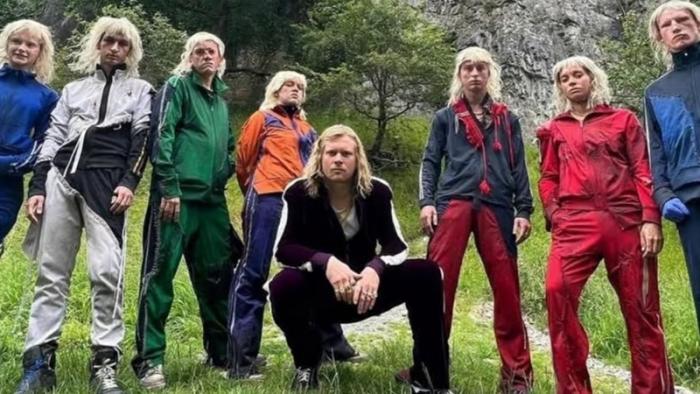
At the end of 28 Years Later, we get a reveal so unexpected that I literally gasped when I saw it. The young Spike, who has lost his mother and left behind his father and newborn sister to venture onto the mainland, is saved from a pack of zombies by a gang of tracksuit-wearing thugs. They all wear ratty white-blonde wigs. Their leader is named Sir Lord Jimmy Crystal. He has a Scottish accent but his cadence is instantly familiar to those in the know. Here is a post-apocalyptic cult themed after Jimmy Savile. Reader, the response from this Brit was one of bafflement.
I’ve no idea how that moment played to Americans or those who do not bear the stifling weight of knowledge regarding Savile’s cultural footprint and his decades-long campaign of abuse. Did you guys just think these were random British teens or something? I’ve seen some people on social media dressed as the Jimmies for Halloween, which felt so deeply wrong that I have to hope they never once googled anything to do with 28 Years Later. Ignorance is, indeed, bliss. With the follow-up film, The Bone Temple, the focus falls squarely upon the Jimmies, and screenwriter Alex Garland has offered a nervy examination of a dark chapter of British history we’ve never fully confronted.
For those who don’t know, here’s a brief summary of Jimmy Savile. He was a DJ and TV presenter who was a constant on British screens for well over 40 years. He hosted Top of the Pops and Jim’ll Fix It, becoming popular with youth audiences before aging into a ‘national treasure.’ For decades, he seemed to be the most committed philanthropist and charity fundraiser in the country, which earned him a knighthood and the acquaintance of royals and politicians alike. Pope John Paul II gave him a papal knighthood in 1990. When he died in 2011 at the age of 84, his gold coffin was driven through the streets to applause.
Immediately after Savile’s death, the BBC began a TV investigation for the programme Newsnight into extensive reports that he was a sexual abuser. That programme was withdrawn before broadcast, while the channel aired two Savile tributes during that period. Eventually, a year after his death, ITV aired a documentary that revealed claims from at least 10 women that Savile had raped or molested them. One victim was 14 when it happened. Soon, literally hundreds of allegations emerged from decades past. Some have theorized that Savile may be responsible for the abuse of literally a thousand-plus people. He’s now known in death as the most prolific sex criminal in British history, and a symbol of a culture of culpability.
Given the 28 years that have passed in the universe of the franchise, the Jimmies of this world are unlikely to have known much about Savile beyond the aesthetic and ‘always on TV’ status that was probably on the fringes of their childhood memories. This is a world where he died unrevealed, an aside nobody thought about as the zombie epidemic ravaged the nation. Maybe many people still living in this time think of him fondly, a remnant of an old life in the same way that the Jimmies talk about the Teletubbies. There are probably others who knew the truth and just have to live with it because justice is now a fantasy concept. In the film, Ralph Fiennes’ character, a doctor who is a good couple of decades older than the Jimmies, admits that he has very few memories of his life before the outbreak. The before times are myth, a near-ephemeral concept it’s pointless to cling to, and yet how can we stop ourselves from doing so? Nothing was bad in the other timeline.
The rose-tinted glasses of nostalgia were ripped from our faces after Savile’s death. Suddenly all those red flags were impossible to ignore. Savile concealed himself with the truth. He looked, dressed, and acted like, well, a sex criminal, and that became his shield. Being a so-called national treasure, a charitable figure endorsed by princes and popes alike, was a defence from open acts of lechery. Yeah, he’s a bit weird but that’s just Jimmy. Eccentric, but not gross, right? And if you ever had an issue with that, it was your problem. There’s a striking moment in Louis Theroux’s documentary about him where he undresses in the middle of the office while women try to work, and it’s allowed to happen because who’s going to tell him no? He was always pushing boundaries like that and getting away with it.
With the Jimmies, they relish in this ability to create discomfort under the guise of quirkiness. They break into a family’s home and demand hospitality, giddy with the knowledge that everyone knows this will end in murder. They speak of ‘charity’ endlessly, which translates to bloodlust and abject cruelty towards those who do not bend the knee. And they’re all doing this in the name of worshipping Satan, who they call Old Nick. For the audience member imbued with context, it’s a notion that is perhaps too on the nose. Is the truth finding a way to break through the madness of this timeline?
Both 28 Years Later films are steeped in ideas of Britishness and the political scars that tore into the nation long before the zombies did. How this this country’s penchant for ‘Keep Calm and Carry On’ wistful stiff-upper-lip reminiscence play out when our tedious adoration of ‘the good old days’ has a pretty sturdy reason to exist? What do we cling to when society as we know it - the one Thatcher claimed there was no such thing as - falls into ruins? For the Jimmies, it seems the thing they’ve clung to is an echo of a memory from their parents’ past, that of a colourful figure who seemed to do lots of good and whose cult of personality had an unnerving thrall over millions. If you’re going to start up a Satanic cult with a taste for flesh, you could do worse for an idol.
Perhaps it’s a sign that the film has done its job when so many non-Brits saw some villains with a quirky aesthetic and giddily embraced it for Halloween costumes and fanart. The dazzle of the gold rings and blonde wigs remains potent. It’s less about idolizing a monster than it is for cherry-picking images and aesthetics that look the part and strengthen your own ideas. The symbolism of Savile to those who know it is one of unfettered evil made mightier by a culture of culpability. If he hadn’t been exposed as an abuser of literally thousands of people, would his supporters watch footage of him being creepy to teenage girls on his TV show and just dismiss it as being of its time? Selective memory, the cherry-picking of identity and good-old British power, is a brutal force that’s tough to defang. The zombies seem easier by comparison.


