Old School. Biblically Independent.
By Lindsay Traves | Film | September 21, 2026
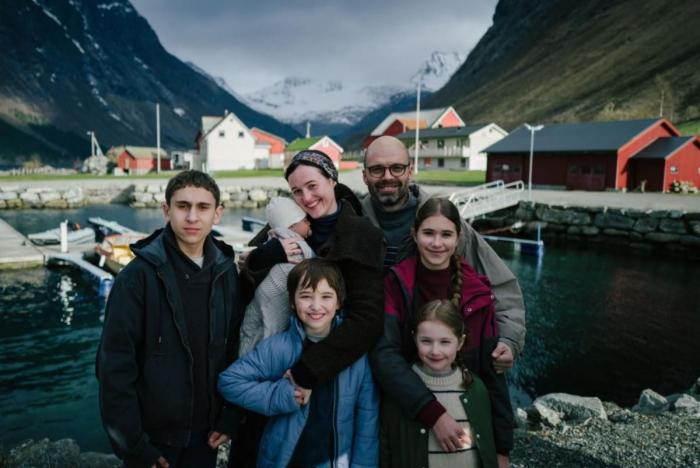
It was a bit of sabotage for tiff to play this slow burn feature to a festival audience at 9:30pm. Trickling in after opening night cocktails and managing a hype driven lineup, audiences were asked to take in a dour and moody film late into the evening, one that toggles between different languages but not intonation. But between the muffled yawns and the quiet leg shifts were scenes of a poignant and powerful legal drama that asks us to question the places in which we find allegiance and what different kinds of oppression and suppression can look like.
Sebatian Stan and Renate Reinsve lead at Mihai and Lisbet Gheorghius, a couple who relocates from his native Romania to her native Norway with their children. The religious Christian family makes fast friends of their neighbors and colleagues, but their idyllic new life is thrown into turmoil when they’re accused of child abuse. Brought under scrutiny by dutiful teachers and a far-reaching child services arm, the family is broken apart and the parents investigated and tried for beating their children. Cultures clash between the uber-progressive secular Norwegians and the conservative Christian Gheorghius family who admits they subject their children to strict religious rules and the odd smack on the behind. Desperate to clear their names and get their children back, Mihai and Lisbet exercise their different avenues and end up becoming beacons for the religious freedoms of the Christian right.
Though there is something to be said about the variance between the approaches of Mihai and Lisbet, in the end, they’re both desperate parents trying to win back their children and save their family. To them, Norway’s version of secularism is an oppressive dissent to their Christian ideals and Fjord asks you to consider whether progressivism is tied into a nation that seems to be kidnapping children. In the middle is Mia (Lisa Carlehed), a neighbor and lawyer who steps in to assist them, shaking the dust off of her litigation skills. Mia represents the letter of the law. She takes no opinion on the religious position of the family, and insists on litigating the facts of the matter at hand- whether the Gheorghius’s abuse their children- ignoring the inflammatory remarks about their chosen way of life. She is up against a salacious trial wherein language, culture, and Christian ideals are on trial, in the court of law and the court of public opinion. This leads to her as the neutral conduit experiencing from the sidelines the implications of Mihail’s chosen allies.
A shallower reading of the film might say it’s an indictment of oppressive progressives, something that might feel poignant to anyone whose language has been policed online, for instance, but there’s more to it than that. It’s about choosing support from perhaps the wrong places, making deals with devils, and where arguments of fact become intertwined with arguments of context and culture.
Those who’ve followed their festival darling appearances won’t be surprised to hear that Stan and Reinsve are phenomenal. The two play in writer/ director Cristian Mungui’s piece so well, as the stoic and calm European parents, Stan only blasting through when sharpness is in demand. As Lisbet, Reinsve plays a character who is meek and somehow icy in her pragmatic way of helping her neighbor. To her, to preach is to save, and to be a member of a community is a duty.
Fjord struggles, perhaps in a way that becomes a meta matter of culture, by being so calm and dour in its approach. It’s not the high-tempo court case of a legal thriller, but a quiet story set within a remote town where everyone speaks matter-of-factly, even when slicing their own wrists. I admire Mungiu’s manner of forcing us to play into the intended tone and pace, but need to admit that in a late night screening, I often had to hold open my own eyelids lest I miss a subtitle.
Fjord played the Toronto International Film Festival and is expected to have a 2026 release from Neon and Elevation Pictures.


