Old School. Biblically Independent.
By Kayleigh Donaldson | Celebrity | April 22, 2026
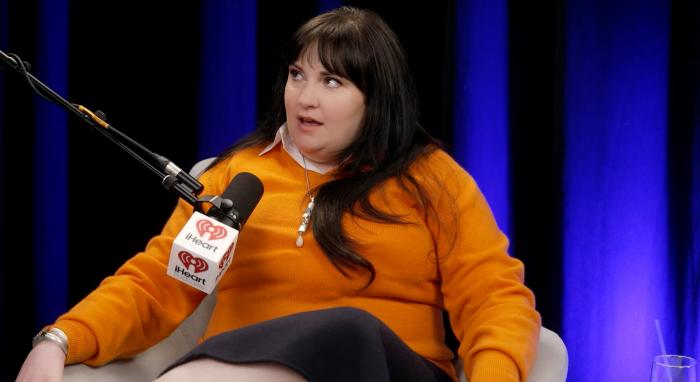
You knew, from the moment it was announced that Lena Dunham was writing a memoir, how you would feel about it. You instinctively knew whether you were going to buy it or avoid it like the plague, or, more likely, read someone else's coverage of it. The writer-director of HBO's Girls has laid low for the past few years, preferring life behind the camera on productions like Catherine, Called Birdy and Too Much. She now lives in England with her husband, largely avoiding internet life as she deals with chronic pain. It's a far cry from the days where every single thing she said or did resulted in a think-piece. But, of course, she is still a lightning rod for a particular kind of discourse, and the arrival of her new book, Famesick, reignited those fires. I knew we were nostalgic for the early 2010s, for some reason, but maybe this is too far.
Dunham's book details her speedy rise to fame, going from hanging around with the mumblecore set and making a movie in her parents' house to landing a HBO deal before she was 25 and becoming the unwitting face of the privileged white lady millennial set. As she fulfils all her creative dreams, she finds herself struggling with myriad health issues, a toxic relationship with her creative partner Jenni Konner, and a romance with producer Jack Antonoff that falls apart through infidelity and a PowerPoint presentation.
Reading Famesick, I couldn't help but be reminded of Adult Braces, the new memoir from Lindy West that also became an online think-piece generator. The books don't really have much in common beyond their humour and indulgences in overshare, but both Dunham and West are seen as representative of a near-past of internet Discourse. They were young, loud, endlessly mocked for their looks, and unafraid to call themselves feminists. They made their names through self-lacerations that could be revealing and occasionally discomfiting. A lot of people hated them. Dunham, in particular, could be careless and dunderheaded on a lot of topics.
I'm not here to relitigate every single thing Dunham has said or done, and how we reacted to them. Again, if you're aware of Dunham then the chances are you know most of this already. She knows that too, although she mercifully avoids turning Famesick into a numbered list of topics to respond to. That's not to say she doesn't feel required to mention some of them. She calls herself a nepo baby at one point, calling back to the criticisms that she only got a HBO show because her parents are niche artists. The lack of diversity on her New York-set series is also talked about. She's candid about how her overshare impacted her family, particularly her brother, Cyrus (the hero of the book, by the way, is Lena's dad, Carroll Dunham, a man with zero filter and a blunt view of the world who can see danger coming from a mile away.)
As with all celebrity memoirs, you come for the gossip. You're here for news of Adam Driver being a method actor jerk who takes his work way too seriously but is also impossibly alluring while doing it (Lena, I get the crush, just saying.) You're here for stories of Jack Antonoff, Dunham's ex-boyfriend and mega-producer, whose closeness with Lorde left Dunham feeling hugely insecure. Personally, I was most fascinated by her relationship with Konner. Dunham describes a kind of dependency on the older woman and industry professional she was paired with to bring Girls to life, one that often blinded her to how cruelly she was treated.
But for every moment of criticism against someone else, Dunham feels the need to itemise her many faults and all the things she must have said or done wrong to irritate the other person. It's like she can hear the Reddit snark thread responses in her head and wants to pre-empt them, not exactly a surprise for someone whose work is so self-lacerating but occasionally a touch overwhelming to read. Then again, the book is very good at capturing what it's like to be smothered by your own insecurities.
If anything lingers with Famesick, its Dunham's self-portrait of her health and how surviving in a world where women's bodies are never taken seriously almost led her to ruin. She visits doctors while doubled over in pain and is ignored. She became reliant on medications for anxiety and PTSD to the point where she ended up in rehab for addiction. Even with good health insurance, the battle to be listened to was arduous, and you'll find yourself as furious as she is at the many "experts" who all but outright said they thought she was lying. It's a moment of tragic victory when she undergoes surgery and a doctor removes no fewer than 37 lesions from her organs. He tells her he doesn't even know how she's been able to walk.
But then there are moments where you roll your eyes so heavily that they risk falling out of your skull. Perhaps the most objectionable thing Dunham has ever done is release a statement in which she defended one of her show's writers, Murray Miller, against a charge of rape made by actress Aurora Perrineau. Dunham and Konner claimed that they had super-secret information that proved Perrineau was lying, but it took very little time for her to admit that this wasn't the case. A Black woman accused one of Dunham's friends of assault and Dunham leapt to defend him, declaring that "Our insider knowledge of Murray's situation makes us confident that, sadly, this accusation is one of the 3% of assault cases that are misreported each year."
She later retracted her claims and apologised. In Famesick, she calls the incident, for lack of a better term, "the one thing in my career, my life, about which I felt - feel, still - genuine shame." She remains, understandably, vague on some of the details to protect Perrineau and not retraumatize her. Dunham then explains that the statement came together while she was recovering from a hysterectomy, and that, while struggling with the grief and physical pain of it, "I was so deep in my own distress that I had ceased to imagine or invest in anyone else's." It is certainly an explanation and not an excuse, and one that will be tough to swallow for many. I admit, I read this moment with heavy scepticism. It had to be addressed and I'm not sure what the "proper" was to do so was. Any response would probably elicit some level of annoyance given the gravity of what she did. In a book built on the embrace of messiness, this is the one part where it's clear Dunham feels adrift from her own sense of self-awareness.
With Lindy West's book, I and many others wondered the same question: why be so brutally honest in this way for such a brutal audience, and for so little in return? With Dunham, I wondered similarly, although the answers seemed clearer. Dunham does this because it's how she's always done things. Her art, even at its least autobiographical, has been powered by a kind of candour that revels in the awkwardness it creates. It's not meant to offer easy solutions to life's problems. Every happy ending is a mere comma to a wider story where there will be hills and valleys of joy and suffering before the full stop. It's what makes Too Much, my personal favourite of her work, so powerful to me. It's also what makes her so aggravating to many. She seems aware of that, but why stop now? Unlike with West, whose book has reportedly been a flop, it actually works for Dunham (also, she's not spending 300 pages trying to convince us to sympathise with a cheating jerk, so that helps.)
So, why read the book? Well, because it's pretty good. Dunham is a funny and whip-smart writer who offers some intriguing insights into the world of mumblecore cinema and Peak TV, through the lens of someone who is equal parts self-aware and oblivious. She's savvy enough with her self-lacerations to get ahead of some of her audience's inevitable criticisms, but then she'll distance herself from a mess so large that you wonder if this is the same author. Here is a woman who has dealt with a lot, some unfairly and some not, and for every lesson she's learned, there's another where she feels stubbornly stuck in her place. Consistency in self-reflection is tough to pull off.
It's been easy for the usual suspects to claim that the millennial feminist era was nothing but a skew of bad takes and narcissism (seriously, why did so many TERFs review West's book?), but in the cold light of 2026 where the manosphere dominates, I do miss the no-holds-barred brashness of women saying the F word. Dunham always felt like a talented woman stifled by her need to be everything and everyone at once, at a time when audiences and cultural conversations were more heightened around topics of inclusivity and privilege. The more she put her foot in her mouth, the more we just wanted her to pull back. Now that she has, and she's about to turn 40 without endless articles written about her weight and tweets, she's given us something akin to an autopsy. She's learned but she's also built her art on never stopping, so why give it up now? It is, if I dare say so, kind of relatable.
But admit it, you knew whether or not you were going to read the book long before you clicked on this review.
Famesick is available in bookstores now.


