Old School. Biblically Independent.
By Kayleigh Donaldson | Celebrity | May 14, 2026
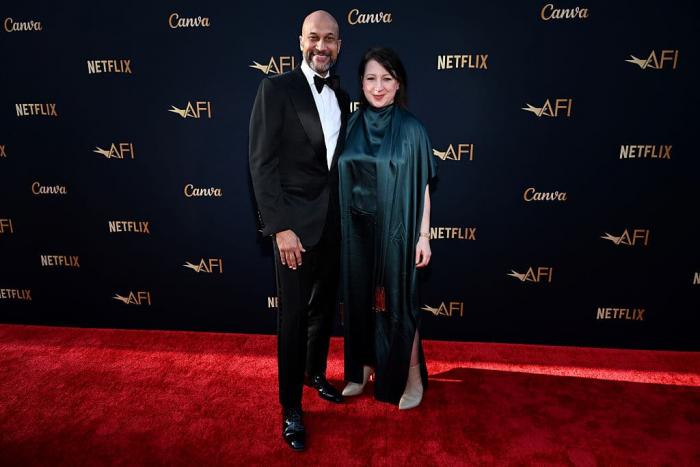
Hey, have you heard the story of Lock and Banana? When writer and comedian Akilah Hughes shared a juicy story online, it didn’t take long for people to figure out who she was talking about, and for her eye-opening claims to go viral. To sum it up as quickly as I can: Hughes revealed that her dream project of a sketch comedy pilot was hobbled in part by Hollywood being Hollywood but also, in part, by her celebrity collaborator’s infuriating and potentially dangerous wife. She used code words throughout but they were hilariously obvious, by design. Lock and Banana were, of course, Keegan-Michael Key and Jordan Peele, and in Hughes’s telling, the pair’s lack of collaboration from the past several years is rooted in Key’s wife, “producer” Elle Key, being such a troublemaker that she’s led to her husband losing work. I recommend you check out the full video for every agonizing detail.
After the internet did its thing, guided along by Hughes, who took a lot of pleasure in her viral moment. Then, a “source” close to Elle Key ran to TMZ to insist that the whole story was false. This was widely agreed to have been a bad move on her part. There’s a sizeable difference in audience between a YouTuber’s spoken word performance (complete with jazz music accompaniment) and an exclusive from one of the most widely read internet tabloids. If you didn’t know about Lock and Banana before that, you certainly knew now, and all of a sudden, people began digging up clips of Elle Key and analysing her constant interruptions of Keegan during interviews. A few old blind items reemerged. Reddit went wild. If you search Keegan-Michael Key on Google, this video is on page one. Call Barbra Streisand because the effect was in action.
Blind items are an old part of celebrity gossip. Their origins date back to the late-1800s, when William d’Alton Mann, the publisher of a New York society paper, Town Topics, used them to blackmail people. That practice continued for decades afterward. Hollywood magazines like Confidential and newspaper columnists like Walter Witchell used blind items to not-so-subtly reveal the seedy secrets of the rich and famous in a way that would skirt libel laws. It didn’t always work — Confidential was sued on several occasions for the falsehoods it published — but the blind item retained its potency nonetheless. It felt like a puzzle for the reader to solve, a cheeky and perhaps powerful insight into a whole new world.
Some blind items are near-indecipherable while others may as well yell the names of the subjects from the rooftops. They often make references to projects the person was involved in, or lines from their movies or songs. The ideal blind item is one that requires a bit of work to figure out. You’re trying to give your audience a reward, after all. But the item itself should, generally speaking, be pretty low-stakes. People want a blind item to be fun and there’s no joy to be mined from revelations over, say, a violent household or a chronic illness. Those aren’t uncommon occurrences in this format, but they tend to be outnumbered by the likes of Deuxmoi, which shares things like upcoming movie castings or rumoured engagements and splits (they also have a bad habit of sharing everything, even transparent nonsense, although they’ve gotten somewhat better at filtering out the rot.)
Is there a way to truly trust a blind item? When the columnists of Hollywood’s golden age used them, we were at least aware, maybe only in hindsight, that a studio head somewhere was the source. Whether the gossip itself was true or not was tougher to verify, and it was often used to keep talent in their place, but we know the intent of such blinds. Now, anyone can say whatever they want online with impunity and there are very few foundations in place to stop the spread. Deuxmoi is notorious for this but so are randos on TikTok who claim to be insiders but largely spew bigoted crap at women who have dared to speak out over abusive experiences.
The intent of blinds hasn’t exactly gotten more progressive. Harvey Weinstein loved to plant blind items in the press to smear women as difficult if they dared to reject his advances. Crazy Days and Nights, a cesspool of bigotry and lies (and a site with a literal disclaimer that admits they make sh*t up), has provided a steady stream of increasingly conspiratorial dreck to a gullible audience for many years. But a lot of us are used to speaking in blind items. We share news about people or topics in hushed tones, keeping out names or incriminating details but retaining the basic foundations so that we can warn friends about that creep we saw in a bar one night, or the boss with a reputation for being handsy. In many ways, gossip is the language of the margins, a way to puncture myths and bypass the spin. Sometimes, it feels necessary to keep it blind, especially when you’re surrounded by litigious bullies with money and power.
But what to make of the story of Lock and Banana? It’s not hard to see why it went viral. It’s juicy, fills in a narrative many have wondered about for years, and provides audiences with an easy villain. Akilah Hughes doesn’t seem to have an obvious reason to lie about something this specific, and her claims do line up with a few things I’d heard about the Keys in the past. As with most gossip, of course, it’s more about believability than verifiable truth. This story sounds like it could be real, and there’s enough kindling on the fire to help it spread. I get why this is a fun thing. I had fun with it.
There’s one detail in it that really stuck with me in a bleak way, though. Hughes recounts receiving an unexpected and very long phone call from “Mrs. Banana”, which is presumably Jordan Peele’s wife, comedian and actress Chelsea Peretti. In that call, Peretti allegedly claimed that she wouldn’t trust Elle Key to hold a baby, that she’d poured alcohol over Chelsea’s birthday cake despite her being 15 years sober, and that she reminded Chelsea of Brynn Hartman, the wife of Phil Hartman who killed him then herself.
Brynn Hartman has become a byword for a kind of craven, untalented but ambitious trophy wife who will drag her husband into the gutter if she doesn’t get her way (I wrote about the case for my newsletter, for anyone who’s interested.) That Peretti would allegedly invoke her to describe the wife of a good friend was the moment when the blind item became deeply insidious to me. I wondered how Peretti would feel about Hughes turning it into a major punchline in her blind item bridge-burning session. I wondered if that video was the first time Keegan-Michael Key heard his friend make that comparison. I wondered if Elle Key really was that similar to a someone whose life ended in a murder-suicide, and if she knew that more people would hear that line once her “source” amplified Hughes’ video.
This story has stuck with me because of that. Hughes got her viral moment and has dismissed criticisms that she went too far in revealing Peretti’s concerns because, according to her, she’s a hero in the story. Social media is now full of people hyper-analysing Instagram posts for proof to back up Hughes’ claims. There’s a spectacle emerging that feels like it can only end in a bad way. Blind items need to simplify things to make the point land with a punch. They need to be fizzy, not gawking, or the illusion falls apart. Because now, truly, all I can think about with this story is Brynn Hartman and how that ended. I doubt that’s what Hughes wanted. I think she just desired a viral moment and a chance to settle some scores. That’s what blind items are for, after all. Sometimes, history really does repeat itself.


