Old School. Biblically Independent.
By Kayleigh Donaldson | Celebrity | February 9, 2026
For most of Hollywood's history, red carpet fashion was not a thing. Sure, stars dressed well for big events like the Oscars, but it wasn't a multi-pronged industry connected to the fashion world where millions of dollars changed hands. Maybe you were lucky enough to have an existing relationship with a designer, like Audrey Hepburn and her career-long collaboration with Givenchy, but largely, red carpets were work events where you just picked something nice out of your wardrobe.
That began to change in the early 1990s, as both fashion and entertainment realised the benefits of a sympatico relationship. Some dresses became Moments that helped to elevate a designer's profile: Cindy Crawford in red, Elizabeth Hurley's safety pin Versace dress, Gwyneth winning her Oscar in pink. Red carpet coverage became bigger, as much a part of the evening as the ceremonies themselves. Networks like E! became the de-facto HQs of this new brand of celebrity coverage, and with it came a legendary comedienne who pioneered fashion trash talk, for better and worse.
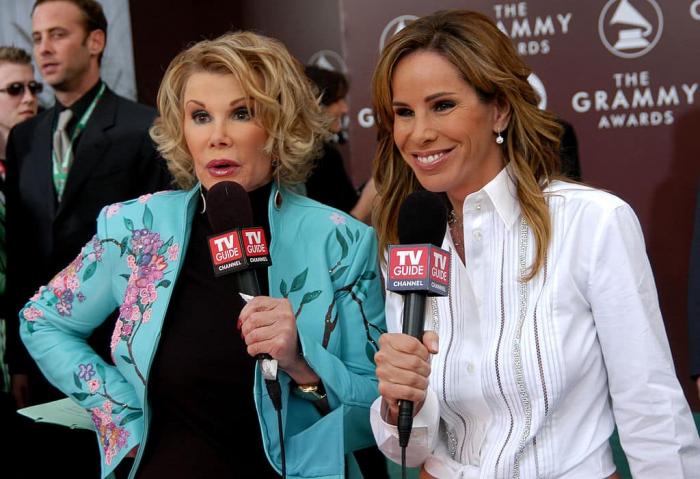
We could be here all day talking about the life and times of Joan Rivers. She remains one of the most important and influential comics of the 20th century, a glass-ceiling breaking funny woman whose scathing wit and workhorse mentality kept her in the headlines for decades. In the early '90s, she had her daytime talk show, a few TV movies and game show gigs, and a QVC product line that helped her to get back on top after some financial issues following the death of her husband. In 1994, she and her daughter Melissa were invited to host the E! Network's pre-awards show for that year's Golden Globes.
They were an instant hit. Audiences loved the Rivers women's casualness and lack of formality. Audiences liked their coziness with the stars, and the celebrities appreciated the fun atmosphere they created on the assembly line of questions and answers that is usually a thankless task. Celebs loved playing along with the Joan of it all, and her 'Who are you wearing?' questions brought a lot of extra publicity to fashion houses and their work. it seemed like a win for everyone. Joan Rivers talked frequently about how her aim was not to be needlessly bitchy but to represent the normal person watching the red carpet at home who's gabbing about the ugly dresses and to their best friends on the couch. It added a relatable sheen to proceedings, but the problem with the rise of the Rivers touch was that, unlike your snarky living room chats, the industry was listening.
A Vanity Fair piece from 2014 quotes Women's Wear Daily executive editor Bridget Foley on the moment where the red carpet became 'the melting pot of mundane.' In 1997, Nicole Kidman wore a silk and fur dress by John Galliano for Dior that was a red letter moment for red carpet fashion. Melissa Rivers loved it. Joan said it was ugly. And she wanted Nicole herself to know how much she hated it. Joan yelled, "Nicole! Come tell me why you wore such an ugly color!" Whether the actress heard or not, she walked past Rivers, who kept screaming. "I hate that color! You are making me puke!" She then made retching noises.
Fashion critics hated Rivers but audiences loved her, and even though she proudly admitted she knew nothing about the world of fashion beyond her own tastes, she became a defining voice of the scene. Everyone was a critic now, and for those in the dresses, the fear of being publicly trashed as ugly and fat and trashy was very real. As Vanity Fair put it, the Rivers-esque smackdowns "led to stars seeking out stylists and straying from riskier red-carpet ensembles." It also led to a lot of copycats trailing the red carpet hoping to have their own pre-social media equivalent of viral moments. Remember when Isaac Mizrahi groped Scarlett Johansson?
The Rivers women eventually stepped away from the red carpet scene but reemerged as its fiercest critics when E! launched Fashion Police in 2010. As well as discussing the outfits of the week, the panel had segments such as 'Starlet or Streetwalker', in which a photograph of a person with their face obscured was shown and people had to guess if it was a major celebrity or a sex worker, and 'Slut Cut', where celebrities were called out for having their dresses altered to be shorter than the runway originals. While one of the panellists was an actual stylist, comedy took precedence over critique, as it has always done under Rivers' reign.
Watching of Fashion Police clips is an odd experience because it was ultimately a show not all that interested in the business of fashion. Sure, you'd have a stylist on-air now and then offering titbits on tailoring or the like, but mostly, the series was there to use clothes as a platform for jokes about celebrities and their bodies. Rivers was a roast comedian who built herself up as the one who could always take the big A-Listers down a peg or two. Sometimes, she was on the ball. By the time Fashion Police was on the air, she mostly relied on transphobia, hating fat people, and comparing women to 'streetwalkers.' Listening to her co-hosts try to keep up with that level of meanness without the ability to land a joke clearly written for them by someone else just drove home the witlessness of it all. Did I laugh at some clips? Yeah, because once upon a time, Joan Rivers was the best and you saw glimpses of that even in her final years. But jeez, hearing her constantly say that Khloe Kardashian was a fat man in woman's clothing? Pass.
Rivers got away with a lot because she was forever committed to the bit. After her death in 2014, as Fashion Police tried to limp forward without her, it didn't take long for the mean fashion formula to fall apart. Giuliana Rancic, one of the E! Network's longest-running presenters, aimed for Joan-esque snark and landed straight into racism when she said that Zendaya's dreadlocks looked as though they smelled of 'patchouli oil and weed.' The backlash was swift, with Zendaya herself calling out the transparent misogynoir and racist stereotyping of this 'joke.' Rancic apologised but the damage was done. The show would be put on hiatus in 2015 after a brief run with Kathy Griffin as host didn't work, and E! has never brought the show back.
It's not that we have to be 100% kind about red carpet choices in 2026. There are plenty of hot messes for us to call out, and with such big money on the line, it's hardly a battle of underdogs. Margot Robbie spent years being forced into ugly clothes through her Chanel contract and darn it we had to talk about it! But writers and fans are more cognisant of the business and its myriad issues: bad fittings, decline in couture quality, a continued failure to appeal to diverse body shapes, etc. We also know the biz of stylists, some of whom are now big names in their own right like Law Roach and Harry Lambert. Expectations are higher for red carpets now, especially in a post-Barbie world where theme dressing is now an expectation for an actor on the promotional trail. There's a whole ecosystem in play to discuss when we, say, look at Alexander Skarsgard in a leather halter top.
And the mundane days of achingly curated stylistic sameness do seem to be over. Straight guys wear pearls and couture. Stars like Tracee Ellis Ross, Gwendoline Christie, Bad Bunny, and, yes, Zendaya are eager to experiment with non-traditional outfits that would surely have earned a cruel jab from Joan Rivers. But surely there's more fun to be mined from embracing the unpredictability of fashion than wearing another strappy black gown and hoping nobody's snarky about it?


