Old School. Biblically Independent.
By Kayleigh Donaldson | Celebrity | February 10, 2026
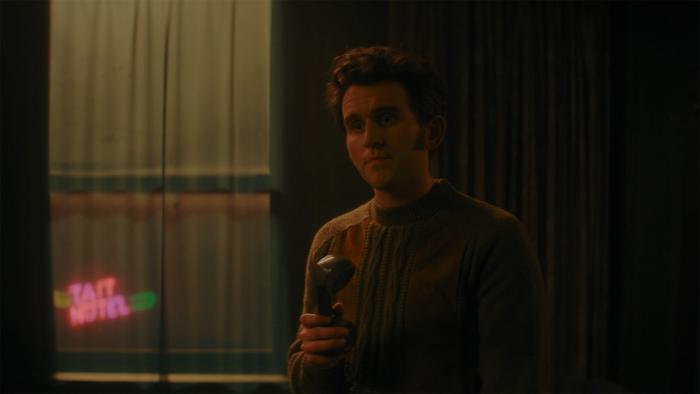
In Pillion, Harry Lighton’s comedic romance of bikers and BDSM, a sheltered 30-something man finds himself. Colin, a traffic attendant who still lives with his parents, is pretty meek. Everyone is surprised when Ray, a man everyone describes as impossibly handsome, cozies up to him in a pub and sets up a date. While Colin doesn’t get the moonlight and roses romance he was hoping for, through Ray’s dominance and the world of kink, he comes into his own as a submissive. Pillion has been referred to by its cast as a ‘dom-com’, although maybe it’d make more sense to call it a coming-of-age tale with heavy emphasis on the first word. It’s funny, melancholic, sexy, unexpected, and exceedingly British. While the hot dom, Alexander Skarsgard, was the draw for many, the true star of the piece is the one playing Colin, Harry Melling.
It seems like every review of Pillion is required to mention that Melling was a child actor in the Harry Potter series, where he had a small but memorable role as Harry’s spoiled fat cousin Dudley Dursley. He’s not in the movies that much, but as with anyone attached to that franchise, it’s remained a defining part of his career. Indeed, many people watching Pillion were stunned to discover who the actor was, suggesting they hadn’t watched anything else he’d done in the 15 or so years since the HP films concluded. That’s a shame because Melling has carved out a fascinating career as a character actor with a taste for offbeat indie projects, and is now established as one of his generation’s most intriguing performers. I’d make the case that he’s the best actor out of all the former HP kids (sorry, RPattz, I do love you, but let’s be real.)
While none of the supporting cast kids in the HP series got much to do, Melling was saddled with perhaps the most thankless of the child actor roles. He was a walking fat joke written by a loser who really hates fat people and always writes them as the villain. There was nothing empathetic about Dudley (and the films cut out the one sliver of pathos the novels gave him in the final book), and looking back, it’s obvious how much J.K. Rowling’s disdain for the character is just lazy writing. Luckily for Melling, who comes from an acting family (his granddad was the second Doctor in Doctor Who!), he got to disappear in-between films and work on being a real performer, largely through stage work (he was in King Lear with Glenda Jackson!)
Meling slowly became one of those actors who would turn up in a small supporting role and whose presence would elicit instant delight, its own sign of quality: The Lost City of Z, Waiting for the Barbarians, and The Old Guard, to name but a few. The turning point came with 2018’s The Ballad of Buster Scruggs, the Western anthology feature from the Coen brothers. In the segment ‘Meal Ticket’, Melling plays a limbless man who is toured around the countryside by Liam Neeson as an actor-slash-sideshow. He performs moving Shakespeare monologues, giving curious audiences an excuse to gawk at a disabled man. As the crowds thin out, Neeson starts to shift focus towards a newer and cheaper gimmick. Outside of the performances, Melling’s character doesn’t say a word. His wide eyes - his most striking feature - convey so much melancholy and weariness over both his circumstances and eagerness to retain some dignity. It’s the kind of performance that could have anchored an entire film.
Melling has mostly stuck to very indie projects, although there are exceptions like the Netflix miniseries The Queen’s Gambit. His most interesting work has come from decidedly un-mainstream works. In Harvest, a very odd period drama-slash-folk horror, he played a rural landlord who is kind but ineffectual in the face of seismic change. My personal favourite Melling movie is Please Baby Please, Amanda Kramer’s giddily queer arthouse drama that’s equal parts John Waters, Kenneth Anger, and off-Broadway musical. Melling and Andrea Riseborough play a couple whose lives are upended after they witness an attack by a group of ridiculously hot bikers. The pair become intrigued by the prospect of life outside of the stifling gender binary, making this one of two films where Melling plays a quiet beta male who finds himself through a hot leather daddy (boy, if I had a nickel…) This is what Melling excels at: roles of slightly askew realities, men who don’t fit the mould of traditional so-called masculinity and strength, and who push against it in unexpected ways.
I’ve spent most of my writing career crying out for more interesting faces in cinema. In an age of fillers, facelifts for 28-year-olds, and trips to Turkey, we’re seeing some of our finest actors lose their distinctiveness (and ability to move their foreheads) disappear in real time. It should be a cause for celebration when we get an actor with the kind of face that would make Norma Desmond proud, and Harry Melling has it. It’s in the giant eyes, the uneven smile, the curly hair, all of which make him feel thoroughly modern yet also like someone who could have modelled for a Renaissance painting. Every single time one of you shallow social media weirdos says he’s not hot enough for Alexander Skarsgard, you should be forced to walk barefoot on Lego bricks (also, that’s part of the whole effing point of the movie, kids!)
I’m always happy when former child stars get to have intriguing adult careers, and I’m even more elated for Melling getting out from under a vast pop culture shadow and doing something completely new. Pillion might be a new and surprising introduction to him for many viewers, but he’s been doing his own thing for a long time now and will continue to do so. His next film is a musical about a man who agrees to be taxidermized. Who else would do a movie like that?!


