
Old School. Biblically Independent.
By Kaleena Rivera | TV | July 24, 2026
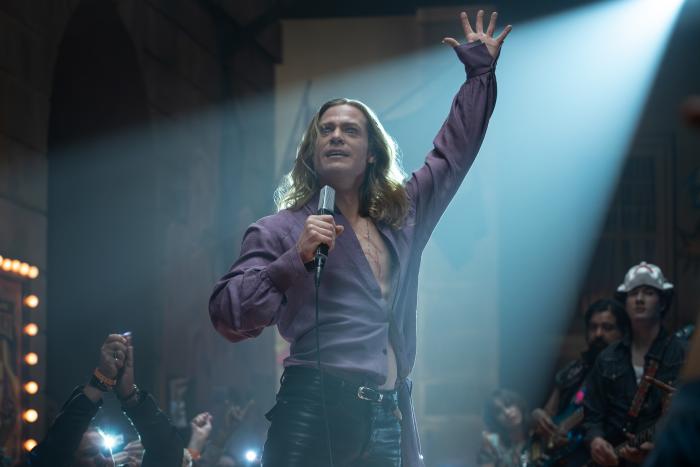
As I predicted last week , there was no possible way for The Vampire Lestat to close out the season with a fully contained story. Really, though, is it actually possible to ‘complete’ the story of a sorta-kinda immortal with the type of trauma-fueled operatic tendencies as Lestat (Sam Reid) within a single seven episode season? Not if you want it done well. But after plumbing my feelings and evaluating the season as a whole, the only conclusion I can reach is that even though “The Failures” was lacking as a big splashy finale, it was a damn fine episode of television.
The final shot of the season was every bit the jaw-dropper it was intended to be, but once I got my bearings, I then had to cope with the disbelief that we have to wait another two years to see the big disastrous concert. That is, of course, supposing that The Vampire Lestat will be greenlit for a second season by AMC execs. While it’s likely, we’ve all experienced more than our fair share of abrupt cancellations, certainly enough to make ending on anything resembling a cliffhanger a risky gamble. I, too, appreciate the old maxim, “leave them wanting more,” but ten minutes of Sheila Atim as Akasha is simply not enough, especially after that monologue (“I am the girl! I am the god! I am the voice! I am the song! I am the night!”).
In lieu of widespread death and destruction, most of the hour was spent on the internal—quite literally in Lestat’s decapitated head—as the Brat Prince comes to terms with what his life has amounted to now that it’s on the verge of ending. Much like his waking life, it’s a show, and this grim dinner party This Is Your Life is conducted by the supporting actors throughout his immortal existence. Each of them are constructs assembled from his memories and, most importantly, the way he feels about himself. Magnus (Damien Atkins) declares them “the failure finders.” I can’t think of a more succinct label to place on the assembly of voices that like to chime in when one is taking inventory of their life’s deeds.
For a finale that’s so contained, it heavily rewards rewatching (it took me four viewings to fully comprehend all of it). The script is deceptively fast with occasional overlapped dialogue and small revelations are delivered in droplets rather than an overwhelming rush, though there’s plenty of that, too. When Lestat recalls the trauma of watching women and girls burned at the stake when he was a boy, it shatters him and his illusions about his mother.
The Gabriella (Jennifer Ehle) concocted in Lestat’s mind is the only one who continuously defends him against the other “failure finders” to this point, but the memory of her forcing him to stare at the burning bodies in turn forces him to see her with clarity for the first time in his long life. What makes it even worse is that he subconsciously modeled her vicious tutelage on the closest thing he ever had to his own child (lending even more depth to his vehement denial of ever threatening to sexually assault Claudia). It’s an anxiety-inducing series of jump cuts framed by fire over a gorgeously nightmarish score (composer Daniel Hart is a wonder) accompanied by Lestat’s prolonged moan. It’s art. It’s also incredibly difficult to watch.
Despite all of Lestat’s pain and deep-seated insecurity, which the show’s highlighted throughout the season, one thing is for certain: no one will ever keep him down for long: “Good show. Bit sh*t. But that’s why you’re opening and I’m headlining.” It’s a resurrection of sorts—a more literal one takes place shortly after once he awakes on the bus—with Lestat affirming his shortcomings and his larger-than-life persona in one fell swoop. “If I failed then that means I actually attempted something,” he declares to the failure finders. It’s triumphant right until he approaches real, actual death and takes a surprisingly spiritual turn when Paul (Steven G. Norfleet) shows up to assure Lestat that Louis (Jacob Anderson) truly loves him. This opens a whole new potential spiritual rabbit hole to pursue next season, such as the existence of God (a feminine figure, no less), whether or not there’s a vampiric soul, and how close said souls may remain to the human, seeing as how Lestat is sharing Paul’s predilection for birdsong as a means of connecting to a higher power (Paul in season one: “The Lord told me to come, Louis. In my head, like a family of birds, any voices, but also one voice”).
“The Failures” wasn’t the finale we expected, but it’s the one The Vampire Lestat deserved. The wait for season four will feel long, but the end result will be entirely worth it. But the season we have now, at this present moment, is a wonderful installment of Jones’ ongoing vampire saga and will age brilliantly over time. “In the end, I think I was pretty f*cking great!” Me, too, Lestat. Me, too.
Best quotes (tie)
Lestat: “Magnus speaks in the third person when he’s on the back foot.”
Louis: “Gives the gift to a pimp who lives to make him miserable, daddy-traps him, slits his throat, and f*cks his ex! A lot!”
All seven episodes of The Vampire Lestat are streaming on AMC+.
Kaleena Rivera is the TV Editor for Pajiba.


