Old School. Biblically Independent.
By Jason Tabrys | TV | May 22, 2026
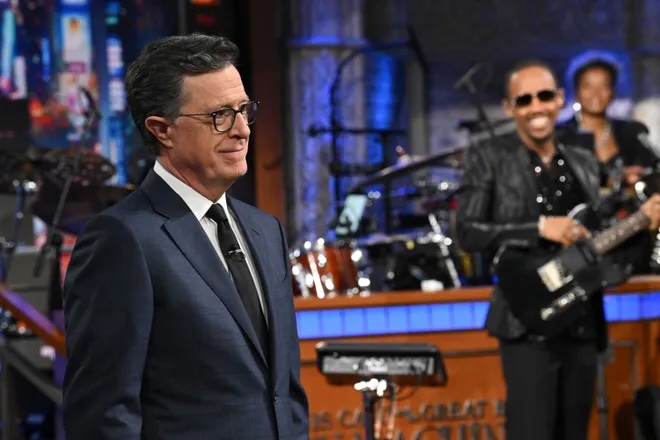
In the end, Stephen Colbert said nothing about Donald Trump or the President’s seeming influence on his exit. Instead, he gave us a Late Show finale that was thoughtful, joyous, nostalgic, silly, and musical. He didn’t offer some sweeping message about the future of the ailing genre of late-night, just a message wrapped within a star-studded bit with the remaining practitioners of televised political comedy (and also Jimmy Fallon) about the inevitable suck of a black hole that may come for them next.
That vacuum has always existed. Everything that begins has a tendency to end, often before we’re ready. It just seems more powerful and voracious now when it comes to art, culture, and the people who make it. The alignment of stars and influence is being remade every day. With that, institutions are falling, leaving what, exactly, in their place?
Somewhere, there is a spreadsheet comparing Stephen Colbert’s Late Show to a random YouTube channel. There’s a column laying out the cost differences and audience reach. There is no space made to contemplate the weight and quality of what comes from these shows. There should be, but what’s the formula for assigning monetary value to something that is a public service, an expression of humanity, and a commodity all at once?
To be fair, I’m not saying nothing of value comes from the creator space. This is not a plea for fewer shows or fealty to the old, monoculture-chasing ways. This is just me talking through the landscape.
The age of niche is here, and it was always the dream. Something for everyone. But we were sold a lie because we believed there would be room in the new world for the old things as well.
Stephen Colbert’s show was very good, it was conventionally popular when measured against its contemporaries, it cost a lot of money, and it gave Colbert a platform to, as he put it last night, “feel the news with you.”
We put entirely too much pressure on our political comedians in these unprecedented times. In addition to lightening our load with jokes amidst the horrors of the news, we look to them to contextualize that news and embody our frustration, fighting back with sharp words that offer us catharsis more than results. But in our defense, we don’t have a lot of other fighters in the game. And we certainly can’t afford to lose one of the best.
Colbert presents as a uniquely good and decent person, a patriot without the hollow statements and garish adornments that usually surround that label. He is intellectually curious and empathetic, and seems to live for the pursuit of joy and peace rather than power. He is the diametric opposite of Donald Trump, a man who loathes all who choose the free light of day over those seeking adjacency to the cloistered confines of his own pukered butthole. Trump seems to loathe Colbert’s persistence, depth, and likability with extra vigor. And while Colbert’s forced exit might feel like a victory for the side of vicious toddlers, all they’ve done is create a free speech martyr who will likely find another platform in his own time and on his own terms (or not, if he so chooses).
That’s the twist of a world with endless channels; theoretically, an established and beloved comedic voice can set up his own shop and reach a large swath of the audience he had on CBS at 11:35 on weeknights (and on that show’s YouTube channel and affiliated social media accounts). The only difference is the lack of (direct) corporate overlords. But Colbert is a unique case, and we’re still living in a world with more voices saying less things. A world with a bottlenecked pipeline when it comes to finding the next Colbert and a first-do-no-harm approach to protecting the powerful yet easily bruised hands that control the spigots of commerce.
I do not know how we counter this deleterious effect of late-stage capitalism on the arts as it smashes into legalized bribery’s advanced effect on politics. I’m similarly stumped on how we counter the bleed of AI into the creation of art and how these things collide, connect, and disincentivize the pursuit of anything outside of soulless, spineless paint-by-numbers “content.” I just know we have to, and we want to.
Jason Tabrys is a longtime TV critic and interviewer whose work has appeared on Uproxx, Splinter, and LateNighter. You can follow him on Bluesky.


