Old School. Biblically Independent.
By Chris Revelle | TV | April 16, 2026
There’s a scene in the documentary Jesus Camp that’s lodged in my brain. It’s night at the evangelical summer camp and a group of boys are doing what kids do at sleepovers: play. They chase each other with flashlights, they hang from the bunks, tell jokes, and make silly noises. Suddenly a camp counselor enters and scolds the kids. He tells them that their play dishonors and disrespects Christ. All at once, you see the light go out of the kids’ eyes and they go back to bed, deflated. This scene comes to mind when I watch The Testaments, Hulu’s adaptation of Margaret Atwood’s sequel to her landmark novel, Handmaid’s Tale. As in Jesus Camp, the adults of Gilead don’t just indoctrinate the kids, they make the kids feel scared and ashamed of being kids. Growing up is difficult just about anywhere you go, but The Testaments will make you want to reach through the screen and take these kids away from the misogynistic dystopia that’s trapped them.
The Testaments returns to Gilead, the theocratic fascist state built on the ruins of America some years after June Osbourne’s six-season journey. Viewers of Handmaid’s Tale, and readers of the book, know the score: Commanders and their Wives use Handmaids to conceive and deliver their babies. When The Testaments picks up, a new generation of girls are cloistered within Aunt Lydia’s preparatory school to be molded into docile, submissive Wives for future Commanders.
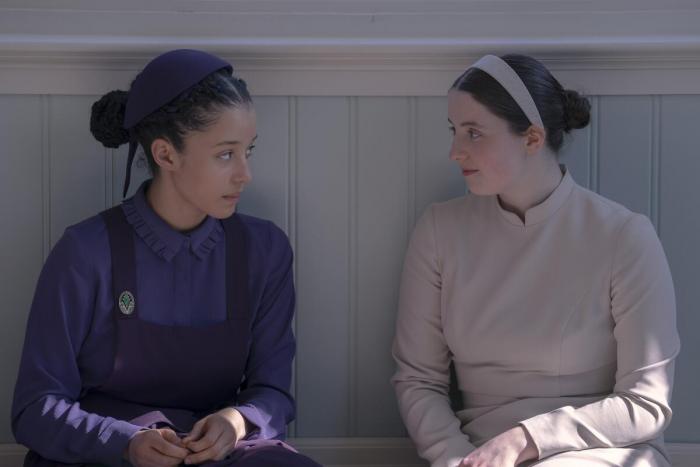
The first few episodes focus on Agnes (Chase Infiniti) and Daisy (Lucy Halliday), two unlikely friends that meet as students at Aunt Lydia’s school. The young girls are sorted into color-coded tiers based on their age, development, and background. Agnes is a Plum, a young teen who hasn’t started menstruating just yet. Daisy is a Pearl, a teen brought into Gilead from the outside world. Agnes and her fellow Plums have only ever known the puritanical, natal-centric culture of Gilead, but Daisy has seen the worldly ways of Canada. The two worlds collide when Aunt Lydia (Ann Dowd) assigns Agnes to Daisy to guide her and help her settle in.
The Testaments hits many of the same beats Handmaid’s Tale did, but it distinguishes itself in meaningful ways. When a young Guardian is punished for indecent behavior, his arm is cut off in front of Aunt Lydia’s young students who cry out for his blood. They are so full of boiling fury and repression that these gory displays are pressure valves used to mollify them. This type of bloody spectacle was done in Handmaid’s Tale too, but it takes on a new level of heartbreak to see children already ensnared in this toxic cycle. That’s the series’ simple, but effective twist on the familiar miseries of Gilead: if you thought it was brutal to see adults go through it, just wait till you see children do it too.
People won’t have to read The Testaments to understand or enjoy the series, but viewers who didn’t watch Handmaid’s Tale might need a little time to catch up. The series does a great job letting viewers into its world all the same. I’m studiously avoiding dropping any spoilers because The Testaments deserves the maximum impact of surprise, but suffice to say that the show effectively juggles its competing interests; it’s both a poignant story about Agnes and Daisy finding connection and sisterhood with one another and a political thriller about the forces working to defeat Gilead once and for all. The Testaments is a worthy successor to Handmaid’s Tale and a great gut-punch of a show in its own right.


