Old School. Biblically Independent.
By Chris Revelle | TV | July 10, 2024
When I was in high school, a friend showed me the 1986 film Lady Jane starring Helena Bonham Carter as the titular Jane Grey, the “Nine Days Queen” who was married off to Lord Guilford Dudley (Cary Elwes) at the schemey behest of her father Duke Henry Grey (Patrick Stewart) in a (eventually) successful bid to make Jane queen. However, as her moniker implies, this reign was extremely short-lived as Mary I managed to challenge and depose Jane, and saw to Grey’s imprisonment and beheading. It was a very straightforward period drama that told the historical events more or less as they happened, with a certain reverence for Jane as a sort of rebel in her academic pursuits that were considered unseemly for women of the time.
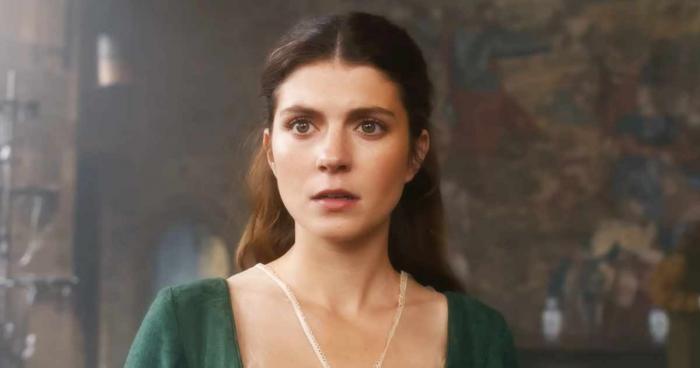
When Amazon Prime debuted the series My Lady Jane (based on a novel of the same title), it appeared to be a cutesy, YA-flavored take on the story that might put some girl-power spin on it, but otherwise was a retelling of what we already knew from history. Then, during a scene in the first episode, I saw Jane’s best friend Susanna turn into a bird and fly away to escape some guards, and my jaw hit the floor. My Lady Jane knows it’s fully a historical fantasy, and it revels in being ridiculous.
I’ll confess that the show’s pitch (“What if Lady Jane, but with shapeshifters”) sounds like a joke on The Other Two, but wow does My Lady Jane make it work. Shapeshifters, or “Ethians” as they’re referred to, are believed to be satanic agents bent on destroying human (or “Verity”) society. Ethians can shift between animal and human at will, meaning they can hide in plain sight when needed. They’ve also been largely ostracized from English society and driven out into the forests where they live hardscrabble lives. Susanna reappears later as a member of an Ethian cell operating in England as a sort of X-Men analog, which sets up a grand power struggle between English oppressors and a marginalized community hated for being born Ethian. It’s not a terribly complicated metaphor for social injustice and like X-Men, My Lady Jane shares the flaws of fantastical bigotry; stories of oppression are weaker for subbing out the very real systems of bigotry in our world for very unreal magical powers. The magic of the series is that it mostly sidesteps this issue with an unexpected and oft-overused narrative tool: narration.
Voiced with well-sauced, plummy verve by Oliver Chris, the narrator is very much in on the joke of My Lady Jane. He begins the series by recounting the actual story of Jane Grey before saying, “f**k that,” and explains that we’ll be seeing a much more fun alternate history. Oliver gives a deliciously dry edge to the narrator’s quips and lampshades the fantastical elements of the show. When Susanna morphs into a hawk, the narrator cuts in to drolly let us know, oh by the way, some people can turn into animals in this story. The narrator explicitly encourages viewers to see My Lady Jane as a lark, something fun and wild instead of something self-serious. It’s an extremely clever device because with this small amount of ironic detachment, My Lady Jane opens itself up to viewers who might otherwise scoff at a shapeshifting underclass in their English period drama. The show knows it’s being absurd and invites viewers to laugh with them in disbelief.
Better yet, as more time is spent with Ethian characters, we come to empathize with and follow them. My Lady Jane keeps its funny flourishes, but it brings the Ethian plight into place as Jane’s just cause against English society. It’s a sensible direction for the character to take because it underlines Jane’s status as being ahead of her bigoted time. It fleshes out the alternate historical aspects of the series, but it’s not the only thing about the historical record the series changes. In this version of events, Lord Seymour (a devilish Dominic Cooper) is poisoning King Edward VI in an effort to kill and supplant him. In reality, Edward VI died of a terminal disease, but My Lady Jane makes some devious hay out of it as a plot against His Highness. The supernatural elements also allow for different spins on real historical points. Edward VI chose his friend and cousin Jane to succeed him because his half-sister Mary was a Catholic zealot who would’ve upended the ongoing Reformation, and his half-sister Elizabeth was the daughter of the most infamous of Henry VIII’s wives, Anne Boleyn. My Lady Jane re-flavors this situation by making Mary not just a mega-Catholic but an anti-Ethian nutjob, and one that bakes poisoned pies for the king. As for Elizabeth, it’s not just that she’s the offspring of a queen accused of being an incestuous slutty witch but that her mother is an Ethian, potentially making her an Ethian herself. The series, at times, will let you forget about the Ethian/Verity fantasy stuff, but the times it intersects with known history are great fun.
I’ve seen My Lady Jane compared to Bridgerton and in some ways, that’s apt; they both engaged in racially diverse casting in a genre usually exclusively dominated by white people. One major difference is that Bridgerton explicitly writes racial diversity into the world of the show, but My Lady Jane takes a more race-indifferent tack. Your mileage may vary, but I like My Lady Jane’s approach here. Edward and Bess are both Black, for example, and that suggests a world of possibilities; Henry VIII could’ve been Black, and maybe Anne Boleyn and Jane Seymour (Edward’s mother) were too. There are merits to Bridgerton’s more realistic approach, but My Lady Jane is resolutely a fantasy. In a world where “it’s not realistic” is often used as a dog whistle for “I don’t want POC in my fantasy,” My Lady Jane dares anyone to have a problem with it. Why not have royals of color in your story? Why not give people of color places at all levels in a fantasy world? Fantasy can be more than a riff on medieval Europe. In a setting where some guy in a tavern can suddenly turn into a bear, what’s “realistic” doesn’t quite matter.
My Lady Jane is blessedly, defiantly bonkers, and I am so glad it’s here. Stuff realism in fantasy; give me boldness and fun! Make a Black man the King of England and make half the population shapeshifters. Who cares about realism? My Lady Jane embraces fantasy to the fullest and I hope you will too.


