
Old School. Biblically Independent.
By Jason Tabrys | TV | July 2, 2026
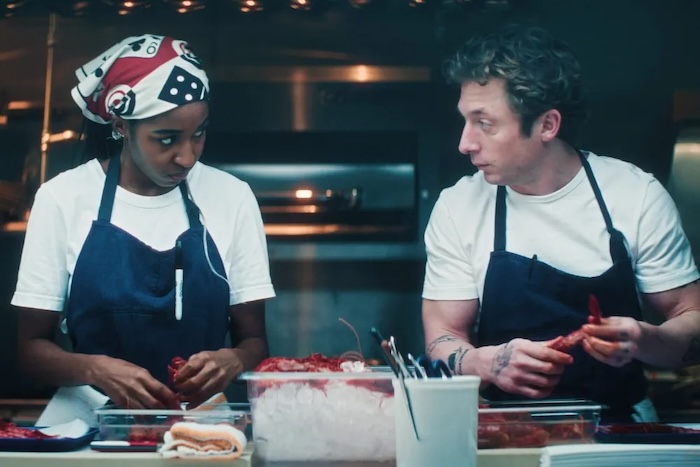
From the gorgeous, creative food to the easily romanticized driving passion and the overbearing but always-there-when-you-need-them support system, The Bear has always been aspirational. Carmy’s decision to quit in pursuit of an actual work-life balance that rejects what had become a grim do-the-day to get-through-the-day existence is no different. Work should not be all we are, no matter if your boss demands it or your ambition permits it. It’ll kill you for real, or put you at such a distance from yourself that it feels like you died.
Richie’s growth is equally inspiring; a seasons long journey toward adulthood and three dimensionality, transforming from a grating caricature of a stuck-in-place townie tough guy to someone whose cup gets filled up with purpose, opening him up to new experiences and relationships.
Sydney’s arc is also satisfying and earned, with the show delving into her relationship with her father, her apprehension about how to best grow her career, and her increasing confidence in making her positions known while protecting herself from the undertow of Carmy’s personality flaws.
It’s also easy to see the truth of Natalie’s stress as the connector, peacemaker, and adult in the room while also trying to repair her relationship with her volatile mother and juggle becoming a mother, herself. Ditto watching Marcus push through imposter syndrome and familial loss to be a superstar chef in his own right.
The Bear took us down these paths, even if it meant they had to put beloved characters into direct, uncomfortable conflict. Even when it gave us reason to question where things were headed.
Carmy’s transformation from hot TV chef boyfriend with some rough edges into a tyrant being driven mad by his own perfectionism is the clearest example of the show’s willingness to challenge the audience’s patience with a character’s behavior. Carmy trauma dumped, he was toxic, emotionally and verbally abusive, and often out of control while striving to always be in control. It was corrosive and, by the end of season 2 and all through season 3, turned the character into the show’s unlikable villain who pushed others to walk on eggshells, scuffle, or contemplate leaving. Amidst that, he made the choice to double down, cutting off his only lifeline to love and life outside the kitchen by breaking up with Claire.
At the time, I wrote about how turning Carmy into a thoroughly unlikable character was a bold and much-needed move made in service to what I hoped would be a message about coming out the other side of his ambition-powered self-destruction. In season 4, on the way back down from the apex of his dickishness, something clicked for Carmy, culminating in his decision to leave the restaurant. As he tells Unc, “You have to break patterns to break patterns.” But none of this was a linear process without rough spots or risk, especially in an era where shows live or die on the whims of parasocial fandom.
This final season dealt with the fallout from Carmy’s far-reaching decision, its imperfect nature (wherein Carmy decides everyone else’s future for them - because a narcissist is always gonna narcissist), awkward application, and emotional impact. In the end, Carmy didn’t get total image rehabilitation, his missteps got called out. He was still a prick, but he was becoming a more self aware one. Progress, not perfection.
The key moment from the finale came when Carmy was talking to Bonnie Hunt’s character at the architectural firm. He reveals that he has been seeing his co-workers (comprised of his friends and family) as tools to get to the end of his day before the hellish service that the show covered through the final season’s first 7 episodes - a day that helped him rediscover his joy and love for those people. That confession proved to be the perfect bow on Carmy’s decision to leave the kitchen and do better, clarifying any lingering questions fans had. It was never as simple as wanting a life outside of The Bear, he was bottoming out on all levels and scared of what that kind of joyless experience might lead to. Would he turn into his mother? His brother? Is that what he wanted from life, or could he let go and recalibrate?
We never see Carmy seek treatment in the traditional sense. There are no breakaway therapy storylines for anyone. Nothing so clean as that, just the kind of messy, incremental change through recognition and repetition that actually resonates as attainable.
Say what you will about The Bear, but it never leaned into the narrative shortcuts other shows take when they want to soften a character or demonstrate growth without having to put in the work. The Bear always put in the work, showed the frustrating intricacies of self-improvement, the false starts, the low lows, and the small wins that can add up to a better, fuller life.
The Bear wasn’t just about food, family, creativity, or building something and trying not to let it get torn apart. It was also about cutting through the baggage and BS of your preprogramming to try and heal in due time.


