
Old School. Biblically Independent.
By Jason Tabrys | TV | September 9, 2026
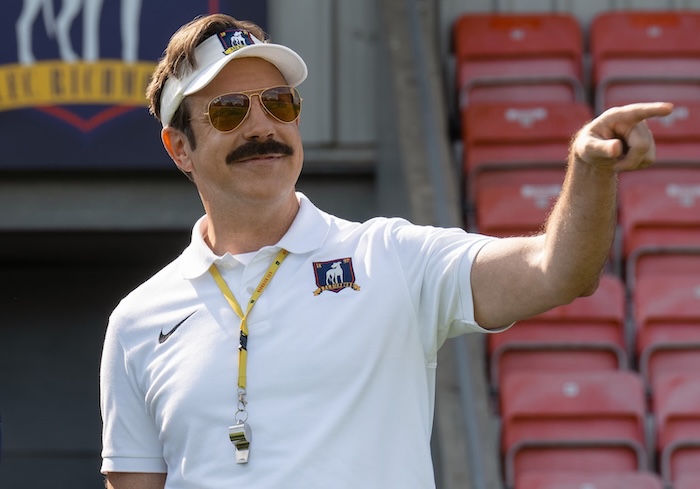
Ted Lasso’s uniqueness has always come from its earnestness. It’s why the show subverted its preordained fate as a forgettable extension of an NBC Sports promo. This was supposed to be the second coming of the GEICO Cavemen TV show, but instead, it came out of nowhere as a crowd-pleaser in the midst of a global pandemic, where its message of radical kindness and empathy hit like a hammer… or a hug.
The original version of Ted was a walking, talking bundle of coach-talk soundbites and little else. No shade - it was a bit, time-limited by its format. But with a full show world to build, Jason Sudeikis, Bill Lawrence, and company gave Ted a soul, turning him into a three-dimensional Ned Flanders clone gone fish out of water. This grounded Ted’s philosophical musings, because you could tell he really believed what he was saying and believed in who he was saying it to.
Rather than focus solely on the comedy and conflict of an American football coach leading a soccer team in the UK, the show expanded out. The culture clash would be a softer side note. The main hook was Ted affecting everyone around him with his confusing, contagiously uncynical, open ways. Like ET, the glow of his heart lit the way.
In seasons 2 and 3, the show continued along, developing its ensemble and trying to go a little deeper into the mechanics of Ted. Along the way, the protective shell that covered the show in its first season cracked, and critics and fans were less unanimous in their praise.
The 12th episode of season three, “So Long, Farewell,” felt like a good point to end on. The show’s lingering fascination with the Nate heel turn/redemptive saga had taken up a frustrating amount of space, Rebecca and Keeley needed new challenges, and characters like Roy, Sam, and Jamie also needed to move up or move on.
While Ted had remained sturdy in his likability, it was getting harder and harder not to see him as an absentee parent with his son left in Kansas City. What was keeping Ted in the UK? What was left to prove that mattered more than being present for Henry? It seemed like a question Ted would pose to a friend, but not to himself until the end.
Three years later, Ted Lasso has returned. And after spending the required time catching everyone up and explaining why Ted would be right to take on another challenge in the UK, the show is starting to hit its stride again. Bringing Ted closer to his new players on the AFC Richmond women’s team has been the key to that. Ted Lasso shines brightest when it occupies the familiar territory of a sports movie, even when the best moments have had little to do with sports.
“If sports movies are about the sport, you’re screwed.” That’s what Bill Lawrence said to me when I interviewed him for UPROXX before Ted Lasso debuted in 2020. It’s something the show has clearly kept as a north star, aiming to be more tao-of-life sports movie (ala Bull Durham) than sportsball-centric (ala Major League).
Outwardly, the barroom brawl team-building exercise in this season’s 3rd episode and the rah-rah halftime speech where Ted tries to take the teeth out of the word “embarrassment” in episode 4 serve as a way of getting the most out of a team of athletes. But winning soccer games is a sort of MacGuffin. Ted Lasso could be about a new manager trying to rally a team of programmers, or a college dean trying to rally the faculty.
The BBQ analogy imparted to the insular new coach, Alice Chilton, after she confronted two players at practice and made the whole team run laps is a perfect example. Sure, Ted is trying to reach a coach who is taking a harder approach than he’d like, but the idea that patience can lead to better results isn’t exclusive to sports.
The sports movie genre persists because its stories transcend the box scores and highlights of athletic achievement. These are stories about leadership, intense bonds between disparate people striving toward a common goal against common enemies, and the intensely human desire to find your team and also root for underdogs and long shots. Sports aren’t the tie that binds; life is. And while the tropes often used to get there are worn, storytellers return to them not because they’re lazy, but because the most important box to check when telling a story is to be understood. And tropes and clichés help to achieve that when used artfully.
To put it in Ted Lasso-ese, just because the cover band at the bar didn’t write “Freebird,” it doesn’t mean they can’t make the ghost of the great Ronnie Van Zant proud.
I don’t know if Ted Lasso qualifies as a great or groundbreaking TV show. All I know is it’s a great cover band, playing all the sports movie hits while cutting through the noise to remind us never to cook out the tenderness and to always “be curious, not judgemental” in the game of life.


