Old School. Biblically Independent.
By Chris Revelle | TV | June 28, 2024
I am fascinated by the erotic thrillers of the 1980s and 1990s. Not only are they usually over-the-top fantasias, but they deal directly with evergreen notions of sex, gender, and all the roles we associate with them. Perhaps unknowingly, erotic thrillers were like a hall of mirrors for heteronormativity. The operatic tone foregrounded a sexualized struggle between men and women and, in my queer eyes, made heteronormative ideals look gaudy and ridiculous. With the male gaze being the primary prism through which these stories were told, it often felt like we were seeing a sort of power fantasy in which the leading man, despite anything he may say or do, is always the hero. Michael Douglas flicks like Fatal Attraction and Disclosure are excellent examples of what I’m talking about; the lead man is just a cool guy trying to have a good time if only these crazy broads would ease up on him. This felt especially true when it came to infidelity plots.
It’s lots of fun to see people do bad things on screen, but it’s a curious choice to frame that particular act as something the lead man cannot help but succumb to. It implies that it’s never really his fault and often the movies arrange themselves to reflect this. There shouldn’t be some moral outrage over the conduct of fictional characters or that all wrong-doers must be explicitly punished, but this fantasy arrangement is pretty absurd to watch. The men in these movies could get away with anything, with (sometimes fatal) consequences for their mistresses, with the implication that the worst sins belong to the other woman. Presumed Innocent, the AppleTV+ series adapting the book and 1990 film of the same title, feels like a total reversal of this dynamic. In this retelling, our philandering lead is made to feel every inch of his shortcomings.
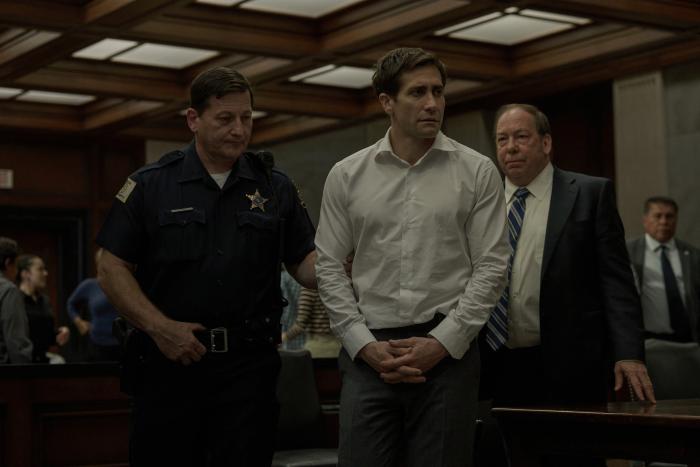
As played by Jake Gyllenhaal, Rusty Sabich is an asshole. He’s a hotshot prosecutor with a great record and his best friend as his boss. When his colleague Carolyn Polhemus is found murdered, naked, and hogtied, viewers make contact with the very tip of the Rusty iceberg and learn that he and Carolyn had been having a long-running affair. Rusty’s memories of her flit and blink through his mind primarily as scenes of sex, indicating the kind of value she had for him. One of the few non-sexual memories of Carolyn that he shares is one of her showing kindness and tenderness to a young child who was taking the stand in a sexual assault case, and he emphasizes how seeing her in this nurturing mode made him realize he was in love with her. It’s an interesting admission, especially in light of how he thinks of his wife, Barbara. In one particularly revealing sequence, Rusty remembers lightly kinky tumbles with Carolyn intercut with a quiet memory of slow-dancing with Barbara in their home. It reminded me of Mad Men’s Don Draper who saw women through a similar Madonna/Whore axis wherein the wife is for family and the mistress is for sex. One gets the impression that Rusty was unaware that he could be attracted to a woman for sexual and emotional reasons at the same time, perhaps shedding some light on his obsession with Carolyn.
Of course, there’s more of the asshole iceberg to explore. Even though Rusty told Barbara that he ended things with Carolyn over a year ago, that’s shown to be a lie when it comes out that not only was Carolyn pregnant at the time of her murder, but that a paternity test confirms Rusty as the father. We learn that Rusty was present in Carolyn’s house the night she was murdered and that they were arguing. Each episode that passes exposes another lie (by omission or otherwise) made by Rusty and we see him own up in the most petulant ways. He shouts, snarls, and curses when confronted with the slightest accountability. He might as well tattoo “WHY ME” on his forehead. Like the erotic thriller leads of yore, he cannot wrap his head around a reality in which what he’s done is his responsibility. Rusty engages in cycles of self-pity, lashing out when his friends and loved ones confront him with their feelings of betrayal, indignation, and worry. He superficially accepts blame, but gives no quarter to the people he’s wronged.
After interrogating his Black son Kyle as if he’s a criminal, Rusty is chastised by Barbara. Rusty responds with self-pitying defenses that he knows he’s f**king up, but that Barbara really needs to “take some responsibility.” After his lawyer Raymond confronts Rusty about a damning lie of omission for a second time in two episodes, Rusty deflects, hemming and hawing with eyes on the floor like a child. Raymond sums up Rusty quite tidily when he expounds on the difference between shame and guilt. Shame, Raymond says, is something you put on yourself, it’s self-centered and self-involved, but guilt is the feeling of owning up and understanding the pain you’ve caused other people. “I do not doubt that you feel shame,” Raymond says, elegantly serving Rusty his own ass. There could have been that 1980s framing of a man unfairly besieged, but Presumed Innocent is more nuanced than that. Rusty is fighting to prove he didn’t murder Carolyn, but proving in the process what a rotten person he’s been. There’s satisfaction to seeing this archetype taken to task this way, changing what could’ve been a power fantasy into a righteous castigation. It’s fun to watch people do bad things and it’s also fun to see a smarmy asshole get the rations of sh** he’s been avoiding.
When you take into account how the Presumed Innocent film ended, there’s a possibility for the series to do the same. Spoilers for a 34 year old movie, but that ended with the twist-reveal that Barbara was Carolyn’s murderer. This is slightly hinted at by the title, but the series seems to apply the notion to other characters like rival prosecutor Tommy Molto and Rusty’s son Kyle. With how rotten Rusty has been in the series so far, this ending could feel akin to Gone Girl: a wronged wife frames her husband for a crime he didn’t commit and allows him to take the rain of blows that follows as penance. It’s not that I want Rusty to go down for something he didn’t do, but I’m quite pleased to watch the weasel twist in the wind. Who knows, he might come out the other side with a few measures of humility.


