
Old School. Biblically Independent.
By Diana Helmuth | TV | December 30, 2025
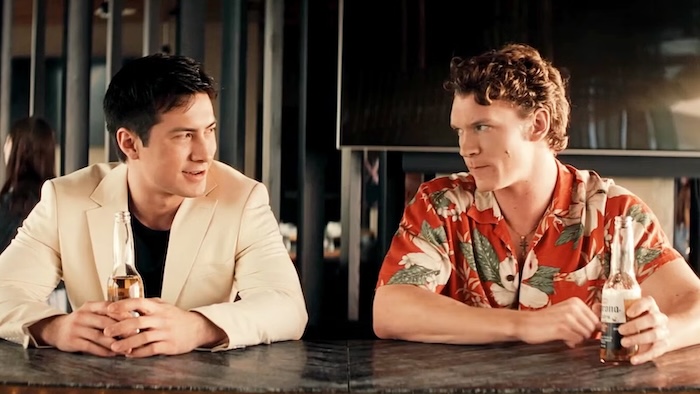
Like millions of people, I am just now coming into contact with one of the more popular sub-genres of romance: gay hockey. Hunky, mouthguarded bros piercing through the scaffolding of homophobia that surrounds their sport in order to fall madly in love with each other. It’s amazing, and I’m so glad to finally be here.
Many words have been penned about why this genre of gay romance is so popular among, in particular, straight women. In watching a gay romance unfurl, women get to experience peak levels of yearning; we get to inhale that exquisite tension that can only be found when love sneaks into forbidden spaces (this enjoyment is not reserved for straight women, but we apparently enjoy it the loudest). In a society where hookups are blase, this is what we want out of our love stories: risk. Risk allows us to feel passion, not just consume it. Sex is about power, and often, its accessibility correlates with our desensitization to it. This is why so many of us are finding refuge in love stories centered on taboos, enemies, and danger.
And what could be more risky than deeply masculine men in a deeply homophobic setting falling in love with each other?
Yes, Connor Storrie and Hudson Williams’ waxed abs are doing a lot of work to keep the show true to its romance-book roots. But I swear that’s not really what makes this show so good. When I am watching Ilya and Shane stare at each other from across a dark dance floor, Ilya’s eyes daring Shane to react to his hands on a woman, and Shane frozen in place, knowing he can’t do anything at all unless he is willing to turn his world upside down - all the while t.A.T.u thrums this is not enough, this is not enough - I think you have to be a sociopath not to feel something. When I watched this scene, I was transported back to my high school assembly hall, staring at my almost-boyfriend who had just told me he loved me, watching him touch another girl, his eyes daring me not to be upset in public, because we weren’t actually supposed to be together. I think t.A.T.u was even playing. I stared at the TV and trembled.
I have heard concerns about fetishization in this sub-genre - that is, straight women, consuming gay love for their own enjoyment, without much care for the actual experiences and rights of gay men in the real world. However, if Heated Rivalry is fetishizing gay love, I can’t help but consider that there may be a positive side effect: straight people relating to gay people. Really relating. Not in some liberal exercise - but actual, deep, emotional empathy for what two men risk to be with each other. Only a romance can do this as deeply as is necessary. Stories like this have existed for decades, of course, but they have been “othered,” set away in the queer section of the bookstore (if that section even existed) or stored in niche online forums that are only found by people who already know where to look.
Heated Rivalry is the opposite of niche. It is also not some chaste, legal kiss at the marriage altar, or a side story where two queer people get a little gasp of happiness before it’s snatched away. This is a gay love story given to us with the primetime intensity heretofore reserved for straight romance. Yes, the actors are young and ripped for mainstream consumption, but it’s still groundbreaking to see two men falling in love on main - not as shy teenagers (like in the tender, YA Heartstopper series), but in an adult setting, fully fledged, gorgeously realized, and graphic. Especially at a moment when queer rights are under renewed pressure, a boldly erotic, impeccably written gay romance airing on HBO on Christmas is so good it practically has its own umami.
It is difficult to empathize with someone whose experience you have not gone through. However, in adapting Heated Rivalry as masterfully as he did, and getting the resources and prime network access he did, I really believe Jacob Tierney has expressed an acute part of the gay experience and made it accessible to outsiders. People who might not ever consume gay stories - because they didn’t think they were for them, or they didn’t know where to look - are now going to watch this, and feel something they are not ready for.
When we watch stories where people fight through the tension of connection through the forbidden, as an automatic byproduct, we are learning to empathize with them. Quietly, I think a very large number of straight people are about to start empathizing with people in their society that they considered “other.” Perhaps not perfectly. But certainly more deeply.
Especially at this moment in history, I cannot herald this as anything else but wonderful.


