
Old School. Biblically Independent.
By Kayleigh Donaldson | TV | November 6, 2026
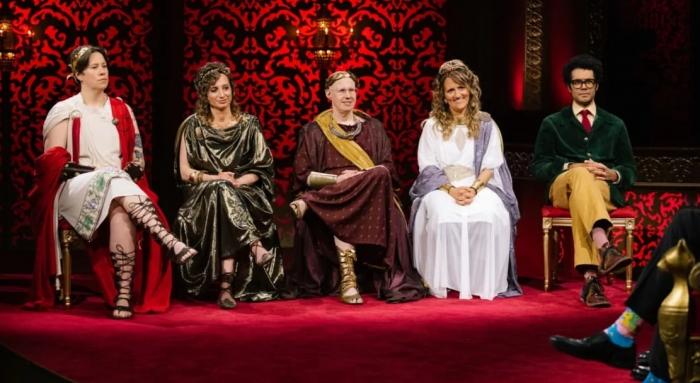
Series 22 of Taskmaster came to a conclusion last night in the UK. No spoilers for those who haven’t caught up yet. While the finale had its moments, I left the episode feeling the same as I had all season: that it was a bit disappointing.
Created by Alex Horne and headlined by Horne and Greg Davies, Taskmaster has been one of the most reliably entertaining shows on British TV this century. It’s a simple set-up: five contestants, usually plucked from the UK comedy scene, are given a series of random tasks to complete. Some are simpler than others—cry, fart, throw the potato in the hole—while others are ludicrous games full of tricks and red herrings that leave the players on the verge of madness. It could have been insufferable or lazy, but in execution, it’s genius, a brilliant blend of smart and stupid that inspires spirals of creativity, surrealness, and abject lunacy. I have laughed myself into wheezing fits from some Taskmaster challenges, and it’s the show my friends and I quote the most to one another, aside from The Simpsons (“Oh, it’s an absolute casserole down there.”)
This season, the five players were Chloe Petts, Isy Suttie, Nina Conti, Richard Ayoade, and Matt Lucas. It seemed like a solid line-up, another example of how Taskmaster had refined its formula: you had the national treasure who was above it all, the hot young talent, the TV favourite, the comedy circuit regular, and Matt Lucas. Ayoade has been featured on practically every dream cast list since the show took off. He seemed ideal for that role of the over-it but still slyly involved contestant in the mould of Julian Clary or Sanjeev Bhaskar. The well-trodden tropes of Ayoade’s act—dry, stony-faced, a tad pedantic but not as above the fray as he pretends—seemed prime for a fun double act or performance of comedic madness. Instead, the act felt more forced than ever.
There are glimmers of him truly enjoying himself, and the show feels more alive in those flashes. The sandcastle task saw him biting his lip to hold back a smile of victory, and I truly wished me would just let himself have that moment of celebration. Yes, he’s got a brand to maintain, but one got the sense that the Ayoade-isms were preventing the development of some much-needed chemistry between him and the cast. Really, there was a distinct lack of chemistry with this quintet. They never seemed to fully bond like the casts of previous seasons and made for a curiously low energy combination. I missed the in-studio banter that typically provides some of the show’s most quotable moments. Perhaps they would have worked better spread across other casts or other pairings. Ayoade needed a Rosie Jones or Ania Magliano to bring some balance to his act.
The presence of Matt Lucas brought with it a whole heap of baggage. His long-time comedic partner David Walliams is currently going through it, which has brought a renewed spotlight to their oft-controversial and outright racist work. Guys, they did so much blackface. The decision to have him on Taskmaster was met with much scepticism. Why him out of all the comedians in Britain? That question was never answered, as his presence throughout the season was largely uninteresting. He seemed out of his element with the tasks. Blessed be to Isy Suttie, who was having a ball, and Chloe Petts, who was the right mixture of competitive and comedic.
It must be hard to think of several unique challenges per episode for eight a series and beyond, and you could really sense in this series how things had gotten strained. Often, you got the sense that the contestants weren’t sure of what to do. I definitely had to rewind a few episodes just to keep up. Part of the fun with Taskmaster is in imagining how you, the viewer, would perform these tasks from home. It wasn’t implausible to pull off more than a few of them with a few tools you could dig out of the junk drawer. There is pleasure in seeing the magic of site-specific tasks thanks to the magic of a Channel 4 budget, like the airport-based challenges, but even they are at their funniest when they’re designed like playground games. Some challenges this season, however, were needlessly convoluted, just to differentiate them from earlier games.
To be fair to Taskmaster, how many shows get to 20+ seasons before the inevitable decline hits? The consistency of this series has been remarkable, a true testament to Horne and company’s inventiveness and canny eye for casting. It didn’t stagnate in the way that many British panel shows of a similar format did, and, by and large, the comedians taking part have been game for this cavalcade of unpredictability. Still, it’s hard to ignore the sharp contrast between, for example, season 20 with Jason Mantzoukas and Stevie Martin and this season, where everything feels both needlessly contrived and completely exhausted. Perhaps Horne and company are just overworked. Two series a year is wild scheduling for British UK when we’re a nation so used to twelve episodes and a Christmas special before it gets cancelled. A breather would be welcome, but we have a New Years special ahead of us and a 23rd series in the works.
After 22 series, I think Taskmaster is allowed one duff edition, although I hope we get back to basics with the next one. Focus on chemistry, don’t overcook the challenges, and keep the banter levels high. And, of course, continue to terrorize Little Alex Horne.


