Old School. Biblically Independent.
By Kaleena Rivera | TV | August 7, 2023
When the first season of Good Omens was released, it quickly became a comfort watch for many, myself included despite the fact I have neither the inclination nor luxury to rewatch most television series (such is the burden of a tv critic). While it’s by no means flawless, the combined power of David Tennant and Michael Sheen made it easy to look past the more rough-around-the-edges portions of the ten-episode series adapted from Neil Gaiman and Terry Pratchett’s much-beloved 1990 novel of the same name. With season one covering the length of the novel, it was intended to be a limited series. However, with great success comes great pressure to continue tapping that same well, and once Gaiman revealed that he and Pratchett had bounced around ideas of what a potential sequel could consist of (many years before Pratchett’s unfortunate passing in 2015), it was only a matter of time before a second season would come to fruition.
Now said fruit has come to bear and despite hanging on the vine for four years, there’s an unavoidable sensation that it’s been plucked too early. What begins as the relatively solid beginning of a story is stretched out until it fully falls apart at the end, a disappointing development considering that this season is a mere six episodes. The end result is something that only partially satisfies, a feeling exacerbated by a cliffhanger so cruel that Satan himself would likely say, “Well done.”
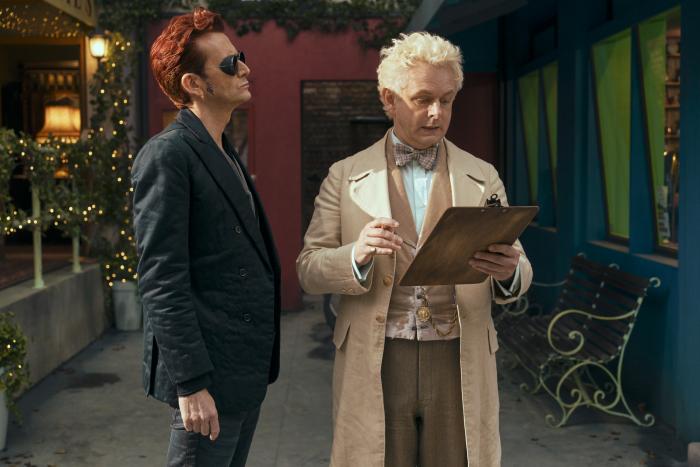
The season opens with Crowley (Tennant) and Aziraphale (Sheen) continuing their supernatural lives here on Earth, both still on the outs with Hell and Heaven (respectively) after they interfered with the two camps’ mutual plan for Armageddon. But when a very naked supreme archangel Gabriel (Jon Hamm) arrives to Aziraphale’s bookshop with no memory of his identity, the two unlikely “friends” (more on that momentarily) must once again join forces to figure the mystery of what’s happened to Gabriel while evading the forces of Heaven and Hell, both of whom have a vested interest in finding him.
Chief among Gaiman’s talents, outside of his writing abilities—which he wielded as the writer for both seasons, bringing on John Finnemore to be his co-writer for season two (with Douglas Mackinnon directing)—is knowing what his audience wants. What that audience has been clamoring for is more Aziraphale and Crowley, and on that front, Gaiman delivers. Fans were quick to ship the odd couple—affectionately nicknamed the “ineffable husbands” on social media, a testament to both Sheen and Tennant’s chemistry with one another—along with the incredibly charming relationship between the two eternal beings (“eternal” applied to the fictional pairing, not the actors, though now that I think about it, who knows for certain?).
Unfortunately, the most effective parts of the first season, namely the “flashback” episode which tracks Crowley and Aziraphale’s friendship over the course of human existence, doesn’t work quite so well here. The problem mostly lies in the fact that these interludes are scattered throughout the season, interspersed in the present-day story with increasingly less and less relevance. Even when the flashbacks do work, such as the episode that centers around their time with a young graverobber in 19th century Edinburgh—including a great moment in which Tennant, to quote our own Jen Maravegias, “goes full Scrooge McDuck”—they’re obviously operating as filler to pad out an otherwise scant story (whereas the World War II era flashback is so inconsequential that even the ineffable husbands can’t save it).
When the grand mystery is finally revealed in a finale that I felt every 56 minutes of, it’s a reveal so paltry and underdone that I actually double-checked the writing credits to ensure a last-minute pinch hitter wasn’t brought in. There are several odd choices made over the course of the season, including whole characters becoming changed nearly beyond recognition (to go into further detail would be a major spoiler) and a half-baked love story involving two shopkeepers, but the most objectionable decision by far is to make the season so truncated when there’s so much potential material to be mined here. There’s literally eons’ worth of existence, both on the earthly plane and beyond, to riff on, but there’s so much effort spent on almost exclusively featuring Crowley and Aziraphale that everything else sadly suffers.
It was only after I finished watching that I discovered at least some of the reasoning behind this: in Gaiman’s own words, season two was indeed intended to be “sandwich filler” for an anticipated season three. While I can understand the artistic impulse to hold back so that one may end with a grand flourish, the journey on the way should be just as worthwhile. Also, in these dark streaming times, banking on an additional season that has yet to be greenlit is a dangerous game.
How much any of this matters is going to vary wildly with each viewer and how fond they are of the central pairing; if you’re here solely for Crowley and Aziraphale, a thin plot and underdeveloped characters will probably not deter you from thoroughly enjoying this season (understandable, as Tennant and Sheen truly are a joy to watch). But for others, this will likely be a one-and-done viewing, unless season three, which again, is still unconfirmed, manages to pull off a miracle and bring it all together. Let’s pray, shall we?
This piece was written during the 2023 WGA and SAG-AFTRA strikes. Without the labor of the writers and actors currently on strike, the second season of ‘Good Omens’ wouldn’t exist.
Kaleena Rivera is the TV Editor of Pajiba. When she isn’t wondering what an Eccles cake is (apparently it’s a puff pastry traditionally filled with currants and spices), she can be found on Bluesky or Twitter.


